Neanderthal heels in 3D: shorter, wider and taller than in Homo sapiens, 7 individuals studied
University of Bologna researchers compared 3D models of heel bones of 7 Neanderthals and 64 Homo sapiens. The shape points to pronation and a flat-foot posture.
A study in the Journal of Human Evolution has analysed for the first time the three-dimensional external shape of the entire heel bone of Neanderthals and compared it with that of Homo sapiens, reports magazine.unibo.it. The work was coordinated by Maria Giovanna Belcastro of the Department of Biological, Geological, and Environmental Sciences, University of Bologna, and led by Rita Sorrentino magazine.unibo.it
magazine.unibo.itmagazine.unibo.itOpen source ↗.
The team compared heels of 7 Homo neanderthalensis individuals with those of 64 Homo sapiens. The modern human sample ranged from Pleistocene hunter-gatherers to Iron Age farmers and a post-industrial urban population from the Documented Human Osteological Collection of the Certosa Cemetery of Bologna. The authors applied 3D geometric morphometry to digital models obtained from laser scans and computed tomography magazine.unibo.it
magazine.unibo.itmagazine.unibo.itOpen source ↗.
Heel shape and foot posture
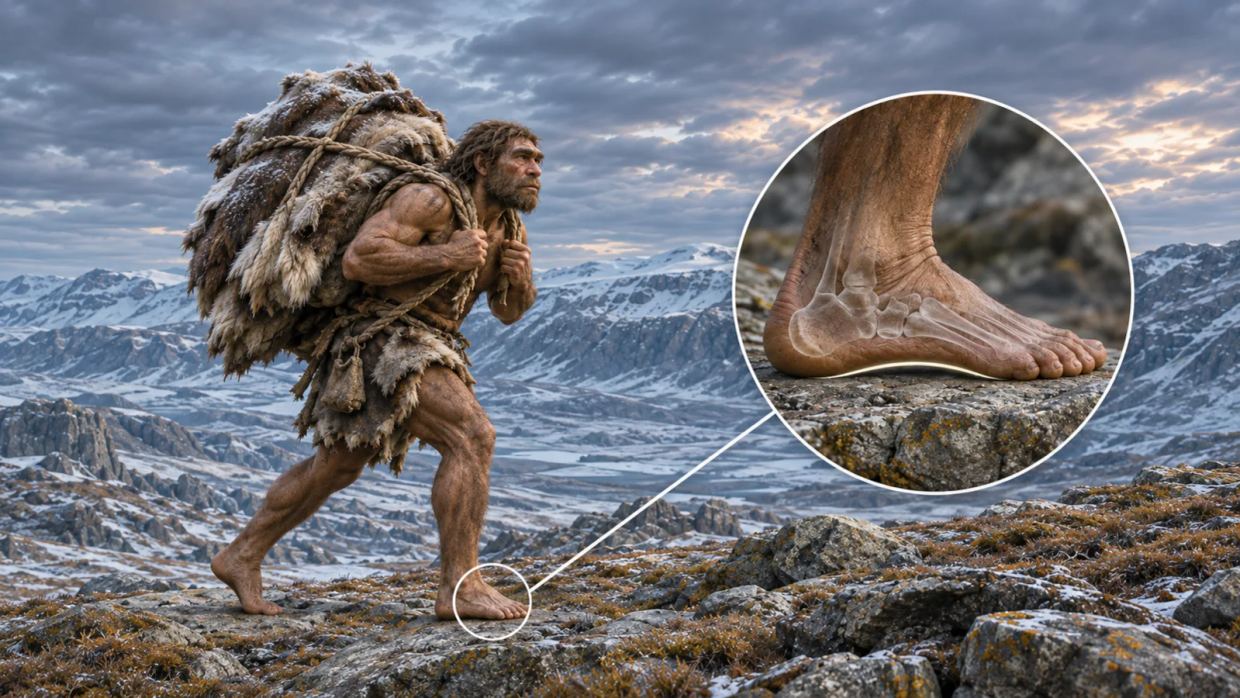
Compared with modern humans, Neanderthal heels were shorter, wider and taller magazine.unibo.it
magazine.unibo.itmagazine.unibo.itOpen source ↗. Geometric analysis indicates that Neanderthals habitually showed foot pronation, and the study also found a lower lateral longitudinal arch. According to the authors, this gave greater flexibility and mobility in the central part of the foot
magazine.unibo.it
magazine.unibo.itmagazine.unibo.itOpen source ↗.
The researchers conclude that Neanderthals most likely had flat feet and used this posture to maximise stability and reduce impact stress under heavy loads. They describe it not as a defect but as a functional strategy for mountainous or rough terrain magazine.unibo.it
magazine.unibo.itmagazine.unibo.itOpen source ↗.
"The robustness of the heel reflects the overall body structure of Neanderthals, characterized by a remarkable muscular and bone mass and an extremely intense level of physical activity," Belcastro said magazine.unibo.it
magazine.unibo.itmagazine.unibo.itOpen source ↗.
Comparison with modern populations
Prehistoric Homo sapiens hunter-gatherers, who travelled long distances barefoot or with soft footwear, had heels whose robustness was more similar to Neanderthals than to modern post-industrial populations magazine.unibo.it
magazine.unibo.itmagazine.unibo.itOpen source ↗.
Heels of people who lived in recent centuries are much weaker, which the authors link to a sedentary lifestyle and habitual use of rigid, closed footwear. Shoes with rigid soles tend to limit inversion and eversion of the foot and tighten the ankle. The researchers regard this as a sign of skeletal gracilization caused by a drastic reduction in natural biomechanical stimuli magazine.unibo.it
magazine.unibo.itmagazine.unibo.itOpen source ↗.
The team also included scholars from the Department of Cultural Heritage and the Department of Industrial Engineering of the University of Bologna, and from the IRCCS Rizzoli Orthopaedic Institute. Belcastro notes that the results may open a dialogue between evolutionary anthropology and clinical orthopaedics magazine.unibo.it
magazine.unibo.itmagazine.unibo.itOpen source ↗.