Estimate for China: 25 µg/m³ PM2.5 limit would have averted 4.3 times more deaths than 35 in 2024
Researchers modeled 2024 mortality: full compliance with China's revised limit would raise progress toward the WHO halving target from 66.2% to 83.4%.
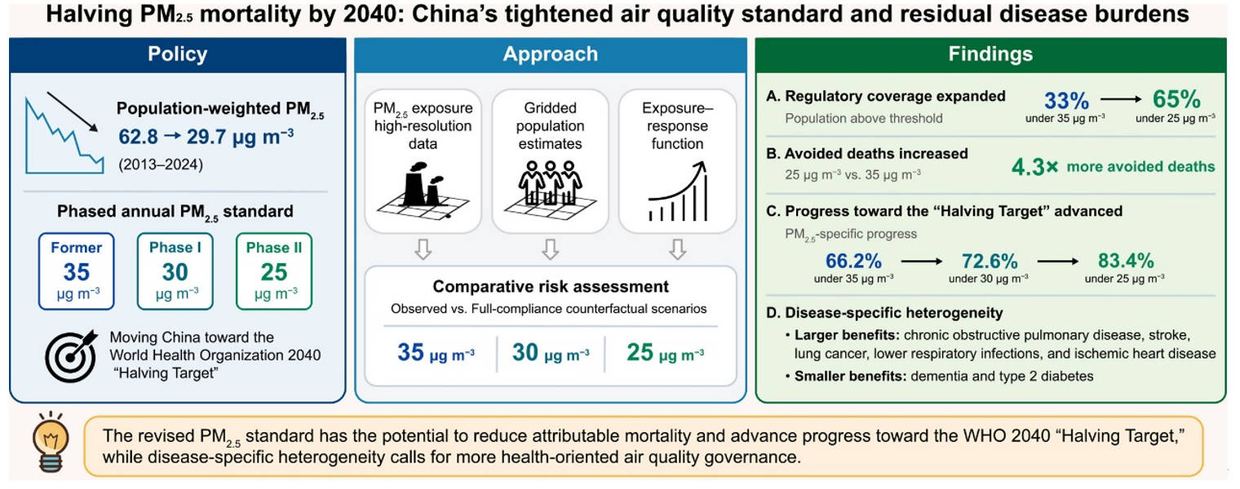
Researchers from Peking University Health Science Center and the Chinese Academy of Environmental Planning estimated how much China's tightened PM₂.₅ standard would reduce deaths. The study was published online on 23 October 2026 in Environmental Science and Ecotechnology. According to the authors, full compliance with 25 µg m⁻³ in 2024 would avert 4.3 times as many deaths as full compliance with the former 35 µg m⁻³ limit doi.org
Environmental Science and Ecotechnologydoi.orgOpen source ↗.
In 2026 China revised its National Ambient Air Quality Standards (GB 3095-2026), lowering the annual PM₂.₅ limit from 35 to 25 µg m⁻³ through phased implementation, with an interim 30 µg m⁻³ stage from 2026 to 2030. Population-weighted exposure fell from 62.8 to 29.7 µg m⁻³ between 2013 and 2024. The World Health Organization has called on countries to halve air-pollution-related mortality by 2040 doi.org
Environmental Science and Ecotechnologydoi.orgOpen source ↗.
Method and deaths averted
The team combined high-resolution PM₂.₅ data, gridded population estimates and disease-specific exposure–response functions in a comparative risk assessment. The analysis covered mainland China from 2013 to 2024 and seven disease outcomes from the Global Burden of Disease 2023 risk set doi.org
Environmental Science and Ecotechnologydoi.orgOpen source ↗.
For 2024, full compliance with 25 µg m⁻³ would have averted an estimated 233,668 premature deaths (95% uncertainty interval 198,354–270,734), a 16.1% reduction from observed levels. Under the 35 µg m⁻³ limit the figure is 53,985 deaths (45,992–62,021). The share of the population above the threshold would rise from 33% to 65% under the stricter limit. The PM₂.₅-attributable fraction of mortality fell from 32.5% in 2015 to 22.6% in 2024 doi.org
Environmental Science and Ecotechnologydoi.orgOpen source ↗.
PM₂.₅-specific progress toward the WHO halving target would be 66.2%, 72.6% and 83.4% under full compliance with 35, 30 and 25 µg m⁻³, respectively doi.org
Environmental Science and Ecotechnologydoi.orgOpen source ↗.
Differences between diseases
Under the 25 µg m⁻³ scenario, mortality would fall by 22.8% for chronic obstructive pulmonary disease, 18.4% for stroke, 18.4% for lung cancer, 18.0% for lower respiratory infections and 16.0% for ischemic heart disease. For dementia the reduction is 1.4% and for type 2 diabetes 1.1%; the authors note that the dementia estimate requires caution because the evidence is weaker doi.org
Environmental Science and Ecotechnologydoi.orgOpen source ↗.
Only chronic obstructive pulmonary disease would exceed the 50% halving benchmark, while dementia and type 2 diabetes would remain far behind. A sensitivity analysis with the Global Exposure Mortality Model for non-communicable diseases and lower respiratory infections showed a similar pattern, with 3.9 times more deaths averted under 25 than under 35 µg m⁻³ doi.org
Environmental Science and Ecotechnologydoi.orgOpen source ↗.