Yakamys sirindhornae: a roughly 30 kg rodent from the Eocene of Thailand described from two teeth
Two fossil teeth from the Krabi Basin represent a new ischyromyid genus; dental allometry gives a body mass of about 30 kg, with wide uncertainty.
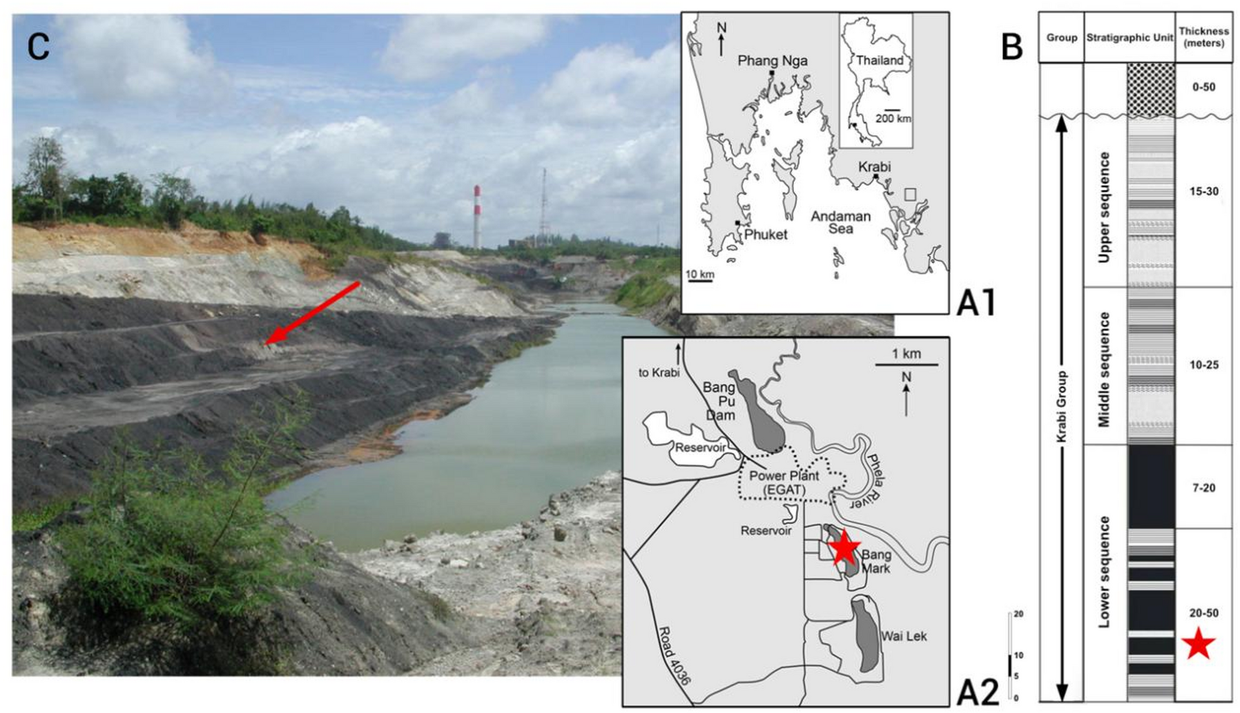
A team from the Université de Poitiers led by Yaowalak Chaimanee has described Yakamys sirindhornae gen. et sp. nov., a giant ischyromyid rodent from the late Eocene, about 35 million years ago. The fossils come from the Bang Mark locality in the Krabi Basin, southern Thailand, according to a paper on nature.com nature.com
nature.comnature.comOpen source ↗. The material consists of a lower second molar and a lower incisor fragment. Body mass is estimated at about 30 kg
nature.com
nature.comnature.comOpen source ↗.
The find and its anatomy
The two specimens were recovered close together from the same fossil-bearing horizon, a clay layer in a lignite mine, and were collected in 2004. The authors assign them provisionally to one taxon on the basis of their concordant exceptional size and stratigraphic position. No more complete skeleton exists to confirm this nature.com
nature.comnature.comOpen source ↗.
The holotype is a right lower second molar (TF 2942), 11.56 mm long and 11.27 mm wide. The tooth has a moderately high crown, a short isolated anteroconid, an incomplete metalophulid II and a bifid entolophid. It has no mesoconid or hypoconulid. The incisor (TF 2943) shows a pauciserial Hunter–Schreger band pattern in its enamel, consistent with the microstructure of Ischyromyidae nature.com
nature.comnature.comOpen source ↗. The genus name combines the Thai yak ("giant") and the Greek mys; the species epithet honors Princess Maha Chakri Sirindhorn for her support of paleontology in Thailand.
Body mass and context
The authors applied seven allometric equations that relate dental dimensions to body mass. The estimates range from 21.4 to 47.3 kg, with a mean of 31.6 kg and a median of 28.6 kg. They use about 30 kg as a rounded summary and note the substantial uncertainty of dental allometry. When the prediction errors of the individual models are included, the combined ranges span 10.8 to 69.0 kg. This span is not a single statistical confidence interval nature.com
nature.comnature.comOpen source ↗.
According to the authors, this is substantially more than any previously described Paleogene ischyromyid. Among earlier giants they cite the Oligocene Manitsha tanka from South Dakota. The best-documented giant rodents are Neogene and Pleistocene South American forms. Josephoartigasia monesi was later estimated at about 350 kg, and Phoberomys pattersoni at 220–280 kg. Ischyromyids in Asia are mostly known from small taxa from China and India. The authors conclude that substantial body-size increases had already occurred in an early rodent lineage by the late Eocene, before the main diversification of giant Neogene caviomorphs nature.com
nature.comnature.comOpen source ↗.