Carbon pentaheptite nanoribbon CPHN1, made on a surface, conducts near one conductance quantum
Researchers synthesized planar carbon nanoribbons of fused five- and seven-membered rings on a surface; one type is metallic with near-ballistic conductance, a lab-scale result.
A research team has reported the on-surface synthesis of planar carbon pentaheptite nanoribbons (CPHNs) in a paper published on nature.com. According to coverage by Yahoo Nachrichten DE, the work comes from the University of Science and Technology of China, with Professors Bing Wang and Qitang Fan leading the team. One of the two ribbon types, CPHN1, is an intrinsic metal and shows near-ballistic conductance approaching one conductance quantum nature.com
nature.comnature.comOpen source ↗.
Metallic carbon nanoribbons are sought as atomically defined one-dimensional conductors for future carbon electrodes and interconnects. Metallic graphene nanoribbons have already been made by band engineering, notably through zero-mode superlattices. Atomically precise metallic nanoribbons of fully non-benzenoid carbon, such as the theorized metallic carbon pentaheptites, had remained unexplored nature.com
nature.comnature.comOpen source ↗. A theoretical work from 1996 predicted a pure-carbon planar covalent metal.
Hierarchical on-surface synthesis
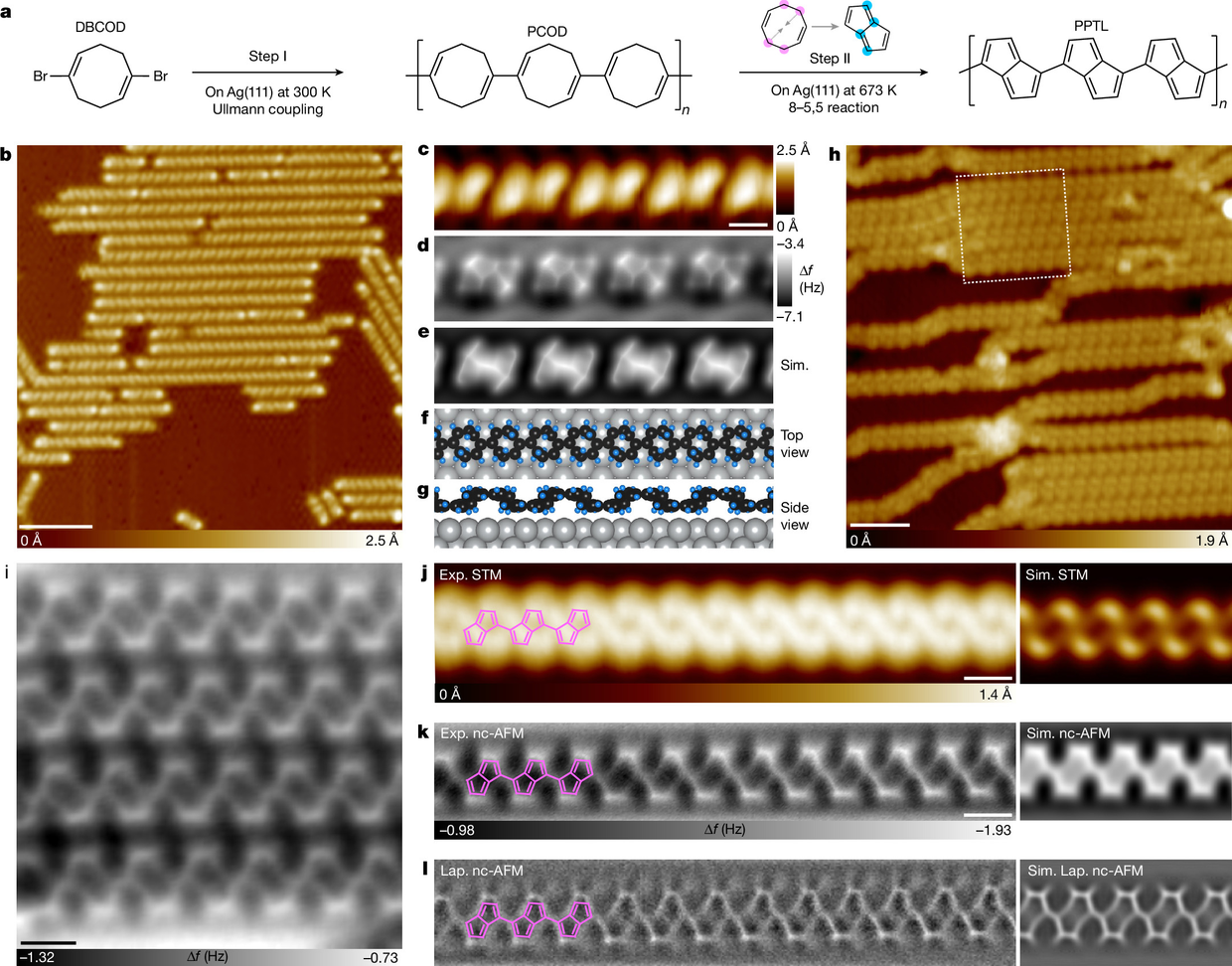
The authors used a hierarchical approach. Pre-synthesized polycyclooctadiene chains were transformed into well-aligned polypentalene chains, which were then fused laterally into ribbons nature.com
nature.comnature.comOpen source ↗. According to the press retelling, the process involved several heating steps on a silver surface, because the originally planned molecules with linked pentagons were too reactive to build longer chains.
Two distinct types of narrow pentaheptite nanoribbon share a similar basal structure: a central heptagon chain flanked by polypentalene chains on opposite lateral edges. In CPHN1 these chains are identically oriented, in CPHN2 they are oriented differently nature.com
nature.comnature.comOpen source ↗.
Metallic and semiconducting variants
CPHN1 is an intrinsic metal, whereas CPHN2 is a narrow-bandgap semiconductor. The CPHN1 ribbon exhibits near-ballistic conductance approaching one conductance quantum, comparable to metallic carbon nanotubes nature.com
nature.comnature.comOpen source ↗. The press retelling adds that the ribbon is 0.9 nanometers wide and that its conductivity stayed nearly unchanged over a distance of four nanometers.
The authors describe CPHN1 as a promising planar carbon metal and suggest a possible route towards carbon quantum wires. They note that further synthetic optimization will be required for device integration nature.com
nature.comnature.comOpen source ↗. Such ribbons could in principle support bottom-up fabrication of all-carbon electronics compatible with semiconducting graphene nanoribbons and nanographenes.
Raw experimental data, including STM and AFM images and spectra, and the numerical data from the calculations are publicly available via Zenodo. The code for the tight-binding calculations and the LDOS analysis is available from the corresponding authors on request.