HFIPS: nitrogen substitution in aluminum single-atom catalyst slows polysulfide loss in Na–S batteries
Chinese researchers replaced one of four oxygen atoms around single aluminum atoms with nitrogen; laboratory sodium–sulfur batteries stayed stable over thousands of cycles.
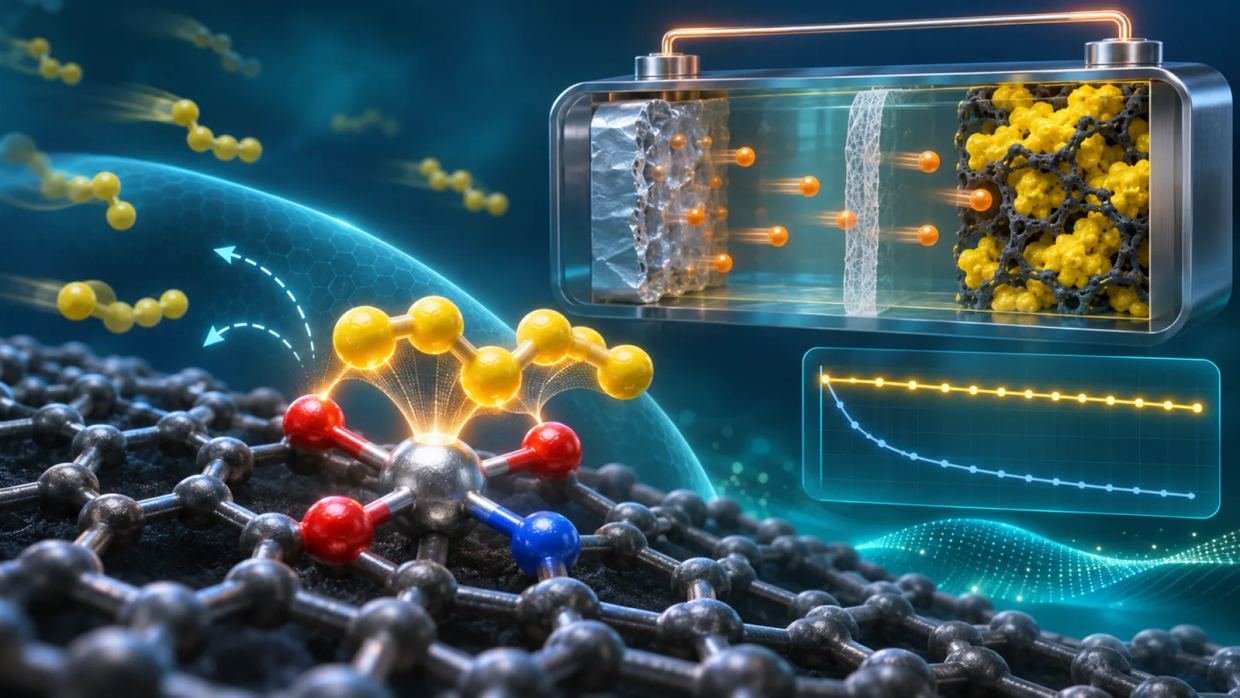
A research team led by Prof. WANG Hui, together with Prof. ZHENG Fangcai from the High Magnetic Field Laboratory, Hefei Institutes of Physical Science (HFIPS), Chinese Academy of Sciences, has developed a way to improve sodium–sulfur battery performance by changing the atomic structure of a catalyst, according to english.hf.cas.cn english.hf.cas.cn
english.hf.cas.cnenglish.hf.cas.cnOpen source ↗. The study was published in Angewandte Chemie. The work was done on laboratory batteries with a modified sulfur cathode.
Single-atom catalysts based on main-group metals
Single-atom catalysts made of main-group metals are attractive for sodium–sulfur batteries because they are relatively inexpensive and have low toxicity english.hf.cas.cn
english.hf.cas.cnenglish.hf.cas.cnOpen source ↗. However, their catalytic activity remains limited. The interactions between p-block metal atoms and the sodium polysulfides formed during battery operation are not yet fully understood
english.hf.cas.cn
english.hf.cas.cnenglish.hf.cas.cnOpen source ↗.
Sodium polysulfides are intermediate compounds. They can leave the sulfur cathode, which removes reactive material from the electrode and hinders the conversion of sulfur. A catalyst is meant to hold these intermediates in place and speed up the reactions.
Nitrogen in place of oxygen around aluminum
The researchers modified the atomic structure around individual aluminum (Al) atoms. In the existing structure, each Al atom was surrounded by four oxygen atoms. The team replaced one oxygen atom with nitrogen, which produced an asymmetric environment of three oxygen atoms and one nitrogen atom around each Al atom english.hf.cas.cn
english.hf.cas.cnenglish.hf.cas.cnOpen source ↗.
This change altered the distribution of electrons around the Al atoms and strengthened their interaction with sodium polysulfides english.hf.cas.cn
english.hf.cas.cnenglish.hf.cas.cnOpen source ↗. The authors describe the electron transfer during Na2S6 adsorption and a p–p orbital hybridization between the Al single atoms and the polysulfides. As a result, fewer polysulfides escaped from the cathode, and the reactions involved in battery operation proceeded more efficiently
english.hf.cas.cn
english.hf.cas.cnenglish.hf.cas.cnOpen source ↗.
The batteries also maintained stable performance over thousands of charge-discharge cycles, which the authors say shows good potential for long-lasting sodium–sulfur batteries english.hf.cas.cn
english.hf.cas.cnenglish.hf.cas.cnOpen source ↗.
According to the authors, the findings show the importance of the local atomic environment in determining the catalytic activity of single-atom catalysts. They also offer new possibilities for designing efficient catalysts based on main-group metals english.hf.cas.cn
english.hf.cas.cnenglish.hf.cas.cnOpen source ↗. The paper is titled "Asymmetrically Coordinated p-Block Aluminum Single-Atom Sites for Stable Na─S Batteries".
Sources · 2
Found a mistake?Read also