Enamel proteins from six Homo erectus teeth, about 0.4 million years old, analysed in China
Proteins from teeth of six Homo erectus individuals from three Chinese sites show two shared amino acid variants, one of them previously unknown.
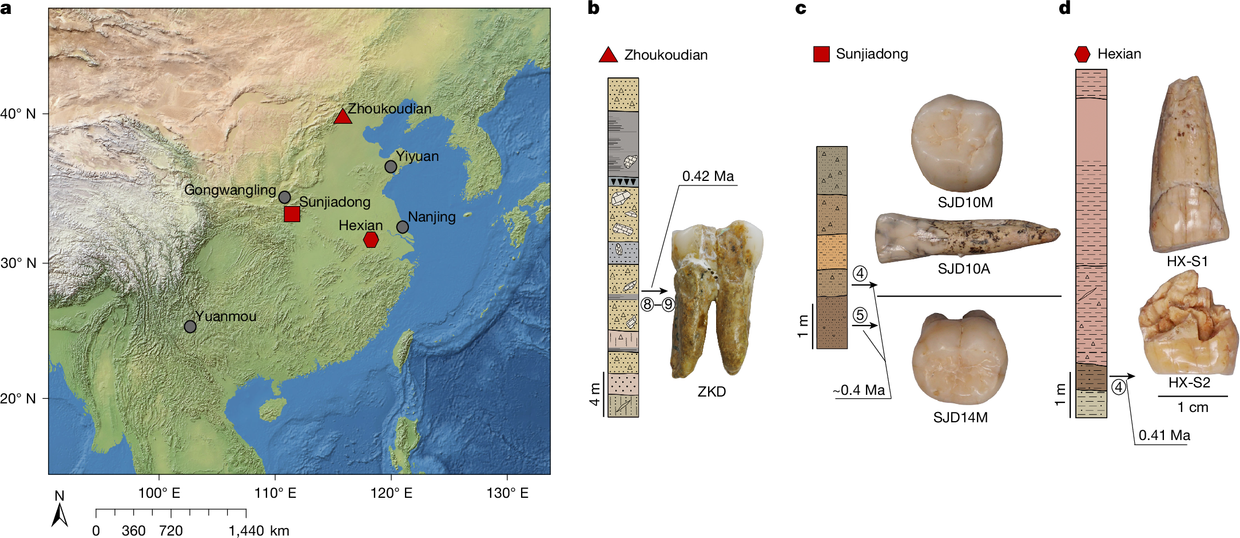
Researchers extracted and analysed ancient enamel proteins from six Middle Pleistocene Homo erectus teeth, from five male and one female individual, found at the Zhoukoudian, Hexian and Sunjiadong sites in China, according to a paper on nature.com. The specimens date to approximately 0.4 million years ago nature.com
nature.comnature.comOpen source ↗. The only molecular data previously recovered from H. erectus were peptides from a 1.77-million-year-old tooth from Dmanisi, Georgia, and those sequences lacked single amino acid polymorphisms that distinguish H. erectus from other human lineages
nature.com
nature.comnature.comOpen source ↗.
Specimens and sites
The Zhoukoudian tooth (PA69) comes from layers 8–9, dated to 0.42 million years, and was found between 1949 and 1951. Two teeth come from the Hexian site in Anhui Province, southern China (0.41 million years), and three from Sunjiadong in Henan Province, northern China (around 0.4 million years) nature.com
nature.comnature.comOpen source ↗. Taken together, the six samples are roughly contemporary and represent individuals from both northern and southern China. The authors also included a tooth from a Denisovan skull from Harbin, China, with a minimum age of 0.15 million years
nature.com
nature.comnature.comOpen source ↗.
The Hexian remains are morphologically closer to the Indonesian Java fossils than to those from Zhoukoudian, while the Nanjing and Sunjiadong fossils resemble the Zhoukoudian material nature.com
nature.comnature.comOpen source ↗.
Shared amino acid variants
All specimens from all three sites share two amino acid variants nature.com
nature.comnature.comOpen source ↗. One of them, A253G in the AMBN protein, was previously unknown. It has not been found in H. erectus from Dmanisi, in Homo antecessor from Atapuerca, in Denisovans, in Neanderthals or in modern humans
nature.com
nature.comnature.comOpen source ↗.
The other variant, AMBN M273V, had been identified earlier in Denisovans. The authors say the new evidence indicates it may have been introduced through populations related to these Middle Pleistocene H. erectus nature.com
nature.comnature.comOpen source ↗. They also conclude that regions of the Denisovan genome attributed to super-archaic introgression, some of which later passed to modern humans, are likely to have originated from H. erectus
nature.com
nature.comnature.comOpen source ↗.
According to the authors, late Middle Pleistocene H. erectus may have coexisted with Denisovans in parts of East Asia, where these interactions are presumed to have occurred nature.com
nature.comnature.comOpen source ↗. A ScienceDaily summary of the study adds that the corresponding variant occurs in living people at 21% in the Philippines and about 1% in India.