Gut microbial SNVs linked to 69 host traits in 10,781 people across six cohorts, Nature reports
A phenome-wide analysis of 12.8 million gut bacterial SNVs found 940 independent associations with age, sex and metabolic parameters, and an open catalogue of results.
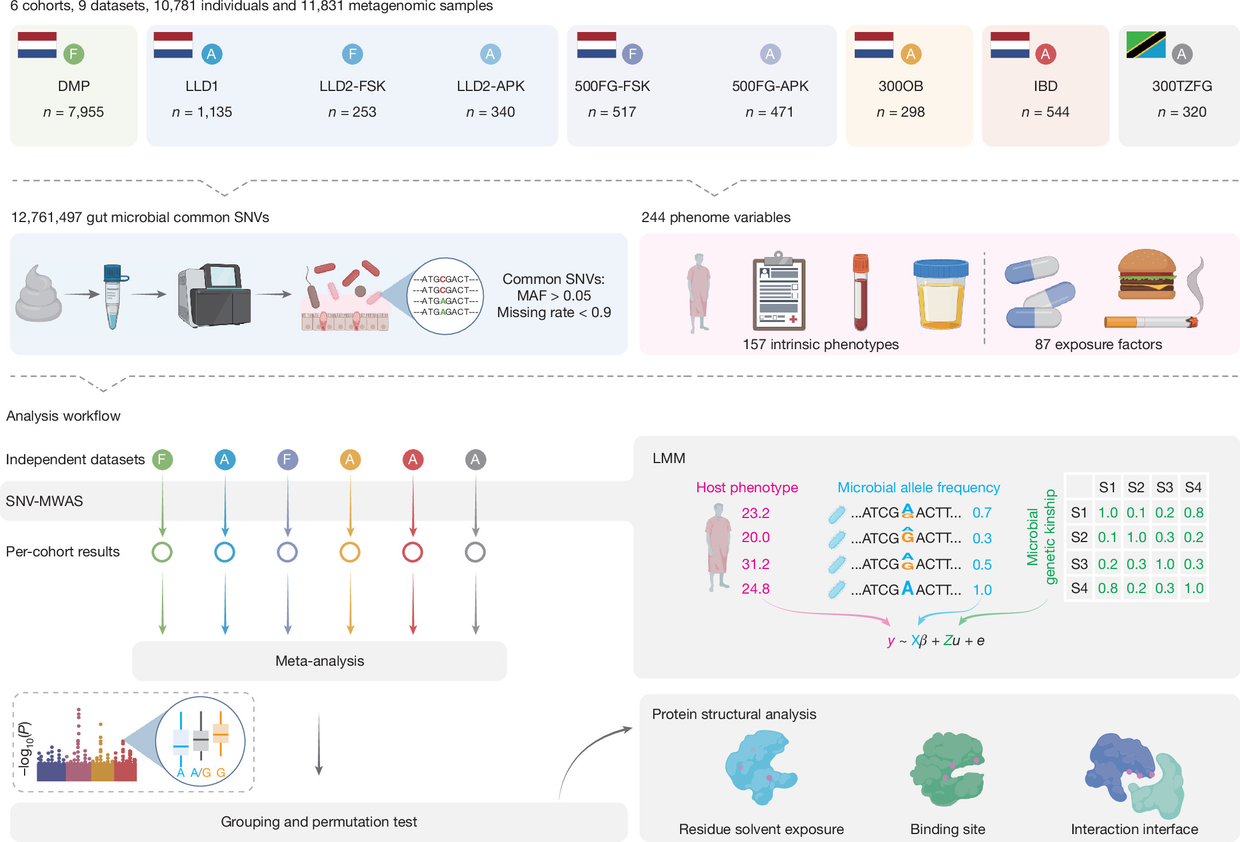
A team led by researchers behind the online catalogue SNV-MWAS reported a phenome-wide association study of gut microbial single-nucleotide variants (SNVs) in Nature. The analysis covered 12.8 million SNVs and 244 host phenotypes and exposures in 10,781 individuals from six independent cohorts doi.org
Naturedoi.orgOpen source ↗.
The authors compiled shotgun metagenomic data from 11,831 faecal samples. Five cohorts are from the Netherlands: the Dutch Microbiome Project (n = 7,955), Lifelines-DEEP (n = 1,135), the 500-Functional Genomics Project (n = 529), the 1000 IBD Project (n = 544) and 300-Obesity (n = 298). The sixth is a Tanzanian cohort, 300TZFG (n = 320) doi.org
Naturedoi.orgOpen source ↗.
Design of the analysis
Microbial genotypes were called with GT-Pro in core genomic regions. The 244 factors comprised 92 binary and 152 continuous or ordinal traits; sample size per phenotype ranged from 593 to 11,706 doi.org
Naturedoi.orgOpen source ↗.
The authors developed a workflow based on a linear mixed model that controls for within-species population genetic structure, so that associations are independent of the cumulative effect of strain lineage. Each cohort was analysed separately, followed by meta-analysis. Linkage disequilibrium-based grouping extracted independent signals, and a permutation test screened for robust ones doi.org
Naturedoi.orgOpen source ↗.
Additional datasets from Lifelines-DEEP follow-up and 500FG, processed with two DNA extraction kits, were used only for technical assessment of how extraction protocol affects SNV profiling doi.org
Naturedoi.orgOpen source ↗.
Associations and protein structure
The study identified 940 independent association signals supported by multiple cohorts. They link 39,663 SNVs across 101 species to 69 host phenotypes or exposures, including age, sex, and cardiovascular and metabolic parameters doi.org
Naturedoi.orgOpen source ↗.
Protein structural analyses placed host-phenotype-associated SNVs in functionally important regions of proteins. According to the authors, this supports mechanistic hypotheses about how microbial genetic changes relate to host physiology and environment. One example is an age-associated SNV in Faecalibacterium prausnitzii that affects an amino acid within the protein pocket that binds glutathione doi.org
Naturedoi.orgOpen source ↗.
The results are associations and do not establish causation. All summary statistics are available in an online catalogue at fulab.web.rug.nl/SNV-MWAS, which the authors describe as a resource for generating hypotheses about strain-level functionality of the gut microbiota doi.org
Naturedoi.orgOpen source ↗.