William Chan of TU Wien orders sets of functions between infinite sets by two coordinates under the Axiom of Determinacy
Under the Axiom of Determinacy and an added assumption, the size of a function set is compared by its domain and codomain. The result covers only part of the infinite cardinals.
Mathematician William Chan of TU Wien (Vienna, Austria) has shown that, under the Axiom of Determinacy, the cardinalities of certain sets of functions between infinite sets can be compared using two parameters: the size of the domain and the size of the codomain. The proof is published in Proceedings of the National Academy of Sciences doi.org
Proceedings of the National Academy of Sciencesdoi.orgOpen source ↗. It holds only below a bound defined through surjections onto ordinals, and it requires an additional assumption besides the Axiom of Determinacy
doi.org
Proceedings of the National Academy of Sciencesdoi.orgOpen source ↗.
Comparing infinite sets without the Axiom of Choice
Sets are compared by cardinality: two sets are equally large if their elements can be matched one to one. This also works for infinite sets. Every natural number can be paired with an even number with none left over, so both sets are equally large, while the real numbers cannot be fully matched with the natural numbers.
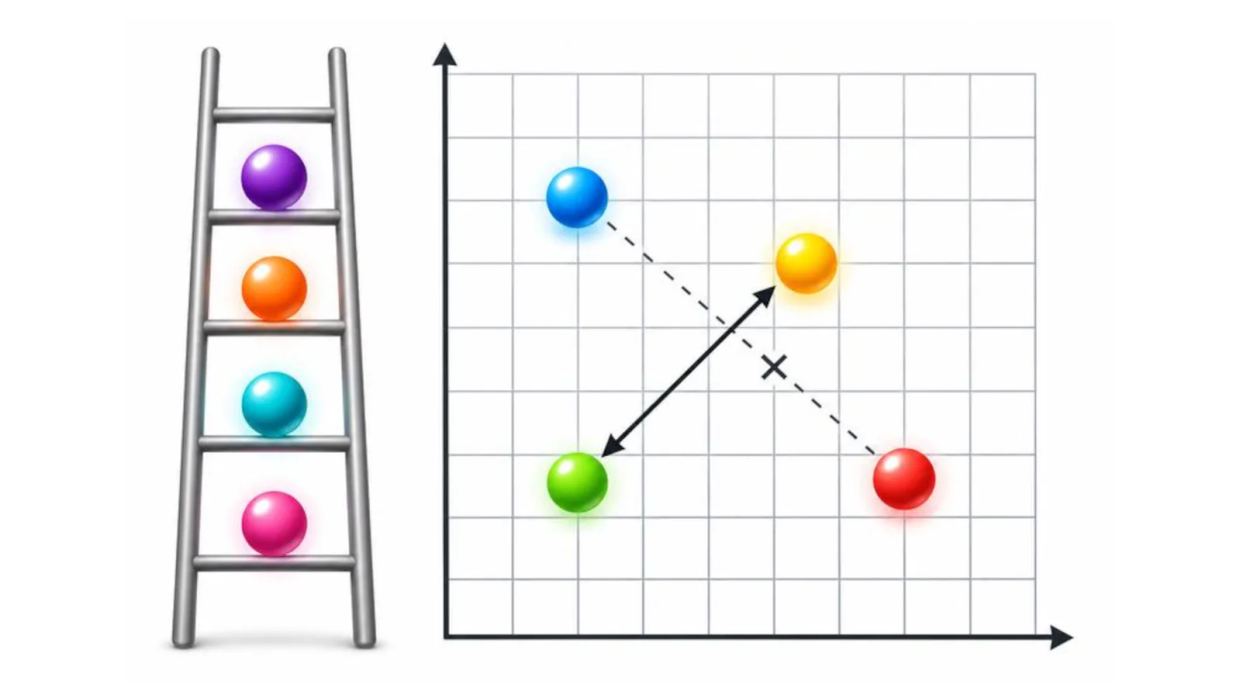
In the usual framework, the Axiom of Choice allows every set to be well-ordered, and cardinalities line up like rungs of a ladder. Chan instead uses the Axiom of Determinacy, which is incompatible with the Axiom of Choice. It states that every infinite two-player game has a winning strategy for one of the players. In these games the players alternately build an infinite sequence of numbers doi.org
Proceedings of the National Academy of Sciencesdoi.orgOpen source ↗.
The ABCD hypothesis and its limits
Cardinal exponentiation is the set of all functions from one cardinal into another. Its size is determined by the size of the domain and the size of the codomain, which can be treated like coordinates on a map. The ABCD hypothesis states a comparison rule for such sets of functions for infinite cardinals doi.org
Proceedings of the National Academy of Sciencesdoi.orgOpen source ↗.
As described, if both the domain and the codomain are at least as large as those of another function set, its cardinality is also at least as large. If one grows and the other shrinks, the two cardinalities are not comparable. The result is a two-dimensional partial order, not a single ladder. The paper shows that if the Axiom of Determinacy and the additional assumption hold, the ABCD hypothesis holds below the bound doi.org
Proceedings of the National Academy of Sciencesdoi.orgOpen source ↗.
The result does not give a classification of all infinities. It also does not decide the continuum hypothesis, which after the work of Kurt Gödel and Paul Cohen can be neither proved nor refuted from the usual axioms of set theory. Chan calls the approach a strikingly simple and fruitful way to rethink the sorting of infinite sets.