JWST finds record deuterium share in methane of interstellar comet 3I/ATLAS: D/H 3.18%
Webb spectra of the interstellar comet 3I/ATLAS give a methane D/H of 3.18%, above any methane value in the Solar System. Its ices are consistent with a cold origin.
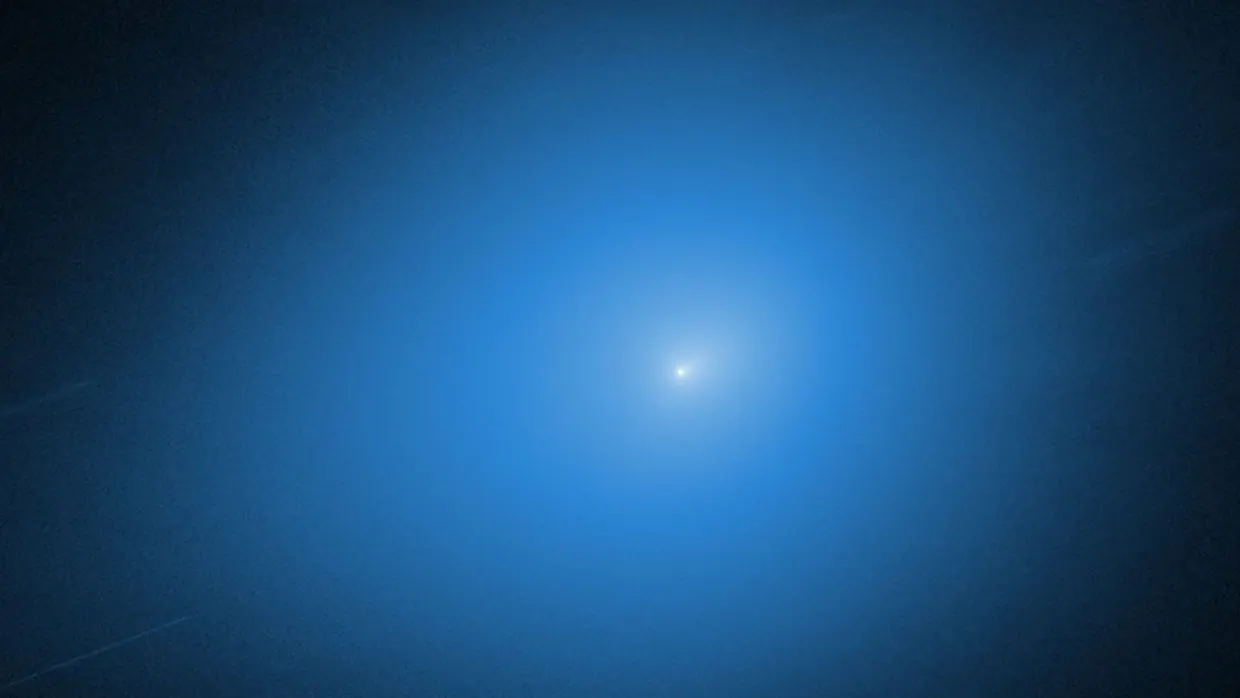
A team led by Nathan X. Roth of NASA's Goddard Space Flight Center and American University, with 17 co-authors, measured the deuterium-to-hydrogen ratio in methane of the interstellar comet 3I/ATLAS using the James Webb Space Telescope. According to the paper at doi.org, the ratio is D/H = (3.18 ± 0.30)% nature.com
doi.orgnature.comOpen source ↗. The authors describe this as a rare detection of deuterated organic molecules in an interstellar object.
Observations and method
3I/ATLAS is the third known visitor from outside the Solar System. The ATLAS survey telescope in Río Hurtado, Chile, reported it on July 1, 2025, and it passed closest to the Sun around October 30. Webb observed it with the Near-Infrared Spectrograph under General Observer program 5094.
Before the observations, position measurements from school groups in Upminster, Bridgend, Alcarràs and Zagreb helped refine the predicted location of the comet. They were collected through the Comet Chasers outreach program led by Helen Usher. On December 22, 2025, Webb took a single 642-second exposure starting at 03:36 UT.
The key data came the next day: five exposures of 700 seconds each, starting at 08:07 UT and covering wavelengths where methane emits strongly. The comet was then about 360 million km from the Sun and 269 million km from Webb. Spectra were extracted from a circle reaching about 980 km from the nucleus.
Lines of ordinary methane were up to 100 times stronger than those of CH3D. Methanol, formaldehyde and ethane also emit at nearby wavelengths, so the team modelled them with NASA's Planetary Spectrum Generator and subtracted them. They then removed ordinary methane, masked its line positions and fitted the remainder together with the spectral baseline.
Deuterium in methane
The measured value exceeds any other methane value in the Solar System. It is a factor of 13 ± 2 higher than that measured by the Rosetta spacecraft in comet 67P/Churyumov–Gerasimenko, the only other comet where CH3D has been detected nature.com
doi.orgnature.comOpen source ↗.
In both comets methane is more deuterated than water. This is consistent with trends in other Solar System bodies and the nearby interstellar medium, where deuteration in organics exceeds that of water by up to an order of magnitude. The D/H ratio in methane has not been constrained in extrasolar sources to date, but the enriched value in 3I/ATLAS resembles those measured in methanol and formaldehyde toward pre- and protostellar environments.
The authors report that the elevated ratio is consistent with the hypothesis that the comet's ices formed in a cold, low-metallicity interstellar or protostellar environment under a high cosmic ray irradiation rate. The paper does not name the star system of origin.