RIKEN cuts qubits for [[30,6,5]] code state preparation from 180 to 84 in simulation
RIKEN researchers designed a fault-tolerant encoder for a code with 6 logical qubits in 30 physical ones. Results come from circuit-level numerical simulation, not hardware.
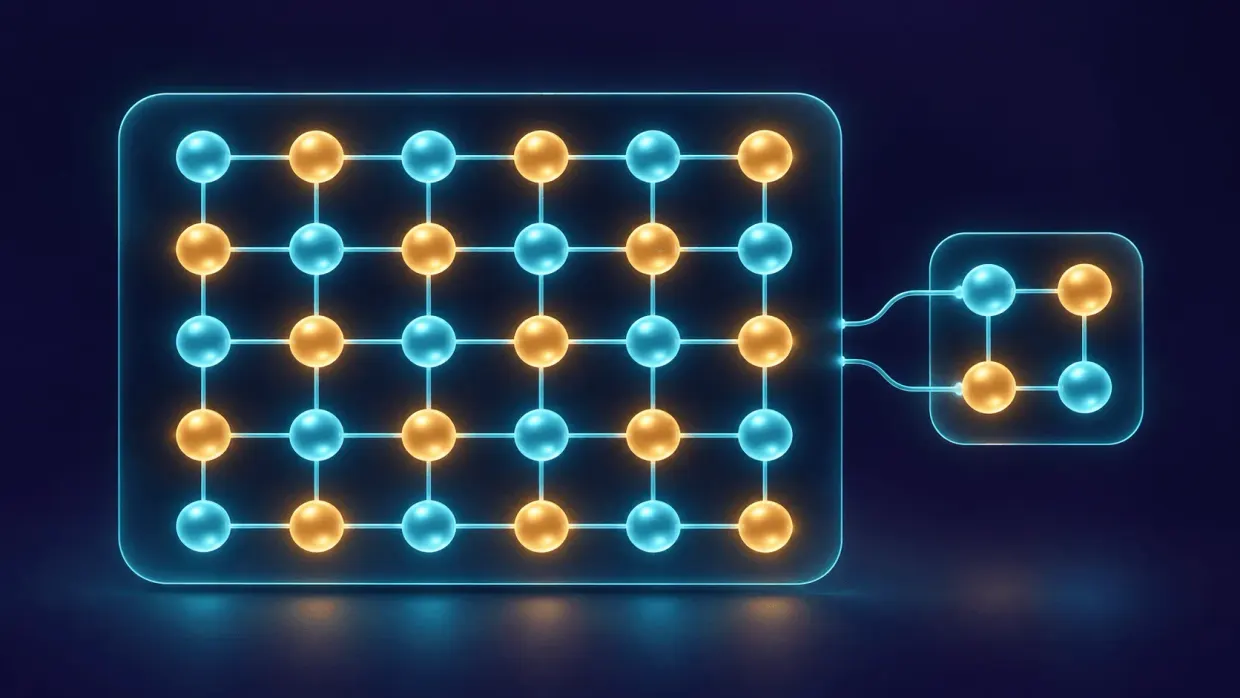
Researchers at RIKEN and the Japan Science and Technology Agency (JST) proposed a fault-tolerant method for preparing logical states of a [[30,6,5]] symplectic double code, according to a paper on arxiv.org arxiv.org
arxiv.orgarxiv.orgOpen source ↗. The code stores 6 logical qubits in 30 physical qubits with code distance 5, an encoding rate of 20%. The paper was published in Science Advances on November 13 (US time), as announced by RIKEN.
Code and encoder
The [[30,6,5]] code is a Calderbank-Shor-Steane (CSS) code derived from a [[15,3,5]] non-CSS stabilizer code via the symplectic double construction. Its encoding rate is higher than that of the bivariate bicycle code [[72,12,6]] (about 17%) and the trivariate bicycle code [[30,4,5]] (about 13%), while the code distance is kept. Earlier studies of fault-tolerant computing with symplectic double codes covered distances up to 3.
The proposed zero-state encoder extends Goto's minimum-overhead verification method for the Steane seven-qubit code. It detects crucial errors during encoding with as few auxiliary qubits as possible. Per RIKEN, the preparation circuit including verification needs 84 physical qubits, versus 180 in the conventional six-copy scheme. The 84 includes auxiliary qubits, so it is not comparable with the 30 qubits of the code itself. The number of two-qubit gates in the circuit for the plus state was reduced from 108 to 67.
Simulation and limits
The authors evaluated the encoder with a circuit-level noise model and report logical error rates as low as those of the six-copy scheme arxiv.org
arxiv.orgarxiv.orgOpen source ↗. After each physical CNOT, one of 15 two-qubit Pauli errors occurs with probability pcirc/15, and initialization and measurement carry a bit-flip error with probability pcirc. Memory errors and single-qubit gate errors are not included, and the results are not hardware measurements.
The authors also developed an arbitrary-state encoder that injects arbitrary quantum states into the code space. Combined with basic fault-tolerant operations, such as magic state distillation, it supports universal quantum computation. As next steps the authors name experimental implementation on trapped ions and neutral atoms, and optimization of circuit compilation.