Webb telescope finds galaxy LAP1-B with record-low oxygen: 1/240 of the Sun's level, 13 billion years ago
A Kanazawa University team used JWST and gravitational lensing to measure LAP1-B's chemistry; the authors say it may be an ancestor of the Milky Way's ultra-faint dwarf galaxies.
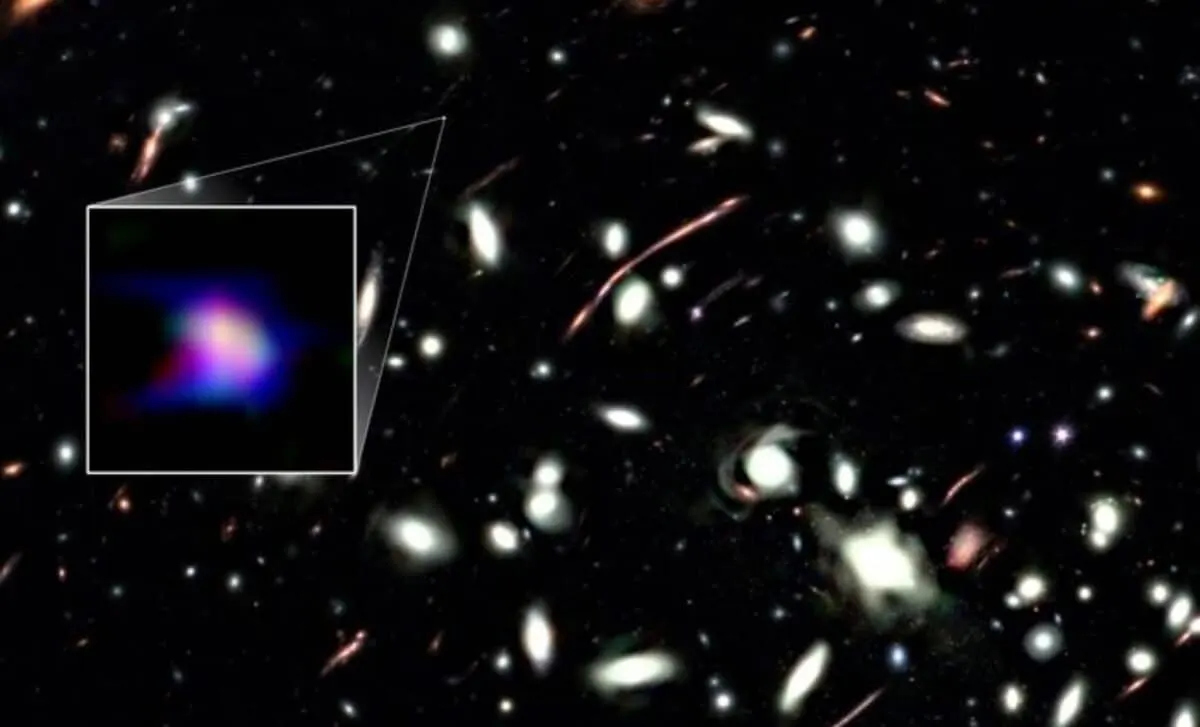
An international team led by Associate Professor Kimihiko Nakajima of Kanazawa University used the James Webb Space Telescope (JWST) to characterize LAP1-B, an ultra-faint galaxy seen as it was 13 billion years ago, according to a release on kanazawa-u.ac.jp. Deep spectroscopy gave an oxygen abundance of about 1/240 of the solar value, which the authors describe as a record low kanazawa-u.ac.jp
kanazawa-u.ac.jpkanazawa-u.ac.jpOpen source ↗. The result was published in Nature.
Measurement through a gravitational lens
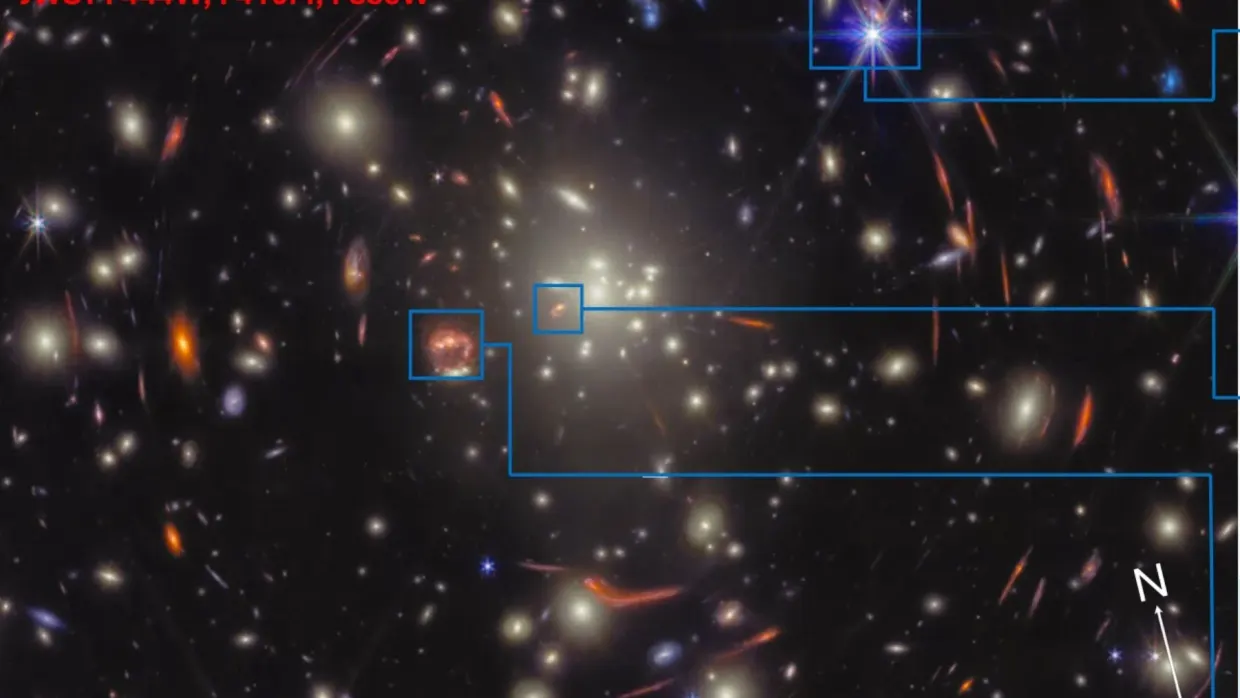
The light of LAP1-B was magnified 100 times by the gravity of the massive galaxy cluster MACS J0416, which works as a natural lens. The team observed this region with JWST for more than 30 hours and carried out deep spectroscopy. The galaxy has so few stars that it is invisible in the NIRCam image, but the NIRSpec data captured faint emission lines of hydrogen and oxygen gas.
The early universe contained mainly hydrogen and helium. Heavier elements such as oxygen and carbon were produced later inside the first stars. Until now, the chemical makeup of such small and faint galaxies was considered nearly impossible to observe, the authors write.
The galaxy also shows an elevated carbon-to-oxygen ratio. According to the team, it closely matches theoretical predictions for material dispersed by explosions of first-generation stars kanazawa-u.ac.jp
kanazawa-u.ac.jpkanazawa-u.ac.jpOpen source ↗.
Link to ultra-faint dwarf galaxies
The team found that LAP1-B is very light: its mass is less than 3,300 times that of the Sun. The authors conclude that most of the galaxy is invisible dark matter. Together with its chemical composition, this makes it a close match for the ultra-faint dwarf galaxies found near the Milky Way today. Their stars are older than 12 billion years.
Professor Masami Ouchi (NAOJ/University of Tokyo), a member of the team, said that astronomers suspected these dwarf galaxies were remnants of the earliest galaxies because they lack heavy elements, but had no direct link until LAP1-B. He said the object looks like the "ancestor" that had so far existed only in theory.
Nakajima noted that astronomers usually infer the past from old stars in the Milky Way's neighborhood, whereas here the gas can be analyzed directly as it was 13 billion years ago. The team plans to use JWST to search for even more primitive objects kanazawa-u.ac.jp
kanazawa-u.ac.jpkanazawa-u.ac.jpOpen source ↗.