Danish study: fish diet skewed radiocarbon age of skeletons from medieval monasteries
Radiocarbon dating of six of 27 skeletons from Danish monasteries conflicted with the buildings' history. The authors link it to the reservoir effect from eating fish.
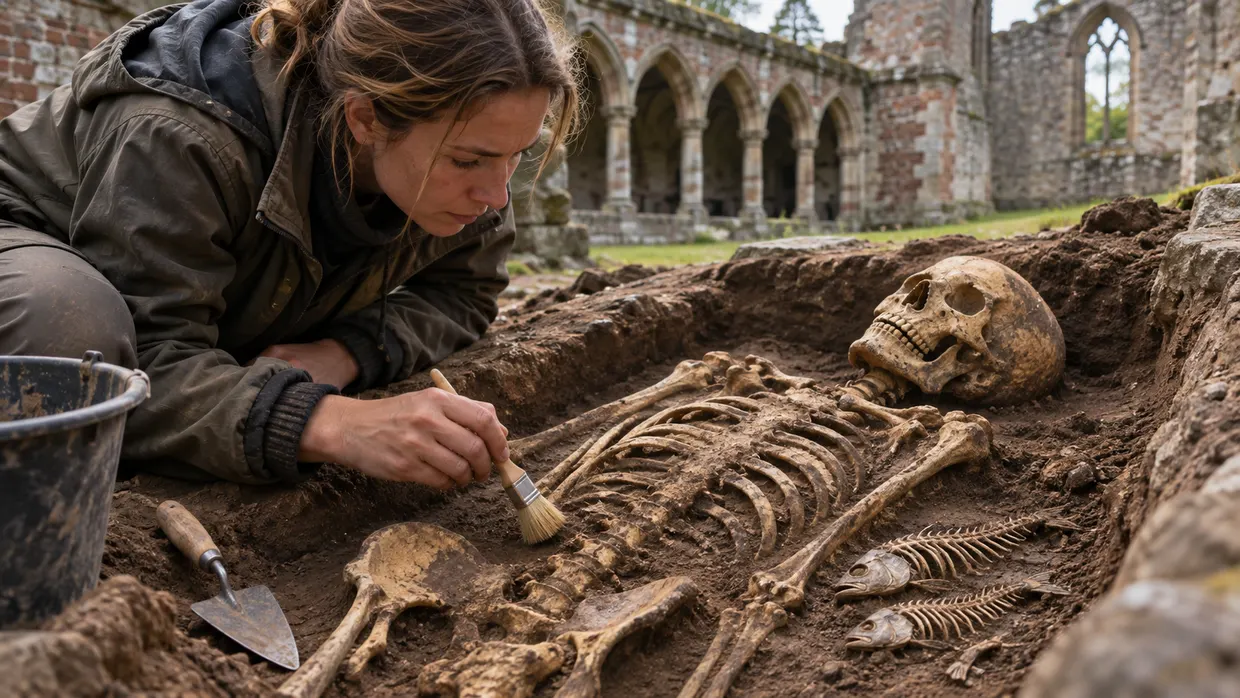
Researchers from the University of Southern Denmark and the Centre for Isotope Research examined the remains of 27 people found during excavations of medieval monasteries in Denmark. According to Poisk, in six cases radiocarbon analysis gave an age that agreed poorly with the historical record: some skeletons appeared decades or even centuries older than the monasteries where they were buried poisknews.ru
Поискpoisknews.ruOpen source ↗. The work was published in npj Heritage Science.
Dates that did not match
A skeleton from Svendborg was dated to between 1100 and 1155, although the monastery next to it was built only in 1236. In Viborg, one skeleton turned out to be no younger than 976, significantly older than the monastery on whose grounds it lay.
The authors attribute the discrepancy to diet. During Lent Christians were restricted in eating meat, but freshwater fish was permitted: unlike the meat of warm-blooded animals and sea fish, it was regarded as a "cold" or "neutral" food. In some Christian communities it was even considered a prestigious product.
The reservoir effect
Radiocarbon dating measures the remaining carbon-14, which forms in the atmosphere under cosmic radiation. In bodies of water the isotope ratio can differ from the atmospheric one because of old carbon from rocks and deep water; in river water carbon-14 is sometimes about 15% lower than in the atmosphere poisknews.ru
Поискpoisknews.ruOpen source ↗. Fish take up this carbon, and a person who eats them carries less carbon-14 in the bones than a person on a mainly terrestrial diet, so the remains look older than they are.
According to archaeometrist Kaare Lund Rasmussen, in exceptional cases a fish from the Rhine can appear 1,300 years older than a land animal that lived at the same time. The error varies, and in freshwater ecosystems it can range from zero to a thousand years, so a fixed number of years cannot simply be subtracted from the result.
As supporting evidence, the researchers measured nitrogen-15, whose elevated levels are typical of aquatic food chains. Its level was raised in all the samples studied, consistent with a substantial share of aquatic food in the diet. The authors also cite a Stone Age site in the Balkans where human remains found with bone arrowheads may be 500 years older than the arrows; one possible explanation is a fish-rich human diet.
The authors recommend measuring nitrogen-15 in bones. If its concentration is elevated, special calculation models can be used to account for the reservoir effect and refine the date poisknews.ru
Поискpoisknews.ruOpen source ↗.