Rubin Observatory data show object R631 orbiting the Sun backwards at 142° inclination
Astronomers found R631 beyond Neptune in Rubin Observatory data. Its orbit is inclined 142 degrees, so it circles the Sun in the direction opposite to the planets.
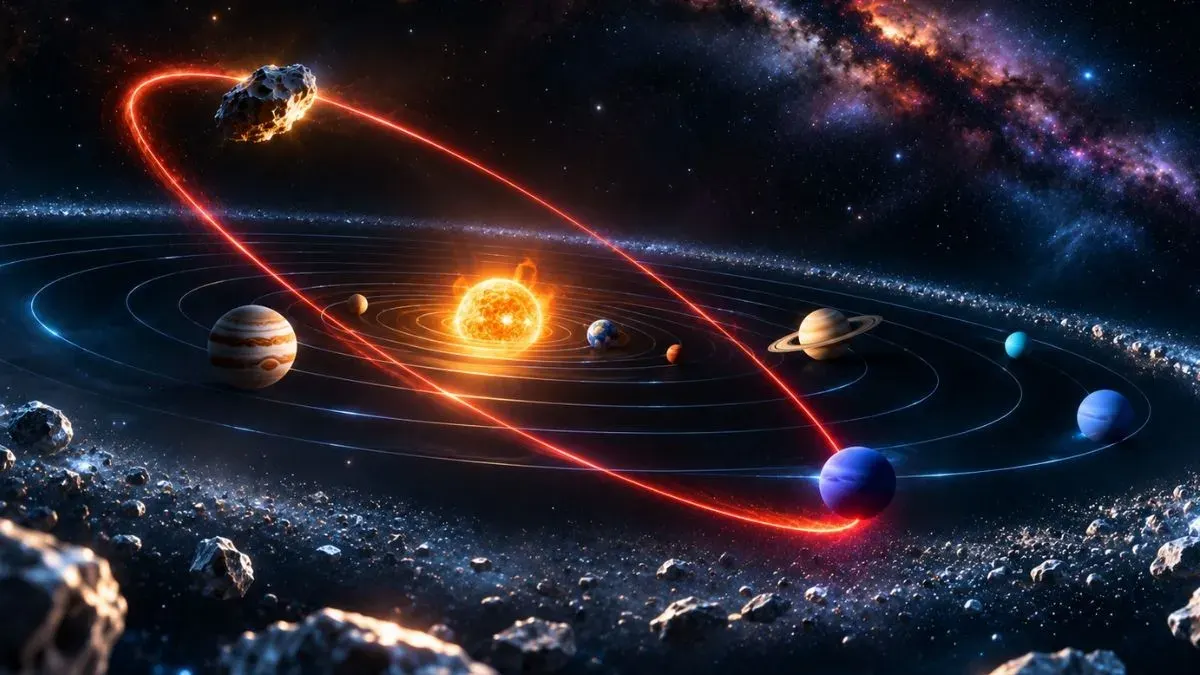
Astronomers have identified an object beyond Neptune, provisionally designated R631, that orbits the Sun in the direction opposite to all the planets, spidersweb.pl reports. spidersweb.pl
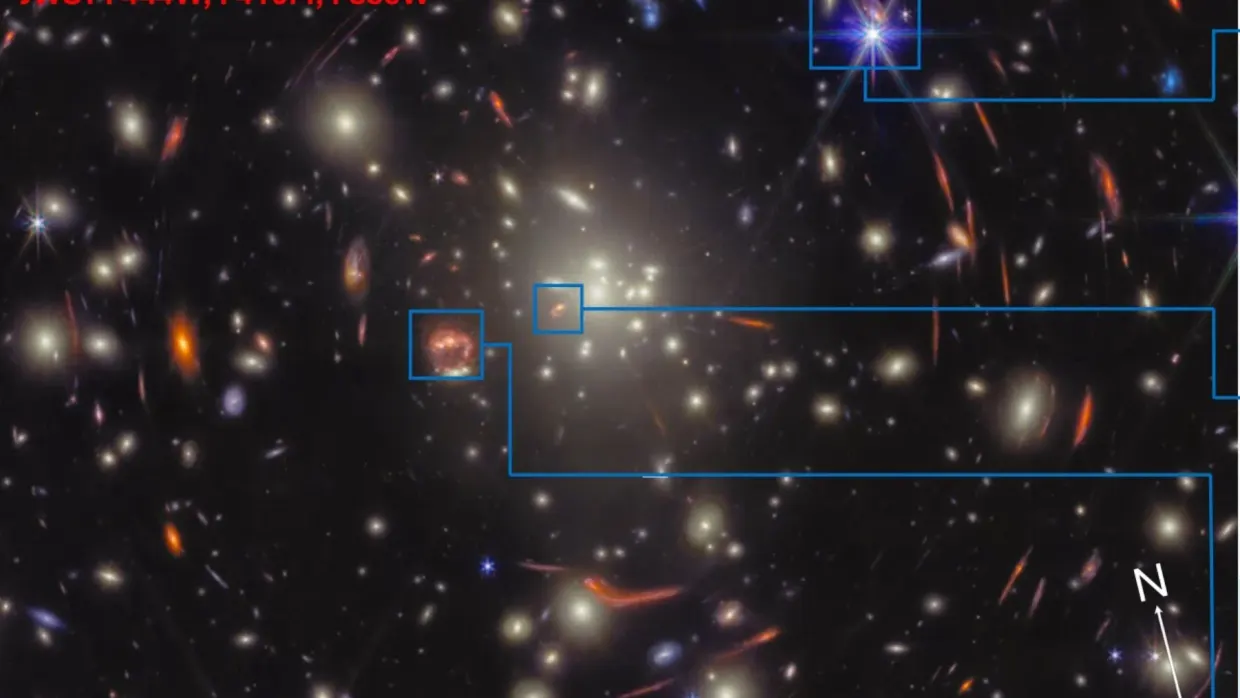
spidersweb.plspidersweb.plOpen source ↗ It was found in public data from the Vera C. Rubin Observatory in Chile, where its traces date from December 2025 to March 2026. Its diameter may be about 100 km, and one orbit around the Sun takes about 547.8 Earth years.
Retrograde orbit and its parameters
The inclination of R631's orbit is about 142 degrees. For comparison, Neptune's orbit is tilted by less than 2 degrees relative to Earth's orbital plane, and Pluto's by about 17 degrees. Beyond 90 degrees the motion runs against the dominant direction in the Solar System, which astronomers call retrograde. The orbit obeys the same laws of gravity as the planets' orbits; it simply differs strongly from the others.
R631 is currently about 32 astronomical units from the Sun, roughly 4.8 billion km. Its orbit is strongly elongated. The closest approach is probably on 31 October 2047, at about 24 astronomical units, or 3.6 billion km, which is closer than Neptune's mean orbital radius. At the far end of its path the object may recede almost 110 astronomical units. All these parameters are still being verified. R631 has not yet received an official designation from the Minor Planet Center, and further observations may change the calculated trajectory.
Size and possible origin
Physicist and astronomer Marshall Eubanks estimated the diameter at about 100 km. The estimate is based on the object's brightness and an assumption about how well it reflects light, so without knowing its surface properties the size cannot be determined precisely. spidersweb.pl
spidersweb.plspidersweb.plOpen source ↗ It may be a large icy body. Eubanks compares it to comet Bernardinelli-Bernstein, whose nucleus is more than 120 km across. If R631 contains volatile substances, it could begin releasing gas and dust near the Sun in 2047, but no such activity has been confirmed.
One explanation is that R631 formed in the Kuiper Belt on a more typical orbit, and a later encounter with Neptune changed its motion. Amateur astronomer Sam Deen suggests such an event could have occurred within the last billion years; this is not a confirmed reconstruction. Another possibility is that the object formed near another star, was ejected and later captured by the Sun. There is no evidence for this so far.
The Rubin Observatory telescope carries a 3.2-gigapixel camera that can image large areas of sky and detect very faint objects.