ExoMars TGO detects isolated HCl over Alba Mons in the Martian cold season; authors cite magmatic activity
Atmospheric Chemistry Suite recorded isolated hydrogen chloride signals over Alba Mons in the cold season; the authors link them to ongoing igneous processes inside Mars.
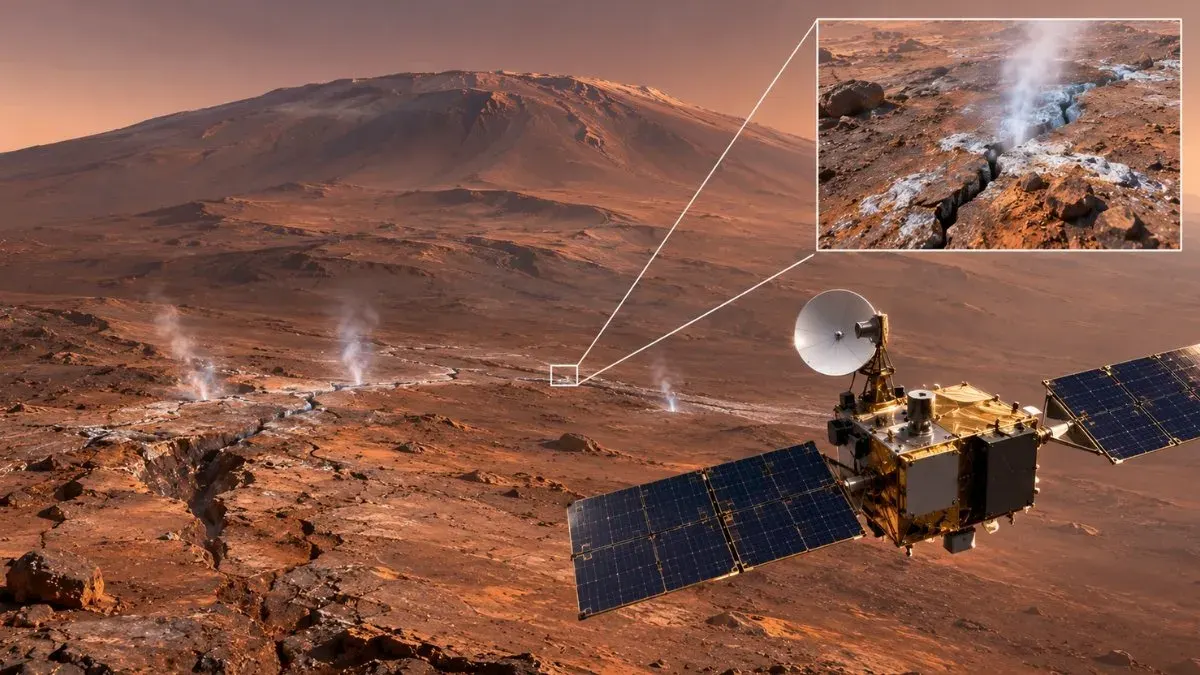
An international team led by Alexander Trokhimovskiy reported in Science Advances detections of hydrogen chloride (HCl) in the Martian atmosphere over the Alba Mons region during the cold aphelion season. The measurements were made by the Atmospheric Chemistry Suite on the ExoMars Trace Gas Orbiter. According to the authors, the results are best explained by ongoing igneous processes in the Martian interior science.org
Science Advancesscience.orgOpen source ↗. Prof. Daniel Mège of the Space Research Centre of the Polish Academy of Sciences and the University of Bern helped interpret the data in the geological context of Mars. The study was published on 4 November.
Hydrogen chloride signal over Alba Mons
Earlier, the same instrument recorded widespread HCl at part-per-billion levels in the Martian atmosphere during the warm perihelion period. That gas was attributed to aerosol-atmospheric sources. The new detections differ: they are isolated in the Alba Mons region and occur in the cold aphelion season. According to the publication that covered the work, there were 8 local detections over the northern slopes of the volcano, in early northern summer, with a concentration of about 2 parts per billion. The signal returned in the same region.
Sulfur dioxide, which could indicate eruptive activity, has not been detected so far. The authors note that seepage of halogen gases such as HCl may identify active magma chambers better. On Earth, HCl can escape from hot volcanic systems without an eruption, slowly seeping through fractures in rock.
Fissures and open questions
Images from the CaSSIS camera on the same orbiter show fresh, narrow fissures in the area, some less than 1 meter wide and in places hundreds of meters long science.org
Science Advancesscience.orgOpen source ↗. Brighter patches of surface were also seen nearby. The authors interpret the fissures as potential HCl pathways rooted into magmatic bodies at depth. Fissures and discoloration alone do not prove the presence of magma. Alba Mons itself dates back about 3.7 billion years, and no lava flow or modern eruption has been observed.
To explain the seasonality, the researchers propose two scenarios. In winter, temperatures there can fall to -120 °C, and ice may block the fissures until sublimation reopens them. Alternatively, gas may escape all year and be captured by ice particles in winter, becoming detectable only when conditions change. Both are hypotheses. The team must separate real changes in gas release from changes in observing conditions. Mège announced laboratory experiments on how magmatic HCl behaves when passing through an ice-rich substrate.