Amsterdam and Birmingham teams build a motorized metamaterial whose vibrations merge into a time crystal
Physicists report wave coarsening in active elastic sheets of 37 and 24 motorized cells: random vibrations grow into one synchronized rhythm, a time crystal.
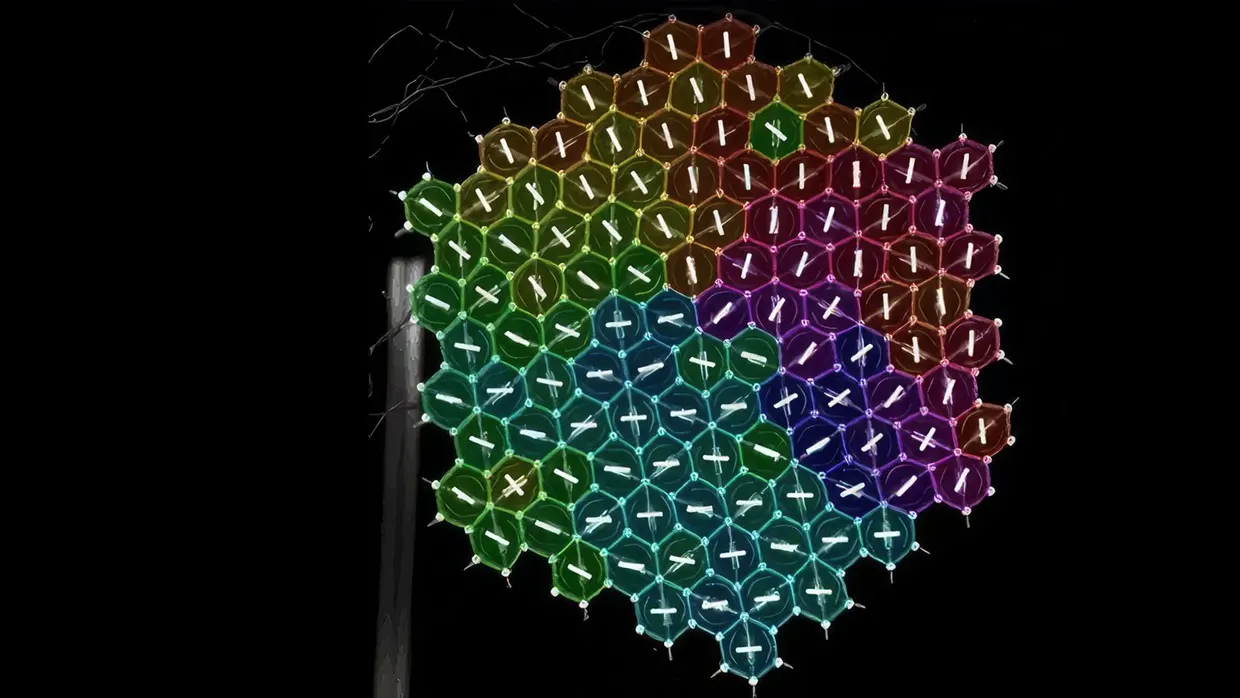
Researchers at the University of Amsterdam and the University of Birmingham have observed wave coarsening in active elastic metamaterials, according to a study in Nature. Vibrations that start at random grow in wavelength, period and amplitude until the whole material oscillates in one synchronized state, a time crystal nature.com
Naturenature.comOpen source ↗.
The authors tested it in one- and two-dimensional mechatronic systems and captured the dynamical scaling of the process. In ordinary systems, patterns such as magnetic domains coarsen by diffusive relaxation towards equilibrium; here the process is a vibrational counterpart.
Motorized cells and non-reciprocal rule
Each cell of the first material is a trio of elastic hexagons connected to a circuit board. A sensor reads how each hexagon is compressed, and a voice-coil actuator pushes on it. When a hexagon is compressed, its clockwise neighbor is compressed too and its counterclockwise neighbor is stretched, so the response depends on direction (non-reciprocal).
The team assembled 37 cells into a honeycomb on a Teflon-coated glass plate. With the feedback strength raised above the threshold at which a single cell oscillates, each cell began vibrating at about 30 times a second after a shake. A longer wave then moved around the edge in one direction and displaced the fast motion, and within a few seconds all cells were shearing together at one rhythm nature.com
Naturenature.comOpen source ↗.
In six runs from different random jolts, the distance over which cells moved in step grew as a power law while the vibration energy rose. A mathematical model reproduced this on a line and on a grid. In simulations with noise, the larger the sheet, the longer the rhythm held.
Ring, friction and edge waves
A second material, an elastic ring with 24 torque motors on an air table, showed the same effect. A six-lobed pattern dominated first, then five-lobed, then four-lobed, and the ring finally settled into a slow cycle around a flattened shape.
The coarsening stops when momentum conservation is broken. With the Teflon removed, the honeycomb rubbed on the glass, and short waves kept circling without merging. In the model, friction sets the wavelength at which waves get stuck nature.com
Naturenature.comOpen source ↗.
In a simulated disc of 5,813 cells, coarsening started everywhere, but waves along the rim soon took over and ran in one direction. On a ring-shaped disc, inner and outer edges carried waves in opposite directions. The authors describe this as a far-from-equilibrium nonlinear analogue of chiral topological edge modes.
The physical samples were flat and only shear. The authors say behavior in a three-dimensional material that can bend and twist is untested and is their next goal. They also ask whether one material could hold several stable rhythms and switch between them.