Secretary birds kick prey with about 195 N of force in 15 milliseconds, Current Biology study finds
The secretary bird's kick has a peak force above five times its body weight and lasts 15 ms, too short for the brain to process feedback from the legs.
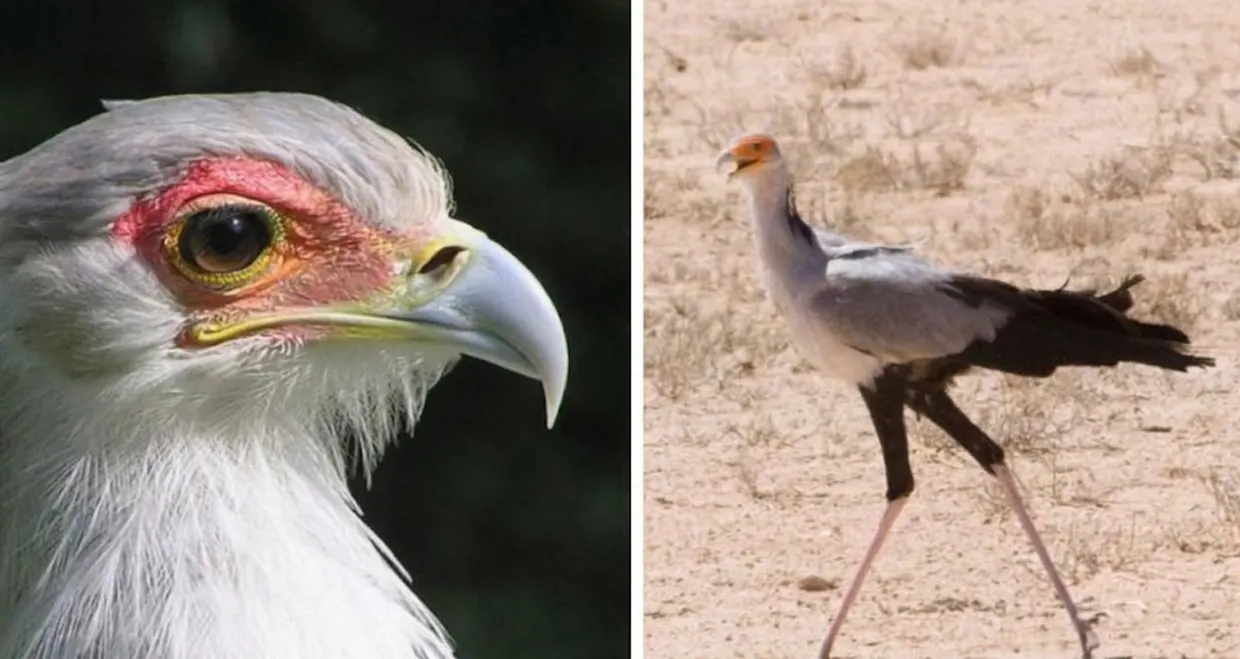
The secretary bird lives in the open grasslands and savannas of Africa. Although it belongs to the order of birds of prey, it hunts on foot rather than from the air, according to sozcu.com.tr. The bird grows up to 1.3 m tall, has long legs and a characteristic crest, and feeds on snakes, lizards, small mammals and large insects. sozcu.com.tr
sozcu.com.trsozcu.com.trOpen source ↗ A study published in Current Biology examined how it uses its legs as a weapon.
Force and speed of the kick
According to the study data, the mean peak force of the kick the bird delivers to its prey exceeds five times its own body weight, about 195 N. The attack lasts only 15 ms.
This duration is not enough for the brain to process feedback signals coming from the legs. The finding suggests that the bird strikes not with instant reflexes but with high-precision movements programmed before the blow with the help of vision.
The long shin and tarsus bones make up more than half of the leg length. They give the bird both a balanced stance and the ability to deliver fast downward blows. sozcu.com.tr
sozcu.com.trsozcu.com.trOpen source ↗
Range, nests and evolutionary parallels
Secretary birds are common south of the Sahara, especially in South Africa, Kenya, Tanzania and Botswana. They prefer open areas with sparse vegetation and a wide field of view. Despite their terrestrial lifestyle, they build nests more than two meters across on acacia trees for safety and observation. The birds are monogamous, stay together all year and defend territories of several square kilometers.
The scientists noted that the bird's hunting method relies on bone structure and attack strategies similar to those of the extinct South American "terror birds" (Phorusrhacidae). The study also shows that peak limb force can occur not only during movement such as running but also in blows delivered from a standing position.
The researchers said that this biomechanical design, which combines strength, speed and visual aiming precision, could serve as a model for developing robots and prosthetic limbs capable of more balanced and faster movement.