Radio source LPT J1555−5631 in the Milky Way emitted two pulses every 62.2 minutes
MeerKAT and ASKAP recorded a long-period radio source in the Galaxy with two oppositely polarized pulses per cycle; the nature of the object remains unknown.
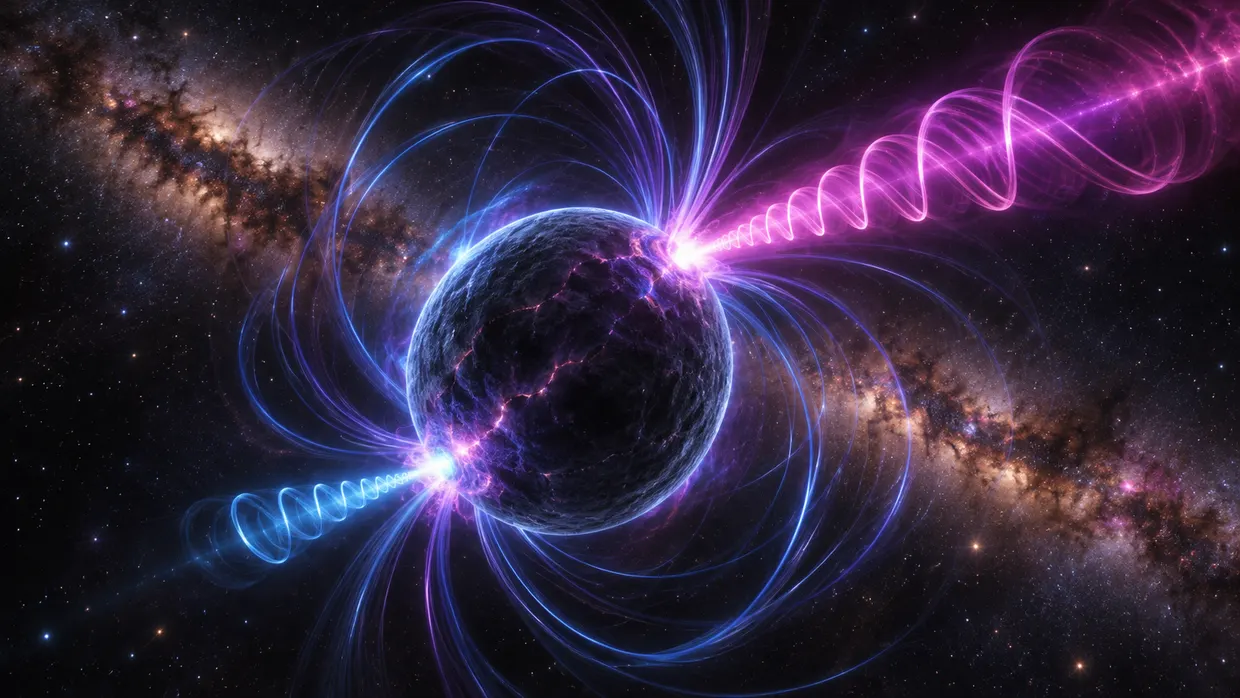
Astronomer Scott Hyman of Sweet Briar College found a radio source in the Milky Way, designated LPT J1555−5631, that emitted two pulses per cycle with a period of 62.2 minutes and then fell silent. The study was published in The Astrophysical Journal, according to Poisk. poisknews.ru
Поискpoisknews.ruOpen source ↗ Hyman found the source in archival MeerKAT observations while searching for millisecond pulsars in 2022. A ten-hour ASKAP recording of the same patch of sky on the same day confirmed the period.
Two pulses and polarization
In each cycle the source produced two separate pulses. One lasted considerably longer than the other, while their peak brightness was roughly equal. The polarization of the first pulse points one way and that of the second the opposite way, meaning the electromagnetic field of the waves rotated in different directions.
The researchers suggest that the emission arises near two magnetic poles, and that the magnetic axis is probably almost perpendicular to the rotation axis. With a simple two-pole field the pulses would be separated by 180 degrees, but the actual angle is 165.4 degrees. This may indicate a more complex magnetic field structure. The object has not been detected even in visible light.
Long-period radio sources
Such objects are called long-period radio transients, with pulses separated by tens of minutes to several hours. In September 2002 Hyman recorded five pulses at exactly 77-minute intervals, after which that source went quiet. The first object that allowed the group to be identified was observed in 2018 and reported in 2022. About ten such sources are now known. poisknews.ru
Поискpoisknews.ruOpen source ↗
Ordinary pulsars rotate much faster, and at such slow rotation they would struggle to create the conditions for powerful radio emission. Magnetars and white dwarfs in binary systems are considered candidates; some sources have already been linked to such systems. No single explanation fits all the objects.
LPT J1555−5631 has not yet been detected again. The 2002 source later became active again, as did two other objects. The researchers suggest that transitions between active and quiet states may be linked to changes in the magnetosphere, but this is only a possible explanation.