University of Sydney builds 3D maps of deuterium in metal alloys using cryo-APT
Julie Cairney's team used deuterium and cryogenic atom probe tomography to show where dissolved hydrogen sits in alloys, which matters for hydrogen embrittlement of metal parts.
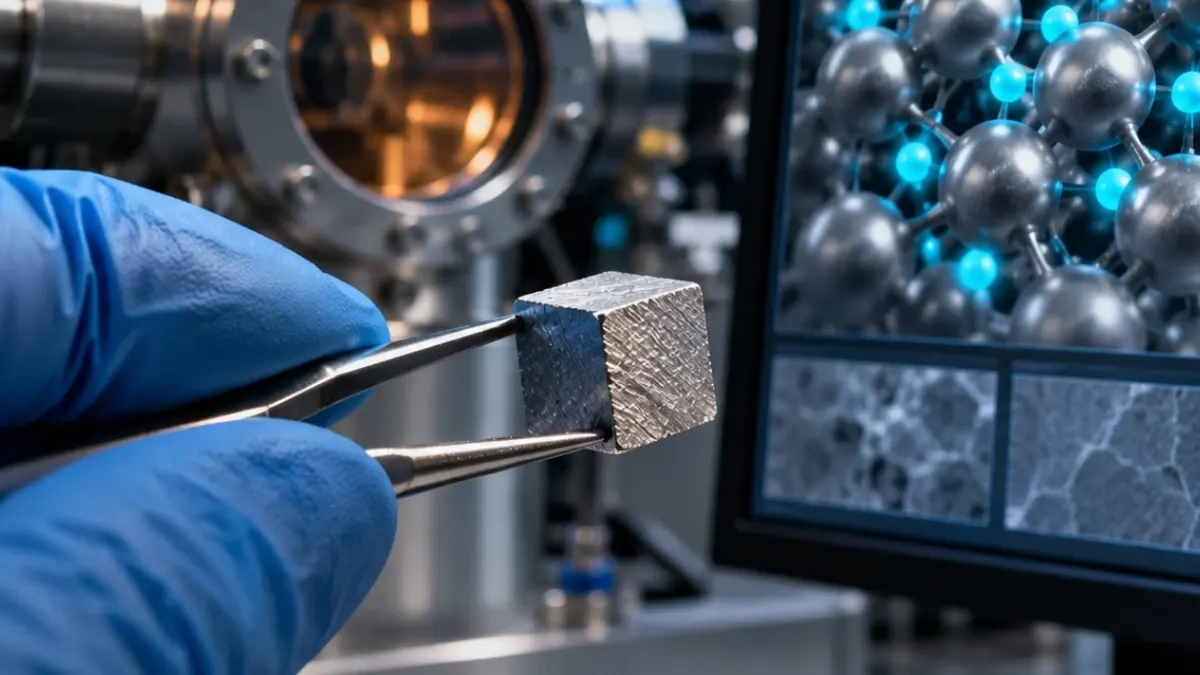
Researchers at the University of Sydney have built three-dimensional maps of hydrogen dissolved in the structure of metal alloys, according to spidersweb.pl. The international team led by Professor Julie Cairney published the results on 4 November in Nature. spidersweb.pl
spidersweb.plspidersweb.plOpen source ↗ The method combines atom probe analysis with deuterium, a heavier isotope of hydrogen.
Why hydrogen is hard to locate in metal
Hydrogen is the lightest element. Single atoms can enter many metals, move through the crystal lattice and collect in certain places. This can cause hydrogen embrittlement: a metal that should withstand heavy load becomes more prone to cracking, sometimes without earlier visible signs of damage.
Inside a metal, hydrogen can form hydrides, collect at defects of the crystal structure or dissolve directly in the atomic lattice, in interstitial positions between neighbouring atoms. The last case remained the least understood. Direct measurement is difficult: hydrogen has very small mass, it can escape from the sample during preparation, and measuring equipment may contain trace hydrogen that is hard to distinguish from the sample's own.
Cryo-APT with deuterium
The deuterium nucleus contains a proton and a neutron, which makes it easier to identify in measurements. The team saturated specially prepared alloy samples with deuterium and rapidly cooled them in liquid nitrogen to limit the movement and escape of atoms. They then applied cryogenic atom probe tomography (cryo-APT). spidersweb.pl
spidersweb.plspidersweb.plOpen source ↗ Atoms are removed one by one from the surface of a sharpened sample, and the mass, time of flight and position of the resulting ions are used to reconstruct the composition. The image is therefore a computer reconstruction, not a direct photograph of an atom.
In alloys containing nickel, cobalt, chromium, aluminium and titanium, small ordered regions of different composition were embedded in the metal matrix. Deuterium accumulated in them much more readily than in the surrounding material, especially in precipitates of the L1₂ phase, made mainly of nickel, aluminium and titanium. In the nickel superalloy Inconel 718, deuterium concentrated mainly in one of the examined phases, while in another its concentration stayed much lower.
The results were compared with electron microscopy, additional defect measurements and theoretical calculations. All of them indicated that the observed deuterium distribution corresponds mainly to interstitial positions. The authors note that a small contribution from hard-to-detect defects cannot be fully ruled out.
What the study does not show
The work does not yet present an alloy resistant to all effects of hydrogen. It also does not prove that limiting accumulation in certain places will by itself prevent cracking. spidersweb.pl
spidersweb.plspidersweb.plOpen source ↗ The team's next task is to check how the observed hydrogen distribution affects the deformation of materials under load. The researchers are already applying these methods to ultra-high-strength steels.