Simulations: magnetic axes of Uranus and Neptune may shift by tens of degrees within decades
Models from the University of Texas at Austin and partners show the tilt of the ice giants' magnetic fields may change within decades. This is not yet observed.
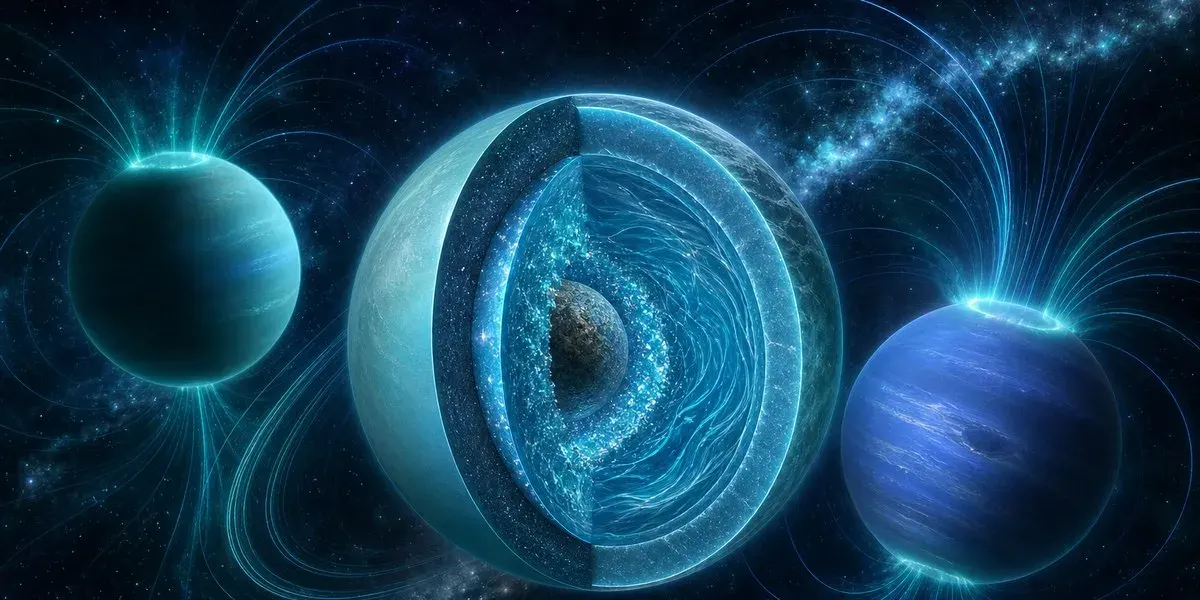
Computer models indicate that the magnetic fields of Uranus and Neptune may change their tilt by tens of degrees over several decades, ua.news reports. The study was published in Communications Physics by a group from the University of Texas at Austin together with colleagues from the University of California, Los Angeles, Imperial College London and Northumbria University. ua.news
ua.newsua.newsOpen source ↗ The researchers link the unusual shape and large tilt of the fields to changes in the electrical conductivity of matter deep inside the ice giants.
Why the magnetic fields are tilted
A planet's magnetic field is produced by a dynamo process: the motion of electrically conductive fluid generates magnetic forces. On Earth this occurs in the liquid outer core, and the magnetic axis is tilted by about 11 degrees from the rotational axis.
The magnetic dipole of Uranus is tilted by 59 degrees, and that of Neptune by 47 degrees. Both planets are about four times wider than Earth. According to scientists' estimates, their interiors contain hydrogen, helium, water, ammonia, methane and rocky material, but the exact composition remains unknown.
What the simulations show
The authors modeled various versions of the planets' internal structure, taking into account fluid motion, temperature changes and the interaction of magnetic forces. They suggest that matter becomes more electrically conductive with depth: under extreme pressure and temperature, water molecules may break down into ions capable of carrying electric current. ua.news
ua.newsua.newsOpen source ↗
In some simulation scenarios, the tilt of the magnetic axis changed by tens of degrees in just a few decades. This means that the fields of Uranus and Neptune may now differ significantly from those recorded by the Voyager 2 spacecraft during its flybys of the planets in the 1980s.
This conclusion is still a model prediction rather than a confirmed observation. Scientists are analyzing infrared images of Uranus and Neptune obtained by the James Webb Space Telescope. They are paying particular attention to auroras and the structure of the ionosphere, since these phenomena are linked to the planets' magnetic activity. The data are planned to be compared with Voyager 2 measurements and the results of new simulations.