Taung Child fossil dated to 2.96–3.03 million years, raising doubts over a single A. africanus species
A new study dates the Taung Child, the holotype of Australopithecus africanus, and finds that several fossils assigned to the species developed differently.
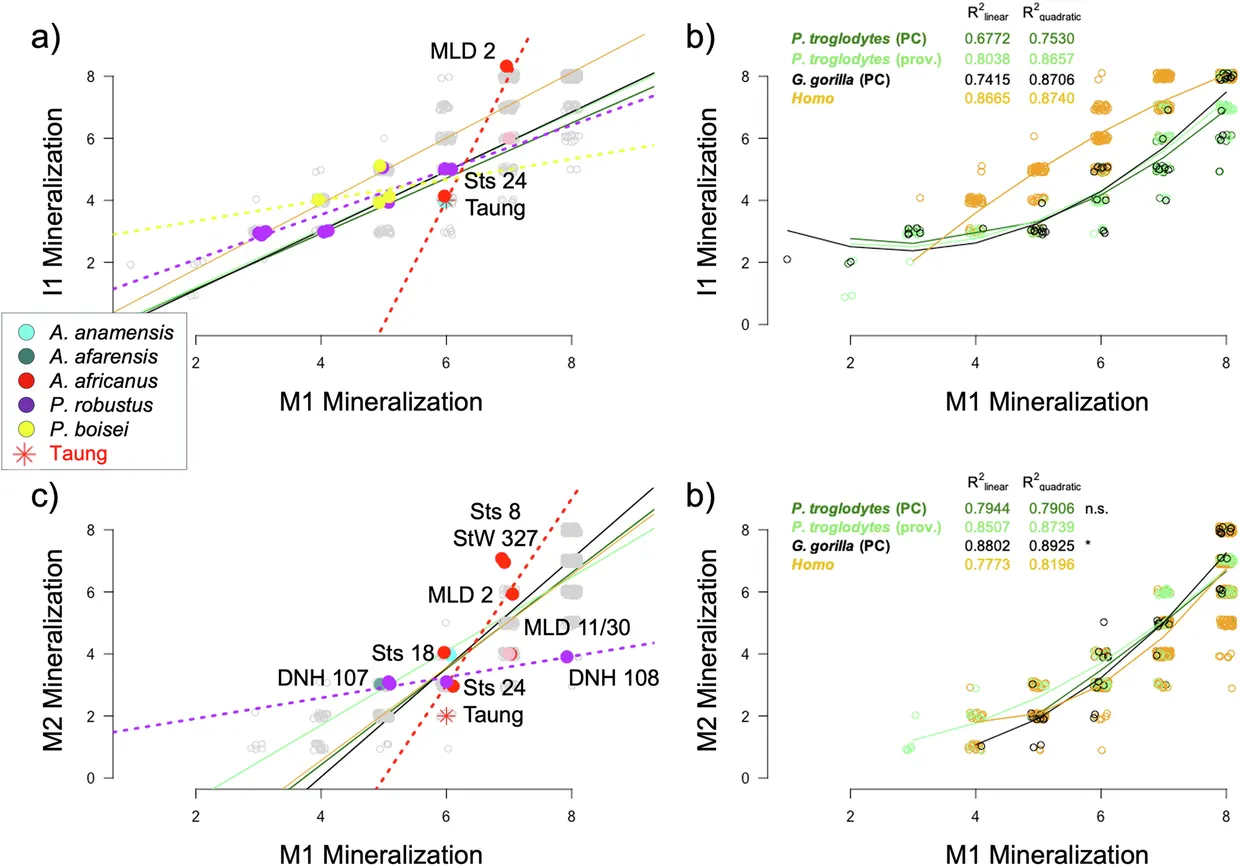
An international team led by Gabriele Macho of Vrije Universiteit Brussel has reassessed the Taung Child, the holotype of Australopithecus africanus, in a paper on nature.com nature.com
nature.comnature.comOpen source ↗. The fossil was found at the Buxton Limeworks quarry in South Africa's Northwest Province in 1924. The authors date it to between 2.96 and 3.03 million years ago and examine its dental and brain development.
Taung remains the only unequivocal specimen of the species. Other fossils from Sterkfontein and Makapansgat were grouped under A. africanus as a means of rationalisation, without agreed diagnostic features. The species is still defined by loosely worded qualitative traits such as "more rounded" or "less extreme".
Dating and development
Because of its young biological age, Taung was accepted as a hominin only after adult hominins were found at sites some 390 km and 670 km northeast of it. The team compared its dental and brain development and the dentino-enamel junction of a first molar with other fossils. According to the authors, these analyses confirm that A. africanus is a poorly defined taxon.
Several adult fossils traditionally classified as A. africanus did not match the developmental trajectory of the Taung Child. Differences in brain development were the most informative. They suggest that several hominin species lived in the Sterkfontein region, either alongside one another or at different times.
Climate and population dynamics
Fossil pollen indicates that the Taung Child lived in a wetter, more forested landscape than modern South Africa, according to the study's summary. Some of the trees that grew there are now found hundreds of kilometres to the northeast.
The authors propose that alternating wet and dry periods repeatedly changed habitats in the region. Populations may have become isolated, evolved separately and later met again. On this reading, southern Africa's position between tropical and temperate ecosystems, at the Zambezian–southern African biogeographic boundary, made it a meeting ground for populations with different histories nature.com
nature.comnature.comOpen source ↗.
The authors suggest that drift and hybridisation probably underlie the morphological diversity of southern African hominins in the Plio-Pleistocene. They describe the emergence of the genus Homo as a complex network of ancient populations rather than a simple succession of ancestors.