Toyama and Nagoya astrophysicists find X-ray precursors of black hole jets 1–10 days ahead
In four binary systems with stellar-mass black holes, X-ray changes preceded the radio brightening tied to jet launches by 1–10 days. The sample is still small.
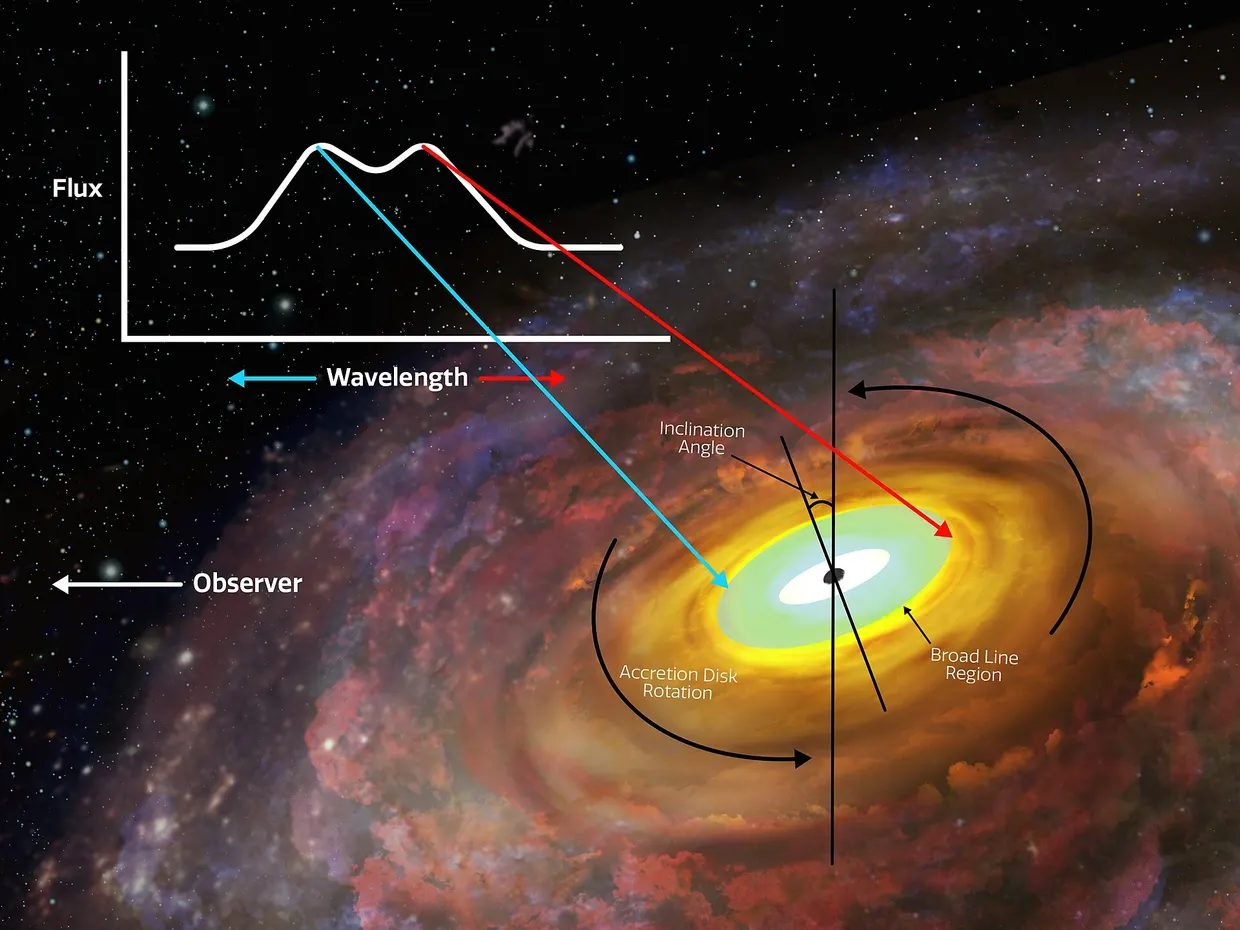
Astrophysicists from the universities of Toyama and Nagoya have found signs that allow jet ejections to be anticipated in stellar-mass black holes, according to ixbt.com. Jets are flows of matter moving at a speed close to the speed of light. In the four binary systems studied, characteristic changes in X-ray emission appeared 1–10 days before the increase in radio emission associated with jet launches ixbt.com
ixbt.comixbt.comOpen source ↗.
In such systems a black hole pulls gas from a companion star, and the matter forms an accretion disk, a rapidly rotating structure of hot gas. Part of the material is ejected along the rotation axis as two narrow jets. They carry a large amount of energy, heat the surrounding gas and can affect star formation in galaxies.
What was measured
In a 2025 study, Toshihiro Kawaguchi and Kazutaka Yamaoka found a link between jet launching and shrinking of the inner radius of the accretion disk. They have now tested this pattern on three more objects: XTE J1550−564, GX 339−4 and MAXI J1820+070. Together with the previously studied XTE J1859+226, the sample came to four binary systems. X-ray observations and radio data were used to match changes in the disks with the moments jets appeared.
The main precursor was the radius of the disk's inner edge. It moves inward quickly until it reaches the ISCO, the innermost stable circular orbit around the black hole. At the same time, the researchers recorded a drop in the fractional amplitude of X-ray variability, which shows how strongly the brightness changes. In every system, both quantities fell before the activity associated with jet ejections ixbt.com
ixbt.comixbt.comOpen source ↗.
Accretion rate and next steps
There were no sharp jumps in the accretion rate, the rate at which matter falls onto the black hole, before the launches. In XTE J1859+226 it declined gradually throughout the observations, with a decay time of about 30 days. The authors noted a possible increase of almost 20% right before some individual ejections, but the available data are insufficient to regard this as established. In XTE J1859+226 and MAXI J1820+070, jets appeared at accretion below the Eddington limit, the theoretical boundary at which radiation pressure balances gravitational attraction. This makes models that require exceeding the limit for jet launching unlikely.
The authors propose an early-warning system that would continuously track the inner disk radius and X-ray variability. When both begin to fall steadily and the inner radius approaches the ISCO, the system would send alerts to observatories so they can request additional observations under the Target of Opportunity program, an unscheduled allocation of telescope time for a short-lived astronomical event.
The pattern has so far been verified in only four systems, so new observations are needed. Researchers still have to establish how fast the disk radius must shrink to launch a jet and why the precursors appear several days before the event ixbt.com
ixbt.comixbt.comOpen source ↗.