Edinburgh and Max Planck teams find six ways a water drop removes dust particles
Simulations and microscopy experiments show that particle removal by a drop depends on capillary force and particle–surface friction, not only on the hydrophobicity of the coating.
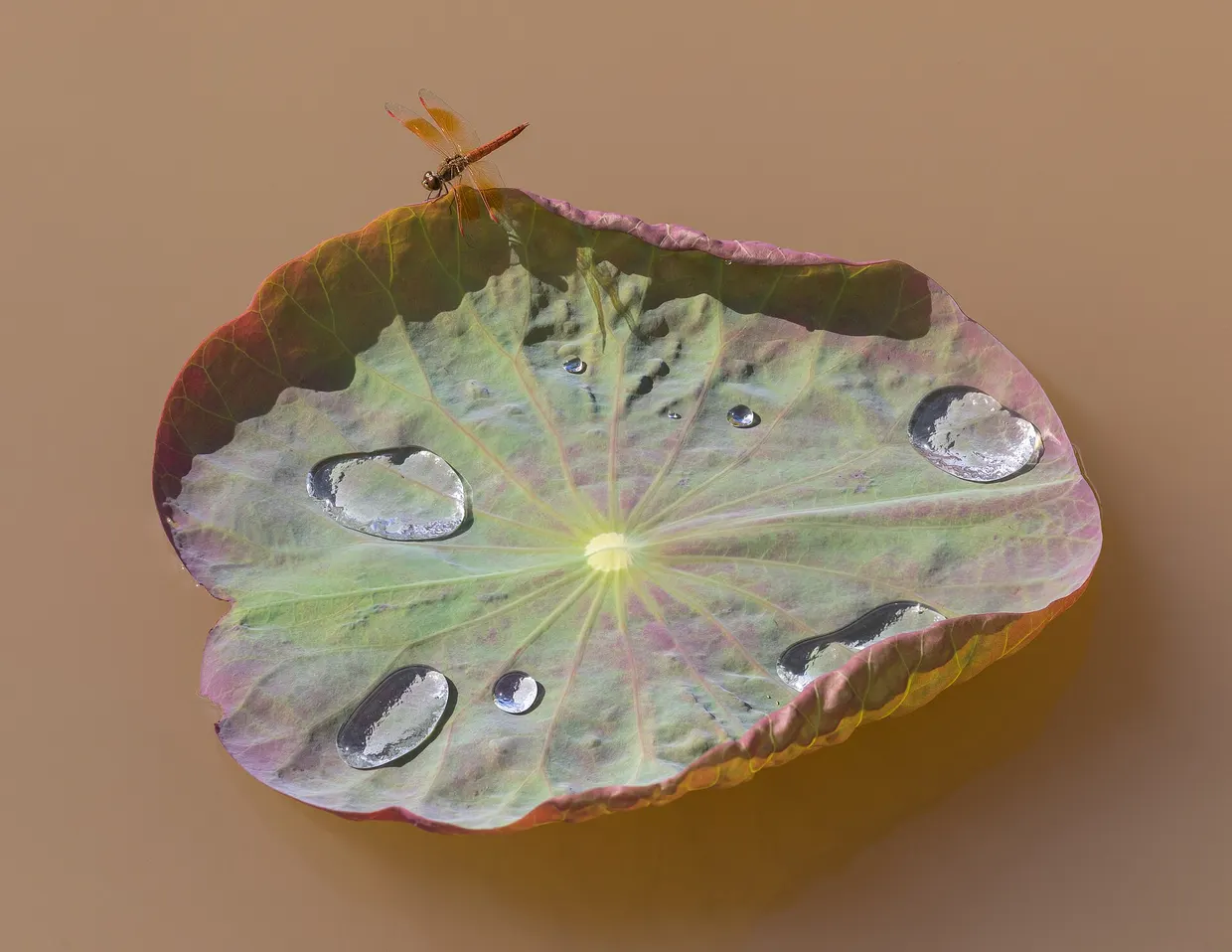
Researchers from the University of Edinburgh and the Max Planck Institute for Polymer Research studied how a single water drop colliding with a particle on a surface can remove it. The work, published in Science Advances, combined lattice Boltzmann simulations with confocal microscopy experiments science.org
Science Advancesscience.orgOpen source ↗.
Particulate contaminants reduce the power output of solar panels and the transparency of windows. In microelectronics, even a single particle can cause a short circuit. Despite substantial research on particle adhesion and self-cleaning, it remained unclear when and how a drop can remove a particle and clean the surface efficiently.
Six scenarios of drop–particle collision
The authors found that at least six different scenarios arise from the interplay of capillary and friction forces when a drop hits a particle on a surface. According to the study's retelling, some encounters lift particles away, while others push them along or leave them behind.
The capillary force plays a dual role. Its tangential component always drives removal, while its normal component can also hinder it science.org
Science Advancesscience.orgOpen source ↗. The team introduced a dimensionless capillary capture parameter. According to the authors, it predicts particle removal across a wide range of particle and surface properties.
Surface design: friction as well as hydrophobicity
A common assumption is that the most water-repellent surface is also the easiest to clean. The results show that the design of easy-to-clean surfaces should focus not only on maximizing hydrophobicity but also on minimizing the friction between particle and surface. Particles that slide or detach easily may be removed by a moving drop without an extremely water-repellent coating.
Solar panels are an obvious application, and the same ideas could apply to windows of tall buildings or historic structures. Cleaning large solar farms requires labor, water and equipment, particularly in dry regions where dust is common.
The work does not yet mean a ready-made self-cleaning solar panel. Real surfaces collect many particles at once, and outdoor conditions involve changing rain, wind, temperature and types of dirt. The best coating for a dry, dusty region may differ from one suited to frequent heavy rain. Further testing will need to show how coatings perform over years of use and whether their benefits justify manufacturing costs.