EPFL prototype robot elephant with a lattice trunk made of one material varies stiffness from 20 to 280 kPa
EPFL researchers built a tendon-driven robotic elephant prototype. Its lattice geometry sets local stiffness, from tissue-like to bone-like, within a single material.
Researchers at the École polytechnique fédérale de Lausanne (EPFL), in the group of Josie Hughes, have described in Science Advances a method for designing soft-rigid robotic structures from lattice geometries made of a single material science.org
Science Advancesscience.orgOpen source ↗. As a demonstrator, they fabricated a tendon-driven robotic elephant prototype modeled on a musculoskeletal system.
Lattice geometry sets stiffness
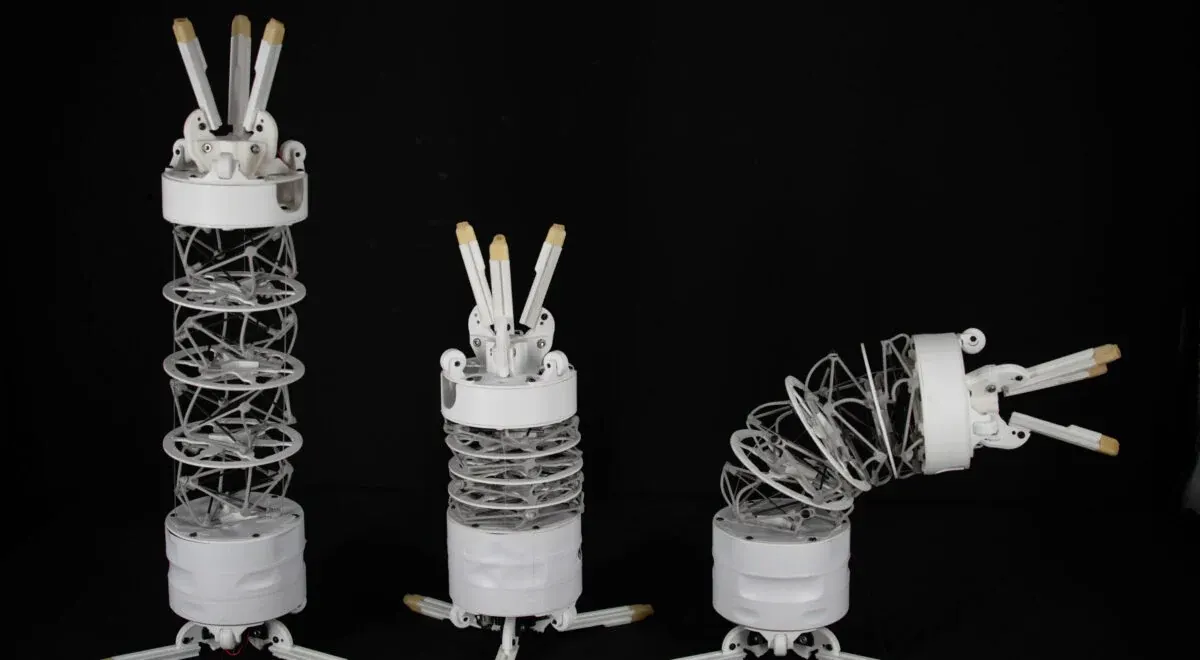
The authors propose new ways to design the unit cells of a lattice, based on continuous blending and superposition of existing lattice geometries. This allows them to tune stiffness and anisotropy precisely. The resulting three-dimensional structures have spatially varying mechanical properties, from tissue-like compliance to rigid, bone-like load-bearing capability.
According to the authors, the generation techniques allow more than 1 million discrete configurations and an infinite number of geometric variations. Science et Vie, in its account of the work, adds that the lattice is 3D-printed from a flexible resin. Stiffness in different zones ranges from 20 to 280 kilopascals without changing material. The design rests on two elementary cells, body-centered cubic and "X-cube", whose combination gradually modulates how the material deforms.
Elephant prototype
The robot is less than 60 centimeters tall. Its trunk is driven by four motors and tensioned wires. It bends, twists and rotates, and, as reported, can grip a wire 0.1 millimeter thick and lift a load of 500 grams. The hips, knees and feet remain firm and carry the body.
The joints integrate programmable bending profiles, and the trunk stays continuously soft science.org
Science Advancesscience.orgOpen source ↗. By shifting and rotating the lattice cells, the researchers reproduce an ankle slide, a knee flexion and the twist of a toe, with smooth transitions between zones. Instead of joining different materials, the structure is made as one lightweight lattice.
The authors describe the approach as a scalable way to design lightweight, adaptable robots. According to Science et Vie, the EPFL team is now working mainly on strengthening the cell walls, to obtain stiffer structures for exoskeletons and for arms that carry loads.