Octopuses use coconut shells as portable shelters for defense
Researchers observed octopuses collecting coconut shell halves to create portable shelters, showcasing advanced problem-solving skills.
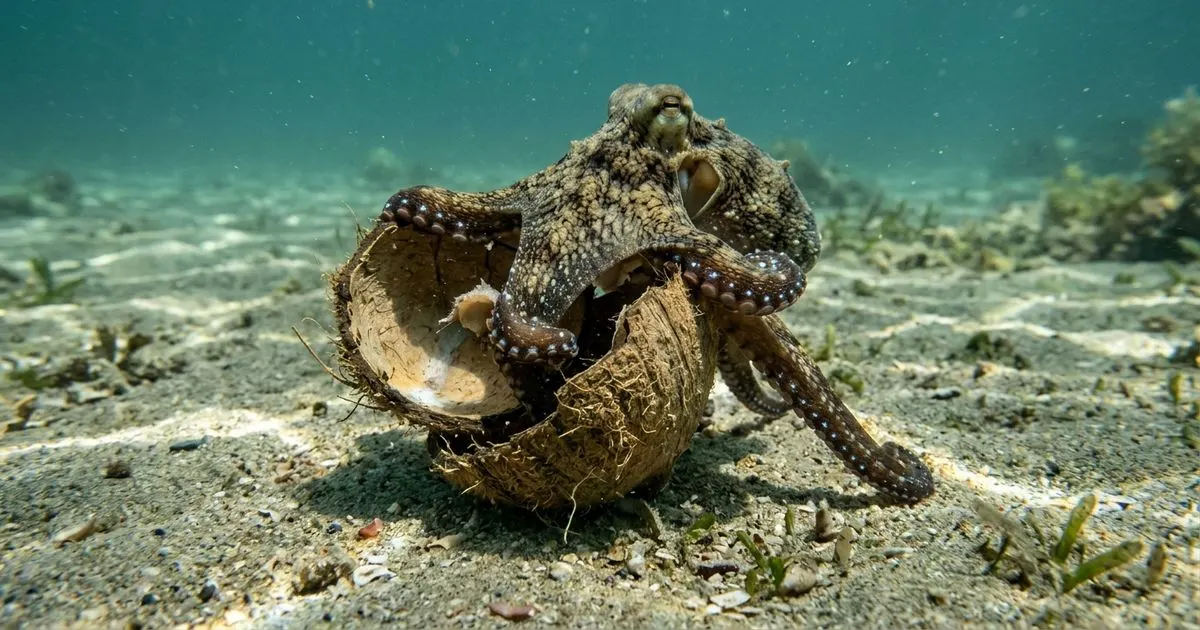
The underwater environment of Indonesia reveals fascinating scenes of remarkable intelligence in invertebrates. Scientists observed cephalopods collecting discarded shell halves, identifying an ingenious defensive system based on portable shelters to ensure their survival.
The octopus species Amphioctopus marginatus actively searches the ocean substrate for compatible coconut shell halves. Upon locating two matching pieces, the animal skillfully joins them to form a rigid protective cover. In sandy plains lacking natural crevices, this makeshift shelter becomes essential against sudden attacks from marine predators. The octopus completely encloses itself within the joined halves, demonstrating a specialized behavior focused on efficient defense.
While moving across the sandy seabed of Indonesia, the invertebrate carries the shells beneath its body, walking on its arms. This curious method allows it to transport the rigid objects over distances that can reach twenty meters. The journey with the load requires unusual physical effort and significantly reduces the animal's escape speed along the route. Throughout this movement on the seafloor, the carried materials do not provide any immediate safety against potential threats.
Researchers Julian Finn, Mark Norman, and Tom Tregenza formally recorded these observations in the journal Current Biology in 2009. The scientific community was surprised to note that an invertebrate could manipulate complex pieces for future purposes. Until then, it was considered quite unlikely that marine creatures without a backbone would expend energy to collect heavy materials devoid of immediate utility. The act of carrying hard halves for a later benefit demonstrated a high level of cognitive sophistication among invertebrates.
For scientists, true tool use occurs when the manipulated object does not serve a practical function at the moment of transport. By storing shells and husks for future assembly, the octopus clearly demonstrates evident planning and strategic reasoning capabilities. This conceptual differentiation separates deliberate tool use from common mechanical reactions observed in other marine creatures in the same region. Storing heavy shells requires anticipation of hostile scenarios, marking an unprecedented scientific milestone for cephalopod biology.
The impressive ability of this species broadens discussions on how cognition operates in nature, challenging classical theories about intelligence. In light of these findings, the oceans continue to reveal endless sources of surprising behaviors that transform our understanding of the aquatic kingdom.