Chinese Academy of Sciences: III-nitride prototype stores light input and switches to fast detection
A prototype AlGaN device from the Chinese Academy of Sciences holds an electrical state set by light and, at a different voltage, works as a fast detector, a step toward in-sensor computing.
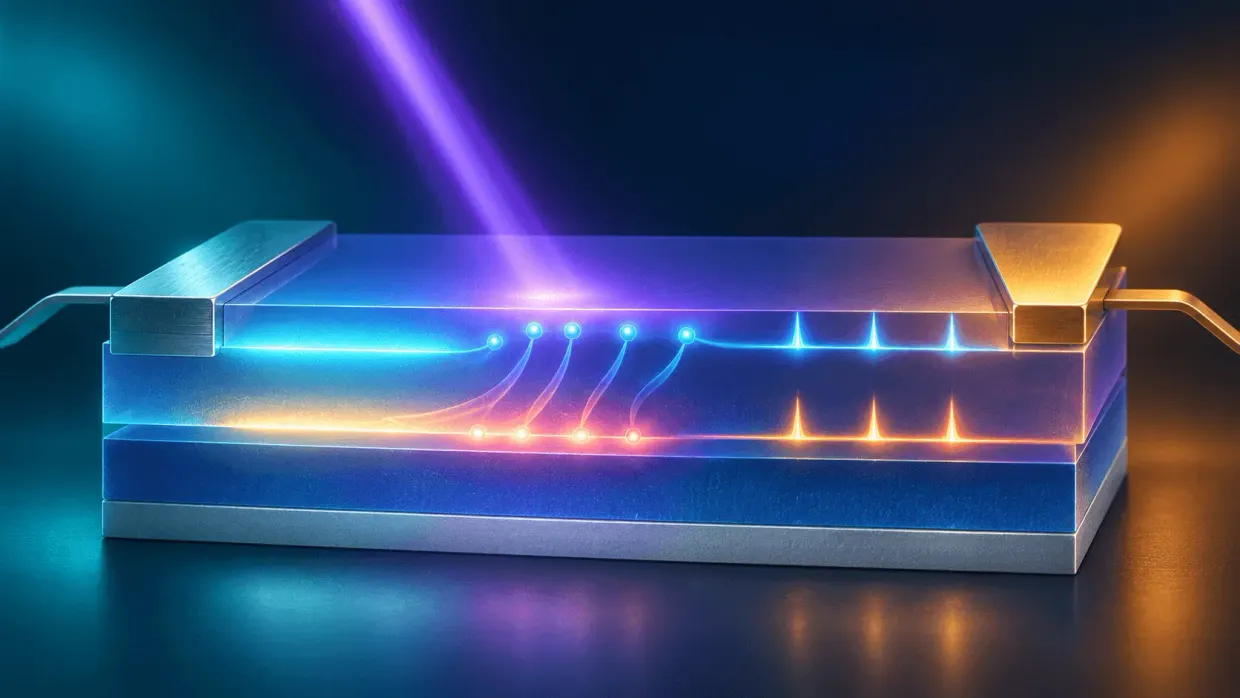
A team at the Chinese Academy of Sciences, including researchers from the Changchun Institute of Optics, Fine Mechanics and Physics, has built a III-nitride prototype device that remembers optical input and can be switched by voltage into a high-speed detector. The work was published in Nature Materials on 27 October, and the academy announced it on 10 November nature.com
Nature Materialsnature.comOpen source ↗. The structure is a stack of AlGaN layers with different aluminium-to-gallium ratios.
How the device works
Polarization charges at the boundaries between the layers create an internal electric field. It separates photogenerated electrons and holes in space and so avoids recombination losses. Asymmetric Ni/Ti metal contacts let the applied voltage either hold the holes at the interface or release them. The device stores not the light itself but the electrical state that the light has changed.
In control experiments, devices with 0, 1 and 3 channels were compared at 1.5 V under 255 nm ultraviolet light of 10 μW/cm² for 5 seconds. Only the 3-channel device kept its current after illumination stopped. A device with symmetric Ni contacts did not show long-term nonvolatile retention.
Characteristics and limits
In the sensor-memristor mode the authors report sensitivity at the level of nanowatts per square centimetre, responsivity at the level of 10^6 A/W and an on/off ratio at the level of 10^5 nature.com
Nature Materialsnature.comOpen source ↗. The response peaks at 235 nm, with a long-wavelength cutoff at 275 nm. With a 193 nm ArF pulsed laser at 200 Hz and a pulse width of about 7 ns, rise and fall times were 8.35 ns and 7.81 ns. Another readout configuration in the supplementary material gives millisecond transients, which the authors attribute mainly to the external circuit.
The device was tested from 50 to 300 °C and endured 1000 write-reset cycles at 300 °C. Over those cycles the switching ratio varied from about 2.1×10^4 to about 1.1×10^7, and dark current rose with temperature. At 350 °C the device still responded to light, but retention became less stable.
The figure of more than 90% accuracy on the Fashion-MNIST image set comes from a computational model, not from hardware. The model used 36 measured current levels as weights. Separately, an array of 81 devices was tracked after one month and one year in air. As of 13 November 2026 no independent replication has been confirmed. Power consumption, integration density and fabrication yield remain to be evaluated on large arrays with readout circuits.