KAIST ruthenium particles of 1 nm raise ammonia synthesis rate 57-fold in lab tests
KAIST researchers shrank ruthenium particles in an ammonia catalyst to 1 nm and measured a 57-fold higher synthesis rate for the same amount of metal in lab experiments.
A team led by Professor Choi Min-ki of the Department of Chemical and Biomolecular Engineering at KAIST has developed a catalyst in which the size of ruthenium particles is tuned to raise ammonia production efficiency, and has identified how it works, biz.heraldcorp.com reports. With the same amount of ruthenium, the total ammonia synthesis rate rose 57-fold biz.heraldcorp.com
biz.heraldcorp.combiz.heraldcorp.comOpen source ↗. The results were published online in the Journal of the American Chemical Society (JACS) on June 17.
Why smaller ruthenium particles help
Ammonia is a key fertilizer feedstock and is considered a carrier for hydrogen storage and transport. Its production requires high temperature and pressure and consumes a great deal of energy, so more active catalysts are needed. Ruthenium performs well in ammonia synthesis, but it is expensive and scarce, which limits industrial use.
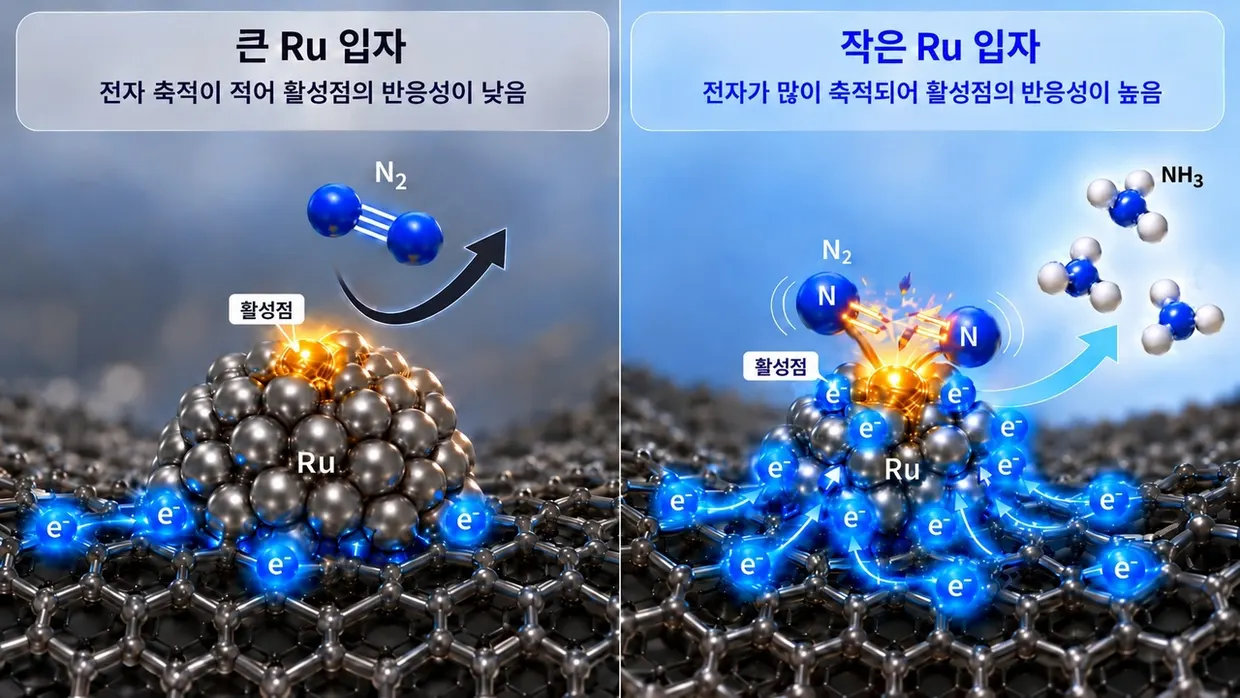
The team reduced ruthenium particles to the nanometer scale. For the same mass of metal, smaller particles have a larger surface area, which provides more sites where nitrogen and hydrogen can react. The researchers also found that the catalytic activity of each individual site rises as the particles get smaller.
Electron transfer and stability
The researchers added barium oxide (BaO), which helps supply electrons, to the ruthenium catalyst and compared reaction behavior at different particle sizes. The smaller the ruthenium particle, the more readily electrons moved from BaO to the ruthenium surface. These electrons help break the nitrogen bond, which speeds up the synthesis reaction biz.heraldcorp.com
biz.heraldcorp.combiz.heraldcorp.comOpen source ↗.
In the experiments, 1 nm ruthenium particles produced ammonia 4.4 times faster per reaction site than 10 nm particles. Combined with the increase in the number of available sites, this gave the 57-fold rise in total synthesis rate for the same amount of ruthenium.
Carbon nanotubes served as the catalyst support. This material resists the loss of carbon through conversion to methane in a hot hydrogen environment. In a 100-hour ammonia synthesis experiment, no drop in catalyst performance and no methane formation were observed.
The team stated that the 57-fold improvement does not mean that energy consumption or production cost in real industrial processes would fall by the same ratio. The researchers plan to continue toward catalysts that need less ruthenium and deliver high ammonia productivity at lower temperature and pressure. Choi said the study clarifies a principle for using an expensive precious metal efficiently to raise ammonia productivity biz.heraldcorp.com
biz.heraldcorp.combiz.heraldcorp.comOpen source ↗.
Sources · 1
Found a mistake?Read also