Neanderthal variant on chromosome 14 linked to occipital lobe volume and lower schizophrenia risk
Zeberg and Pääbo found a four-letter deletion inherited from Neanderthals. It is associated with about 0.1% smaller occipital lobe volume and a lower relative risk of schizophrenia.
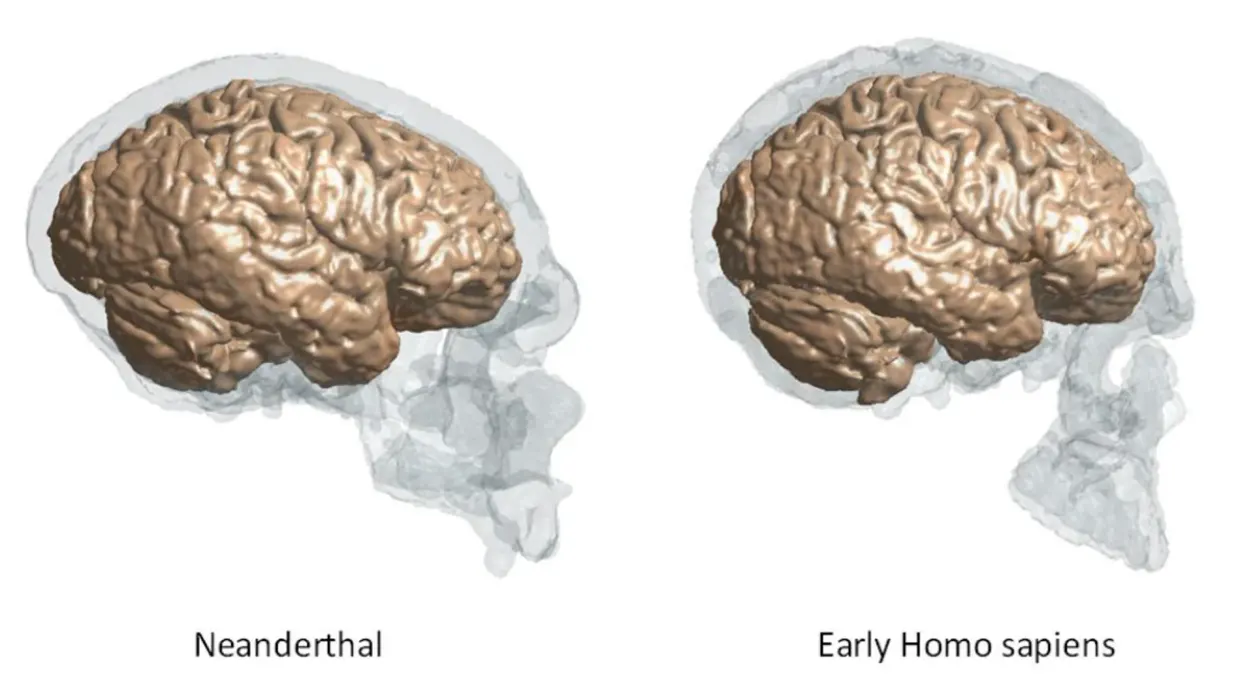
A study in Proceedings of the National Academy of Sciences, led by Hugo Zeberg of the Karolinska Institute (Sweden) and Svante Pääbo of the Max Planck Institute for Evolutionary Anthropology (Germany), identified a small genetic variant inherited from Neanderthals, according to larazon.es. The variant is associated with the volume of the occipital lobe and with a lower risk of schizophrenia larazon.es
larazon.eslarazon.esOpen source ↗. It is a deletion of four DNA letters on chromosome 14.
The starting point was a known anatomical difference: Neanderthal skulls were generally more elongated and less globular than those of modern humans, which suggests a different distribution of brain tissue. One region that could explain part of the difference is the occipital lobe at the back of the brain, which contains the visual cortex.
How the variant was identified
The team analyzed data from the 1000 Genomes Project and compared them with ancient genomes. The variant occurs in present-day populations outside sub-Saharan Africa, mainly in Europe and Asia, and was not found in the two high-quality Denisovan genomes analyzed. The length of the DNA fragment that accompanies it makes it unlikely to have survived intact from the common ancestor of Neanderthals and modern humans, so it fits inheritance from interbreeding.
To link the sequence to the brain, the authors used genetic association studies that combine DNA data with brain imaging, in a database of about 4,000 MRI-derived features. The strongest association was with the volume of the cuneus, a structure on the inner side of the occipital lobe involved in visual processing larazon.es
larazon.eslarazon.esOpen source ↗.
Effect size and schizophrenia
For the lobe as a whole, carriers had about 0.85 cubic centimeters less volume per inherited copy, and those with two copies about 1.7 cubic centimeters less. The calculations accounted for total cranial cavity or head size, so this is a difference in the relative volume of one region, about 0.1% in total.
The variant lies near the DAAM1 gene, which is involved in brain development and cytoskeleton organization. It does not alter the encoded protein; its effect is probably regulatory, since it sits in a DNA region with transcription factor signals. The authors found modest changes in DAAM1 expression in some tissues but cannot yet attribute the effect to a single modification or reconstruct the full mechanism.
The association with schizophrenia was about 5% lower odds per copy and close to 10% with two copies. This is a relative reduction, not ten percentage points of absolute risk, and carrying the variant does not guarantee protection larazon.es
larazon.eslarazon.esOpen source ↗. No significant association with general intelligence was found, and the link to educational attainment was so small that, at the upper limit of the estimate, it equals about thirteen fewer days of schooling per copy.
One paradox remains: anatomical reconstructions suggest Neanderthals had relatively larger occipital lobes, yet the variant they passed on is associated with a smaller volume today. Brain shape is a complex trait shaped by many genes and by features such as eye and body size, so a single sequence cannot explain differences between two species.