KIMS developed nanocomposite aerogel that speeds composite induction welding by 94.6%
A powdered CNT/Fe3O4/PA6 interlayer combines Joule heating and magnetic losses, increasing weld strength by 30.8% in laboratory tests.
Researchers from the Korea Institute of Materials Science (KIMS) and Oak Ridge National Laboratory developed a powdered nanocomposite aerogel interlayer for induction welding of carbon fiber-reinforced thermoplastic composites (CFRTPs). According to a study published in Advanced Composites and Hybrid Materials, the material accelerated the initial interfacial heating rate to 148.7 °C·s⁻¹, representing a 94.6% improvement over unmodified composite joints springer.com
Advanced Composites and Hybrid Materialsspringer.comOpen source ↗. The system also reduced the time needed to reach the target joining temperature by 57% while increasing interfacial shear strength by 30.8%.
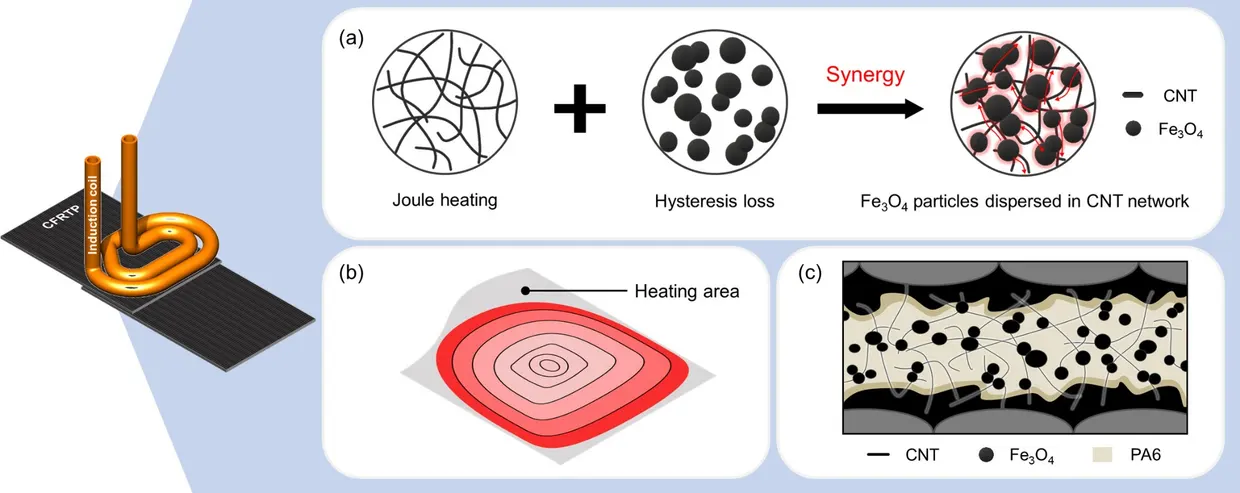
Induction welding offers rapid, non-contact heating for composite structures, but uneven magnetic fields and complex conduction paths within carbon fiber networks frequently cause local overheating or incomplete interfacial melting. To resolve these spatial gradients, the researchers synthesized a porous aerogel combining carbon nanotubes (CNTs), magnetite (Fe3O4) nanoparticles, and polyamide 6 (PA6). The mixture was freeze-dried to prevent the dense iron oxide particles from agglomerating, and the resulting aerogel was ground into a powder to be applied directly at the joint interface.
Synergistic heating mechanisms
The nanocomposite combines two distinct heat-generation modes under an alternating electromagnetic field. The embedded carbon nanotubes establish continuous conductive pathways that facilitate electrical conduction and Joule heating across the joint line. Simultaneously, the dispersed Fe3O4 nanoparticles act as distributed heat sources driven by magnetic loss mechanisms. This dual effect prevents localized thermal runaway while accelerating bulk temperature rise, allowing the PA6 matrix to melt and flow smoothly.
Mechanical bridging and interfacial strength
Microstructural and fracture-surface evaluations demonstrated improved polymer melting and more thorough interfacial impregnation across the weld zone. Beyond their electrical role, the carbon nanotubes functioned as mechanical nanoscale pins bridging the adjacent CFRTP substrates, directly contributing to the 30.8% increase in interfacial shear strength springer.com
Advanced Composites and Hybrid Materialsspringer.comOpen source ↗. The team demonstrated that tuning the constituent ratios yielded optimal thermal and mechanical performance for rapid composite bonding.