CNR Nanotec perovskite polariton circuit lases and shifts phase at room temperature under laser pumping
Italian researchers grew a perovskite polariton circuit in one crystallization step; it lases and amplifies light at room temperature, but only under external femtosecond laser pumping.
Researchers at CNR Nanotec in Lecce, Italy, grew cesium lead bromide (CsPbBr3) waveguide circuits that lase, amplify light and shift its phase at room temperature in a single crystallization step, according to a paper on nature.com published on November 18 nature.com
nature.comnature.comOpen source ↗. The paper is titled "Fully integrated perovskite active polaritonic circuits"; Antonio Fieramosca is the first author and Daniele Sanvitto the last. All results were obtained under femtosecond laser pumping.
Circuit and growth method
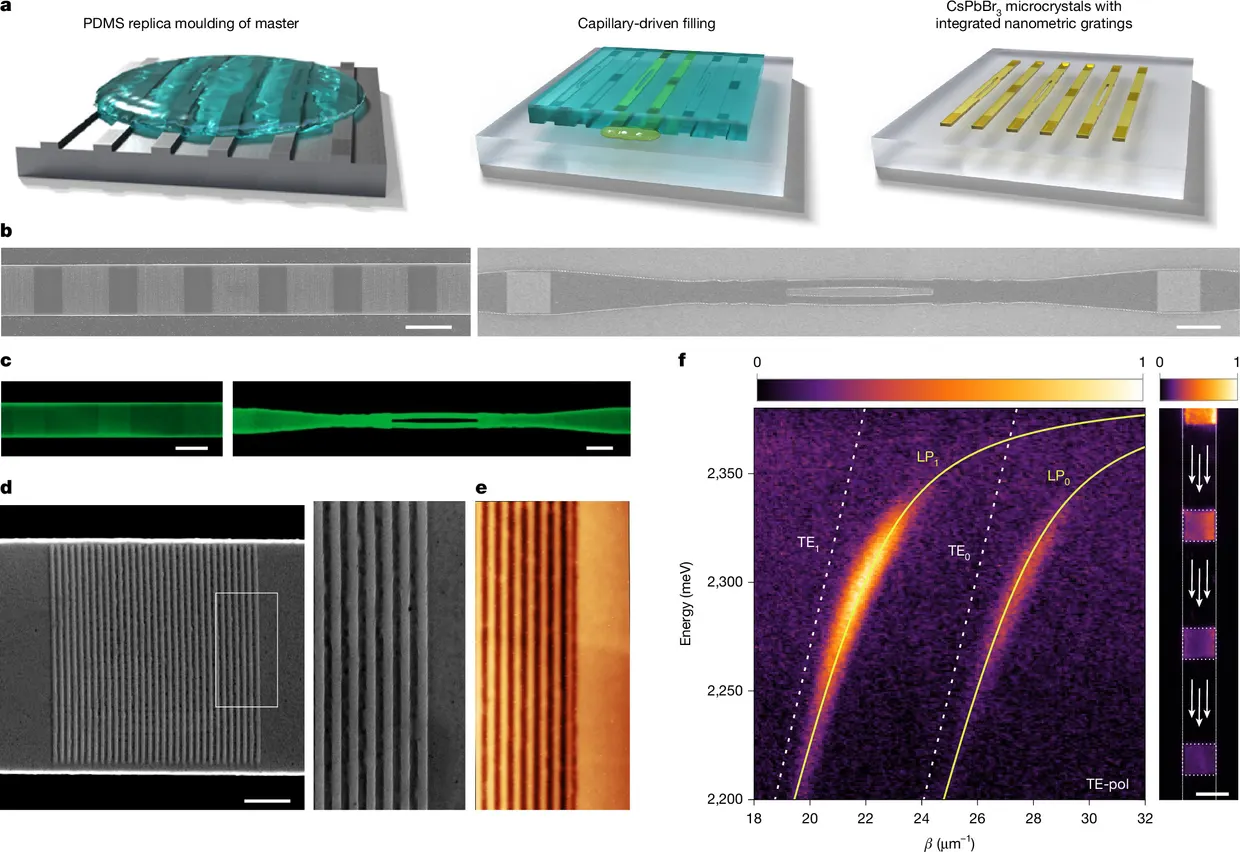
The waveguides are hundreds of micrometres long and micrometre-scale in width. Their thickness, 250 to 290 nm, is inferred from simulations. Gratings grown from the same crystal act as couplers and reflectors and form in-plane Fabry–Pérot cavities along each waveguide.
The circuits are made by bottom-up soft lithography that combines surface-tension-assisted and microfluidic growth. A silicon master, patterned by electron-beam lithography and reactive ion etching, is replicated in a PDMS mould. The mould shapes a 0.42 molar solution of CsBr and PbBr2 in dimethyl sulfoxide, diluted to 0.05–0.1 molar, as it crystallizes. Crystallization was optimized with temperature ramps from 4 °C to room temperature under controlled vapour saturation. The authors say that growing the finished circuit this way avoids post-processing damage and refractive-index mismatches.
Measured functions and limits
Under off-resonant pumping, the gratings provide longitudinal feedback. The authors report polariton lasing with coherent guided emission at a wavelength defined by the grating geometry nature.com
nature.comnature.comOpen source ↗. Amplification was shown in a two-beam experiment: a resonantly injected propagating polariton wavepacket was amplified by stimulation from an exciton reservoir created by an additional off-resonant beam. The authors also report nonlinear optical phase control exceeding π in the same on-chip architecture.
For comparison, the authors say GaAs and ZnO polariton platforms require cryogenic operation and epitaxial growth. They also note that a room-temperature GaN waveguide polariton laser exists, but its lasing mode stays inside the reflective elements instead of coupling efficiently into a propagating waveguide mode.
The perovskite waveguides generate gain themselves, but the pump lasers are external femtosecond systems. The paper demonstrates no logic gates, so the work shows how to integrate the parts of an optical chip, not yet how to compute with them.