Tutankhamen's iron dagger scanned in Cairo: 11.8 wt% nickel, forged below 950 °C, authors report
Authors of a nondestructive analysis of the dagger in the Egyptian Museum of Cairo link its blade to an octahedrite meteorite. Another researcher disputes this interpretation.
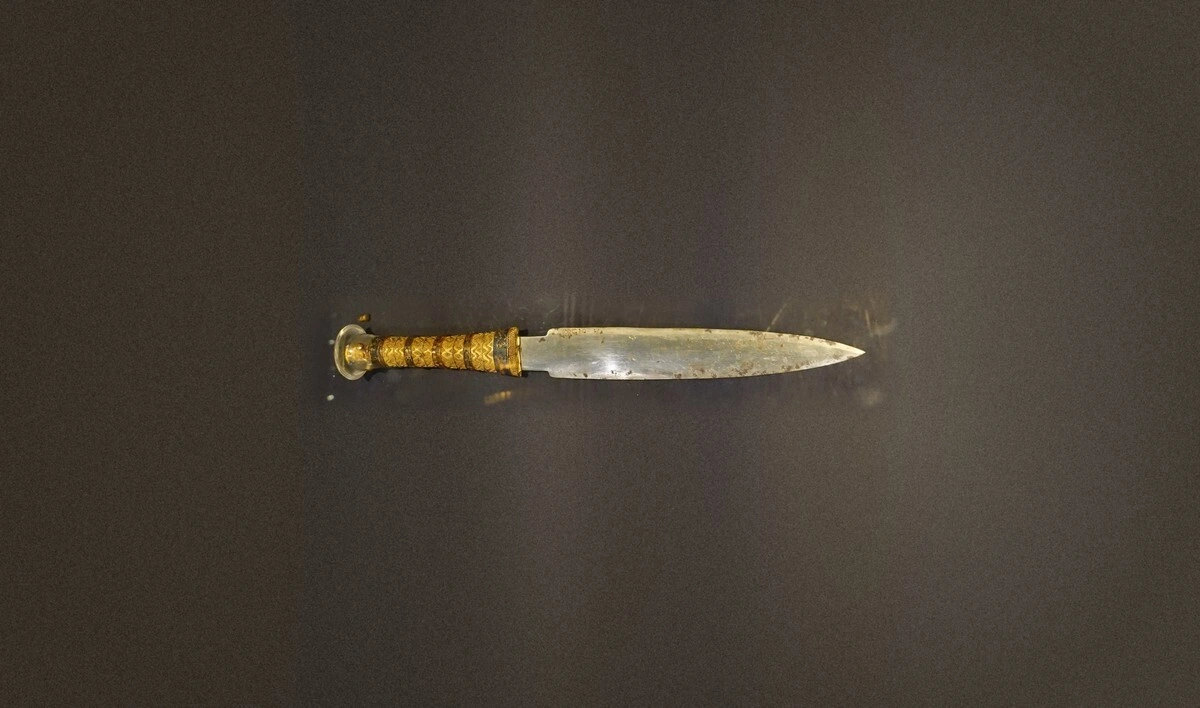
A research team reported nondestructive two-dimensional chemical analyses of the iron dagger of King Tutankhamen (1361–1352 B.C.), carried out at the Egyptian Museum of Cairo and published in Meteoritics and Planetary Science. Howard Carter found the dagger in 1925 among the linen wrappings of the mummy. The nickel content of the metallic areas of the blade averaged 11.8 ± 0.5 wt% wiley.com
Meteoritics and Planetary Sciencewiley.comOpen source ↗.
Meteoritic iron and earlier measurements
Tutankhamen reigned in the late Bronze Age. Widespread use of smelted iron in the eastern Mediterranean began only after about 1200 B.C.
A 2016 study used portable X-ray fluorescence at two spots on the blade, calibrated with eleven iron meteorites and eleven certified steel samples. It measured 10.8 ± 0.3 wt% nickel and 0.58 ± 0.04 wt% cobalt, a nickel-to-cobalt ratio of about 20. The authors considered a meteoritic origin well supported but could not identify a specific meteorite or chemical group.
The later study mapped both sides of the blade point by point. The nickel maps show discontinuous bands about 1 mm wide, in places with cubic symmetry. The authors interpret them as a Widmanstätten pattern. Together with the intermediate nickel content, they assign the source meteorite to the octahedrites wiley.com
Meteoritics and Planetary Sciencewiley.comOpen source ↗.
Forging temperature and the gold hilt
Randomly distributed black spots on the blade are rich in sulfur. According to the authors, they are likely remnants of troilite (FeS) inclusions of the iron meteorite. From the preserved pattern and the remnant troilite, they conclude that the dagger was forged at low temperature, below 950 °C. In their interpretation, the working temperature reached at least about 700 °C.
The gold hilt contains a few percent of calcium and no sulfur. Calcium was 3.3% and 1.7% at two points of the hilt and below 0.5% on the scabbard. The authors take this as a sign that lime plaster, not gypsum plaster, was used as the adhesive for the hilt decorations. Lime plaster came into use in Egypt in the Ptolemaic period (305–30 B.C.), so they suggest a foreign origin of the hilt, possibly from Mitanni in Anatolia. One of the Amarna letters mentions an iron dagger with a gold hilt gifted by the king of Mitanni to Amenhotep III, the grandfather of Tutankhamen.
The interpretation is disputed. In a December 2022 comment, geochemist Albert Jambon pointed to the lack of reference samples for the mapping. The measurement points were 0.9 mm apart, while the excited area exceeded 1 mm. For 11.8% nickel he expected much finer bands of about 0.1–0.2 mm. He did not dispute the meteoritic origin of the iron shown by the 2016 study. His objections concern the octahedrite assignment and the derived forging temperature.