Sun Yat-sen University maps oxygen content and superconductivity in La3Ni2O7+δ nickelate crystals under pressure
Six samples with oxygen from La3Ni2O6.66 to La3Ni2O7.08 link each transition, at about 84, 71 and 5 K, to a specific structural phase. The result clarifies scattered nickelate data.
Researchers led by Sun Yat-sen University, together with the China Spallation Neutron Source, the Institut Laue-Langevin and ISIS, mapped how oxygen content sets superconductivity in the bilayer nickelate La3Ni2O7+δ, according to eurekalert.org. They synthesized six compositions with averaged oxygen from La3Ni2O6.66 to La3Ni2O7.08, that is δ from −0.34 to +0.08. The work was published in The Innovation Physics in 2026. eurekalert.org
eurekalert.orgeurekalert.orgOpen source ↗
The nickelate was announced as a superconductor in 2023. Since then the experimental record has stayed inconsistent: batches differ in oxygen content, and crystals contain intergrown Ruddlesden–Popper phases, including bilayer, monolayer-bilayer hybrid and trilayer insertions.
Oxygen content and microstructure
The team determined stoichiometry with X-ray absorption spectroscopy and thermogravimetric analysis. Microstructure was studied with neutron and synchrotron diffraction and electron microscopy.
The most oxygen-poor sample, O6.66, remained insulating under pressure up to 37.6 gigapascals. Near O6.86 bilayer and monolayer-bilayer phases coexisted. Near O6.95 the material was almost purely bilayer. In oxygen-rich samples mixed structure returned, and trilayer intergrowths made up more than half of the material at O7.08. eurekalert.org
eurekalert.orgeurekalert.orgOpen source ↗
Transitions under pressure
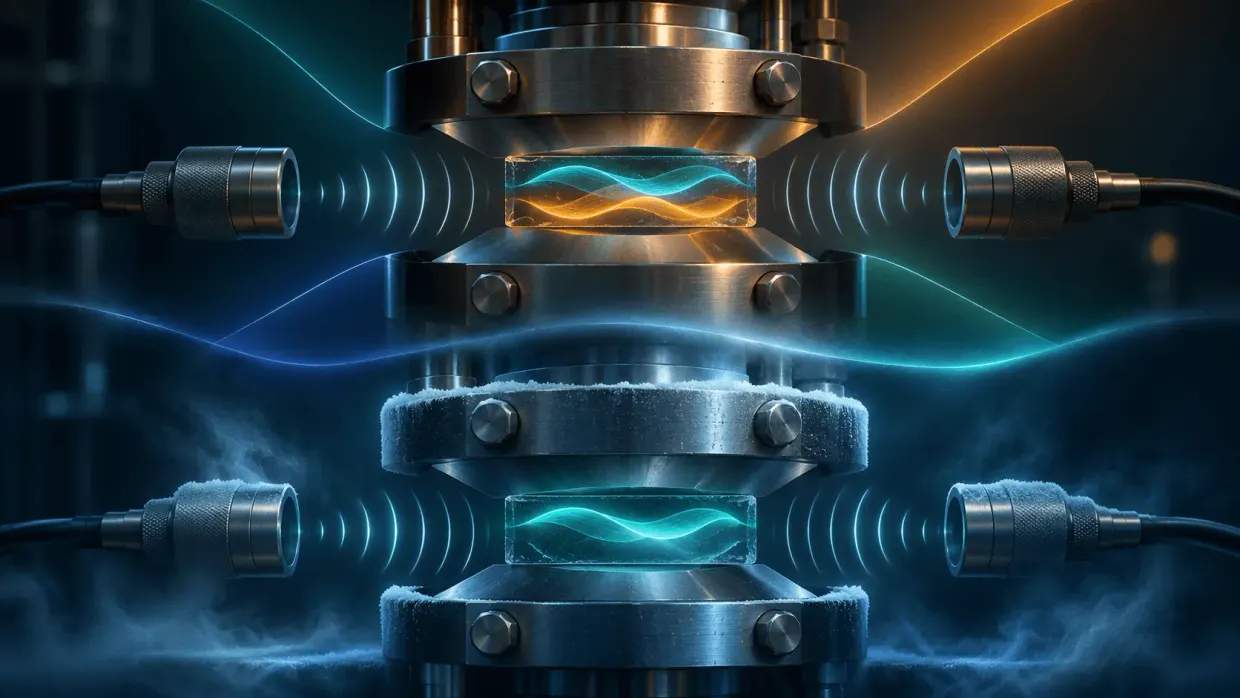
Transport measurements at 25.5 gigapascals separated the contributions of the phases. The bilayer phase became superconducting near 84 K, in line with pressurized single crystals. The monolayer-bilayer hybrid showed a separate transition near 71 K, and trilayer inclusions superconducted only around 5 K.
Phase purity also affected the upper critical field: cleaner bilayer samples showed a higher value. Samples with the same nominal formula can therefore behave differently because of oxygen-driven microstructure.
The authors plotted transition temperature and upper critical field against oxygen content and built a phase diagram. It separates superconducting from non-superconducting regions and assigns each transition to a phase. According to the study, scattered literature values for La3Ni2O7+δ plausibly reflect differing oxygen stoichiometry and phase fractions rather than irreproducible physics. eurekalert.org
eurekalert.orgeurekalert.orgOpen source ↗
The authors write that the work "advances synthetic control and provides new insights into the superconducting mechanism" of Ruddlesden–Popper nickelates. The diagram indicates where the pure bilayer window lies for crystal growers and gives theorists defined endpoint compositions for testing models of the pairing mechanism.