Heliene and Caelux start commercial production of perovskite-glass and silicon tandem solar modules
The US companies say their Hybrid-Tandem modules reach 27% efficiency or more and yield up to 20% more energy than some N-type silicon modules. Production is under way in Minnesota.
Heliene and Caelux, two US companies, announced on 10 November 2026 the start of commercial production of Hybrid-Tandem photovoltaic modules, according to ecoinventos.com ecoinventos.com
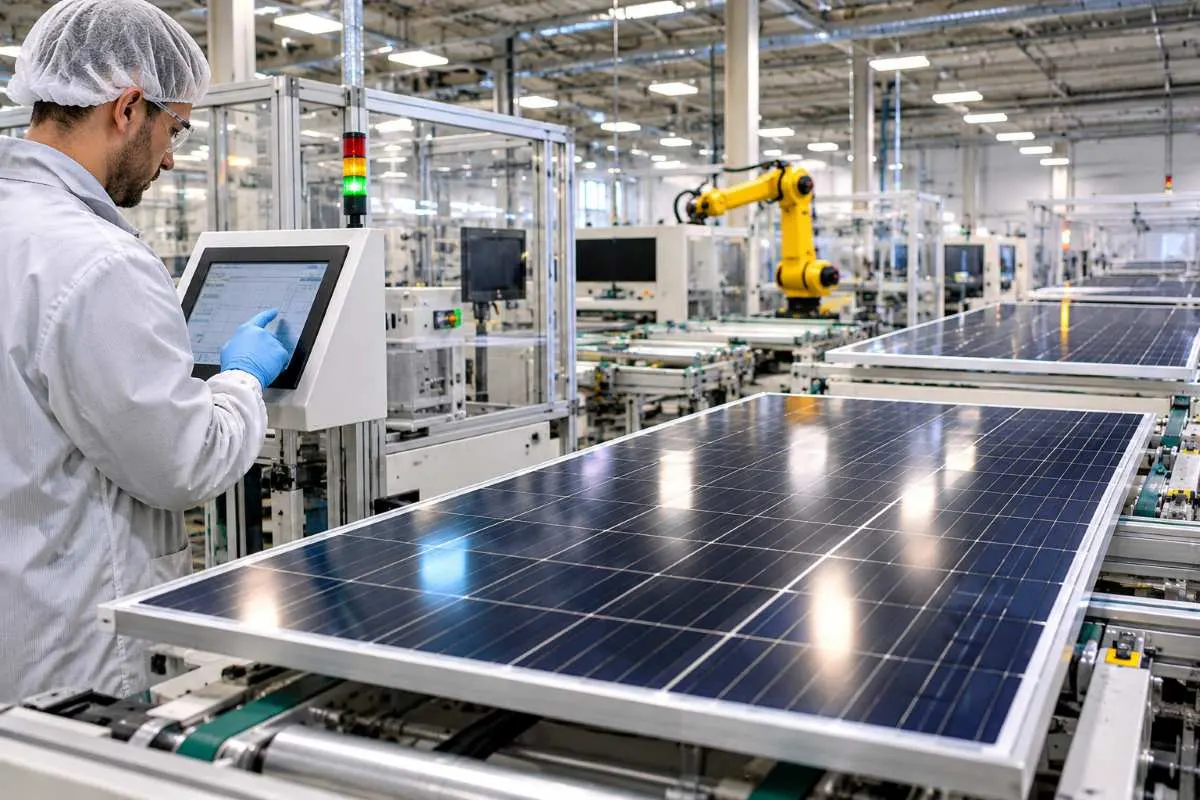
ecoinventos.comecoinventos.comOpen source ↗. The modules combine silicon cells with a glass sheet carrying a perovskite layer that also generates electricity. The companies say production is under way in Mountain Iron, Minnesota, and the first industrial order is being manufactured.
According to the manufacturers, conversion efficiency is 27% or higher, and the modules can produce up to 20% more energy than certain conventional N-type silicon modules. The gain depends on the reference panel, the installation and operating conditions.
Architecture: perovskite glass over silicon
Caelux does not replace the silicon cells. It supplies glass with a perovskite film that adds a second generating layer on top of them. Tandem cells use materials with different band gaps to capture different parts of the solar spectrum, which reduces losses that occur when a single semiconductor must process all the radiation.
The design is a four-terminal (4T) tandem. The perovskite layer and the silicon cells have independent electrical circuits, each with its own positive and negative contacts, so their output is managed separately. This differs from monolithic two-terminal tandems, where the materials share one electrical structure. The independence of the layers makes it easier to combine the glass with different silicon technologies and avoids restrictions tied to series connection of subcells. It also allows the perovskite glass to be made separately and added during module assembly.
Production and schedule
The glass, called Energy Producing Glass, is made at Caelux's facility in Baldwin Park, California, while the modules are assembled in Minnesota ecoinventos.com
ecoinventos.comecoinventos.comOpen source ↗. Heliene says the component can be fitted into its existing assembly lines without building entirely new infrastructure. The companies also announced a multi-year agreement of several gigawatts to market the technology, but have not publicly given a full annual production schedule.
The first modules are to be shown at the RE+ trade show in Las Vegas, scheduled for 17–19 November 2026, and first commercial deliveries are planned for 2027. The companies have set a roadmap to module efficiencies above 29% in 2028. This is a development target, not performance demonstrated in commercial production.
Efficiency, nominal power and annual energy yield are related but not equivalent quantities. Long-term performance under ultraviolet radiation, humidity, heat and thermal cycling remains a condition for commercial viability, and perovskites have known stability challenges.