Study of 110,000 Shenzhen residents: short tracking windows exaggerate exposure inequality
Researchers analysed a year of anonymized mobile signaling data. Tracks lasting days or weeks inflated differences in greenspace and air pollution exposure between people.
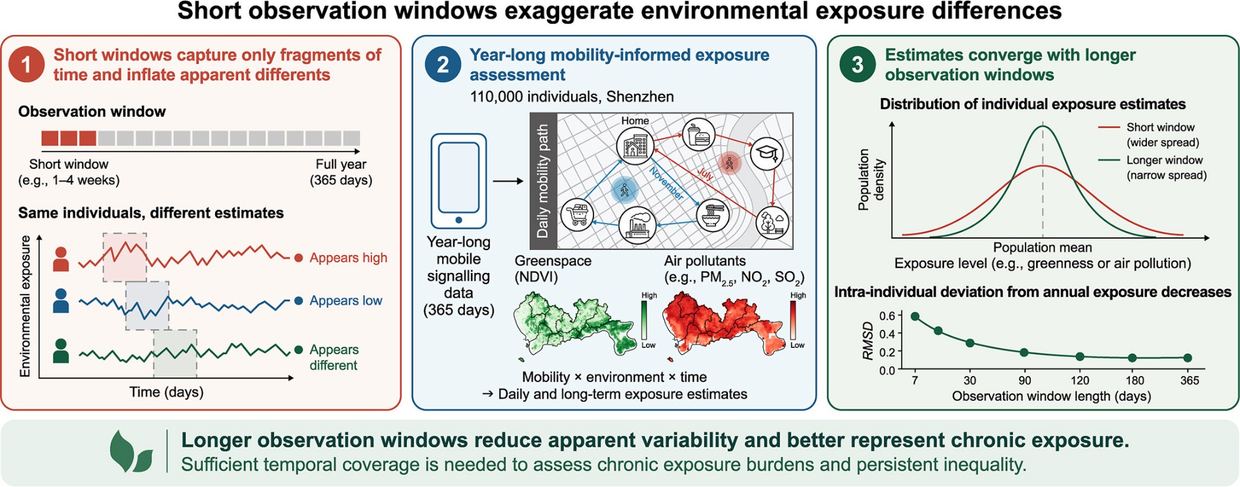
Researchers from Hong Kong University of Science and Technology (Guangzhou), The Chinese University of Hong Kong, Tongji University and Peking University Shenzhen Graduate School have shown that short observation windows exaggerate differences in environmental exposure between people. The study, published in 2026 in Environmental Science and Ecotechnology, used anonymized mobile signaling records of 110,000 Shenzhen residents from March 2023 to February 2024 doi.org
Environmental Science and Ecotechnologydoi.orgOpen source ↗. The authors call this bias the temporal exposure averaging problem (TEAP).
Many exposure studies rely on GPS or mobile signaling tracks lasting days or weeks and treat them as representative of long-term conditions. Environmental exposure varies across weekdays, weekends, seasons and weather, so a short window captures only part of that variation doi.org
Environmental Science and Ecotechnologydoi.orgOpen source ↗.
Data and sampling design
The team mapped residents' locations to 250 m or 500 m grid cells. The environmental layers were the monthly normalized difference vegetation index (NDVI) for greenspace, fine particulate matter, sulfur dioxide, carbon monoxide and nitrogen dioxide. The researchers compared monthly mobility-based exposure with year-long exposure. They also randomly sampled from one to 12 months, repeating each window length 100 times doi.org
Environmental Science and Ecotechnologydoi.orgOpen source ↗.
What the comparison showed
Monthly coefficients of variation consistently exceeded annual ones. People with low monthly exposure tended to have higher annual exposure, and vice versa, a compression toward the mean in both directions doi.org
Environmental Science and Ecotechnologydoi.orgOpen source ↗.
Both the deviation of each person's estimate from their own annual value (root mean squared deviation) and the variability between people (standard deviation and coefficient of variation) fell as the window grew. Both converged toward the full-year values. The pattern held across age and gender groups. It was weakest among middle-aged adults and stronger among younger and older groups and among women doi.org
Environmental Science and Ecotechnologydoi.orgOpen source ↗.
Seasonally stratified four-month sampling gave results nearly identical to unrestricted four-month sampling. The authors suggest that extending the observation period matters more than choosing nominally representative months.
Implications for assessment
The authors said TEAP is a structural bias, not random measurement noise, and that short windows can make environmental disparities look sharper than they are. They said long-term averages suit questions about chronic burden and persistent inequality, while high-frequency data suit acute peaks and sensitive periods.
The authors propose a tolerance-based approach for setting minimum observation windows. When full-year data are unavailable, they call for model-based temporal extrapolation, adaptive sampling and bias-correction methods.
Sources · 2
Found a mistake?Read also