JWST NEXUS survey finds AT 2026abck, a luminous young transient at z=5.017
AT 2026abck in a star-forming galaxy is the first robustly detected transient at z≳5 in a non-lensing field; a core-collapse supernova origin is favored.
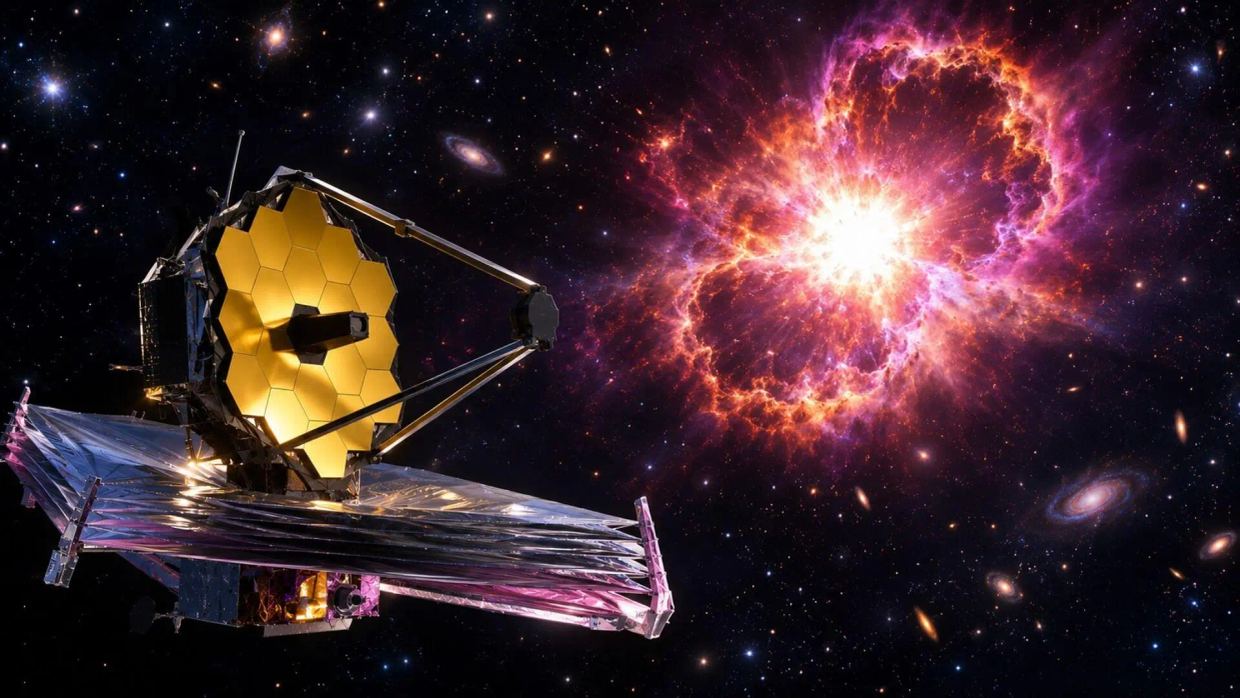
Ming-Yang Zhuang and colleagues report on arXiv (Cornell University) the discovery of AT 2026abck, a young transient in a star-forming galaxy at z=5.017±0.001. It was identified in Year-2 observations of the NEXUS JWST treasury program. The source was detected on 2026 Aug 7 in NIRCam F200W imaging, with a contemporaneous detection in parallel NIRCam F150W+F277W imaging doi.org
arXiv (Cornell University)doi.orgOpen source ↗.
Brightness and photosphere
According to the authors, AT 2026abck brightened by more than 1.4 mag in F200W over no more than about 12 rest-frame days, as inferred from the last non-detection. Its magnitudes in F150W, F200W and F277W are nearly identical, about 27.4 mag. The source is undetected in F444W (>27.9 mag, 3σ) doi.org
arXiv (Cornell University)doi.orgOpen source ↗. The authors call it the first robustly detected transient at z≳5 in a non-lensing field.
A blackbody fit gives a hot photosphere of about 1.7×10^4 K, a radius of about 7×10^14 cm (about 46 au) and a bolometric luminosity of about 3×10^43 erg s^-1 doi.org
arXiv (Cornell University)doi.orgOpen source ↗.
The authors estimate that the transient was detected about 4–10 rest-frame days after explosion. Rest-frame time describes the phase of the event in its own galaxy, not the time elapsed on Earth since the explosion: the light has been travelling for billions of years.
Origin and host galaxy
The off-nucleus location and the hot, UV-bright spectral energy distribution favor a core-collapse supernova origin. At the same time, the temperature and luminosity exceed those of normal SNe II at comparable early phases doi.org
arXiv (Cornell University)doi.orgOpen source ↗. The nature of the source is not confirmed.
The host is an intermediate-mass galaxy with M*≈10^9.8 M☉ and a star-formation rate of about 20 M☉ yr^-1, lying on the z≈5 main sequence. It is about 3.3 dex more massive than the ultra-faint host of the lensed supernova SN Eos at z=5.13 doi.org
arXiv (Cornell University)doi.orgOpen source ↗.
Taken together, the two events show, in the authors' words, that core-collapse supernovae at z>5 occur across a wide range of host environments. The authors also conclude that high-cadence blank-field JWST surveys can capture high-redshift supernovae during their early, UV-bright phase doi.org
arXiv (Cornell University)doi.orgOpen source ↗.