Alteromonas bacteria amplify virus-induced mortality of Gephyrocapsa huxleyi algae in lab co-cultures
In cultures, antibiotic treatment cut virus-induced algal mortality up to 19-fold, pointing to bacteria as an additional cause of bloom collapse.
A team of researchers reported in Nature that bacteria significantly enhance virus-induced mortality of the coccolithophore Gephyrocapsa huxleyi (formerly Emiliania huxleyi). The work used a synthetic community of the alga, bacteria and viruses isolated during a bloom. The authors also saw the effect in three other widespread microalgae doi.org
Naturedoi.orgOpen source ↗.
The starting point was a discrepancy: blooms collapse synchronously, yet fewer than 30% of algal cells are actively infected by viruses during the collapse. This suggested that other mortality agents act together with the virus doi.org
Naturedoi.orgOpen source ↗.
Antibiotic experiments in xenic cultures
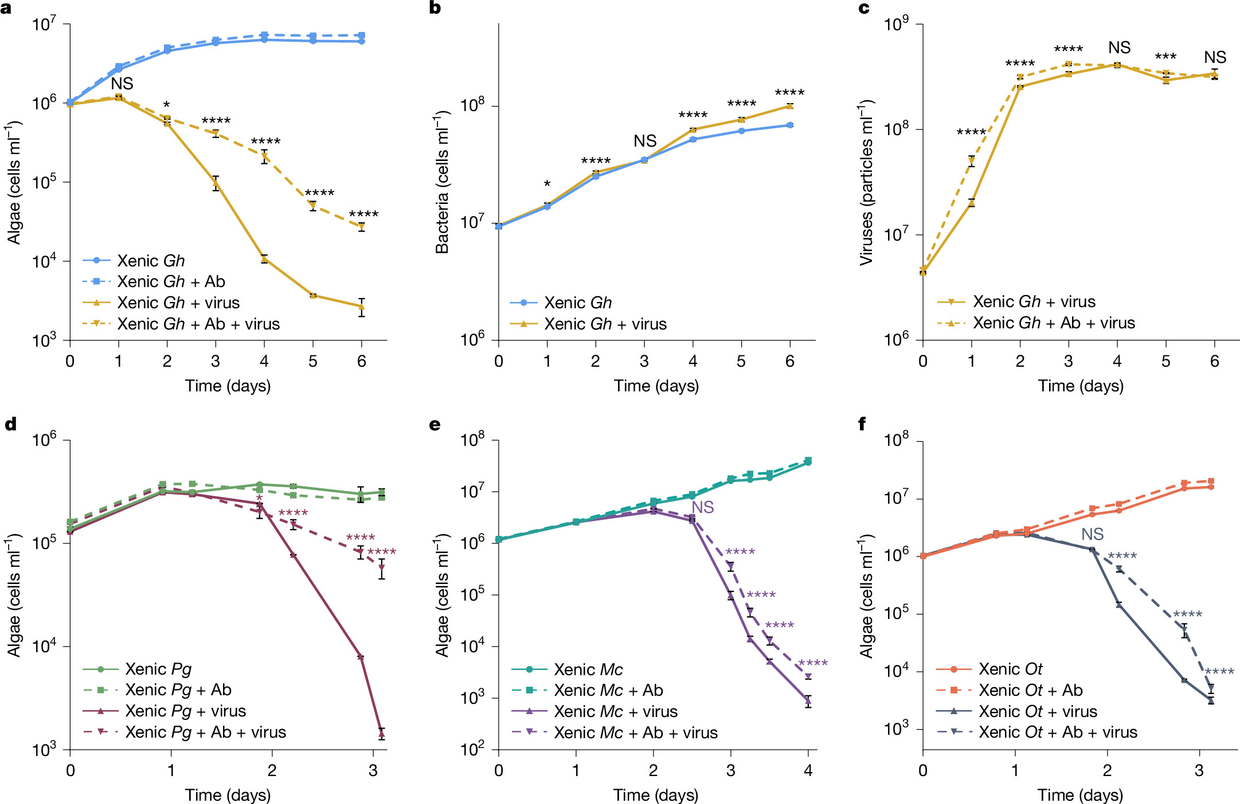
The authors used a xenic G. huxleyi strain isolated from a bloom in a mesocosm experiment near Bergen, Norway. Without viral infection, antibiotic-treated cultures grew up to 1.2-fold better, which the authors read as a competitive relationship between the alga and its associated bacteria doi.org
Naturedoi.orgOpen source ↗.
Infection with the Emiliania huxleyi virus (EhV) caused population decline from day 1. When antibiotics reduced the algal microbiome, mortality fell by up to 19-fold compared with untreated infected cultures (P < 0.05 from day 2) doi.org
Naturedoi.orgOpen source ↗.
Bacteria reached 1.5-fold higher abundance in virus-infected cultures than in uninfected ones, from day 4. Viral production differed between treated and untreated cultures during the days of viral release, but total viral abundance leveled off at similar values doi.org
Naturedoi.orgOpen source ↗.
Other algae and the role of Alteromonas
Antibiotics also attenuated virus-induced mortality in Phaeocystis globosa, Micromonas commoda and Ostreococcus tauri. The exception was O. tauri infected with a specialist virus, where antibiotics did not reduce mortality; the authors suggest rapid recovery of a resistant population as a possible reason doi.org
Naturedoi.orgOpen source ↗.
The team introduced two metrics: a synergy index for the strength of viral–bacterial interaction and a benefit index for changes in bacterial fitness. Alteromonas bacteria showed consistently high values of both and were identified as drivers of co-infection doi.org
Naturedoi.orgOpen source ↗.
According to the authors, Alteromonas displayed strong chemoattraction toward extracts of infected cells, accumulated in aggregates derived from bloom demise, and increased in abundance during the collapse of an oceanic bloom doi.org
Naturedoi.orgOpen source ↗.
The authors describe viral–bacterial synergy as a previously unrecognized mortality agent in bloom termination. They link it to the balance between the viral shunt, which recycles carbon in the surface ocean, and the viral shuttle, which exports carbon through sinking aggregates doi.org
Naturedoi.orgOpen source ↗.