NASA's Voyager 1 nears one light-day from Earth, over 16 billion miles, 49 years after launch
Voyager 1 will become the first spacecraft whose radio signal takes 24 hours to reach Earth. It still returns science data on interstellar space, though contact was briefly lost in October.
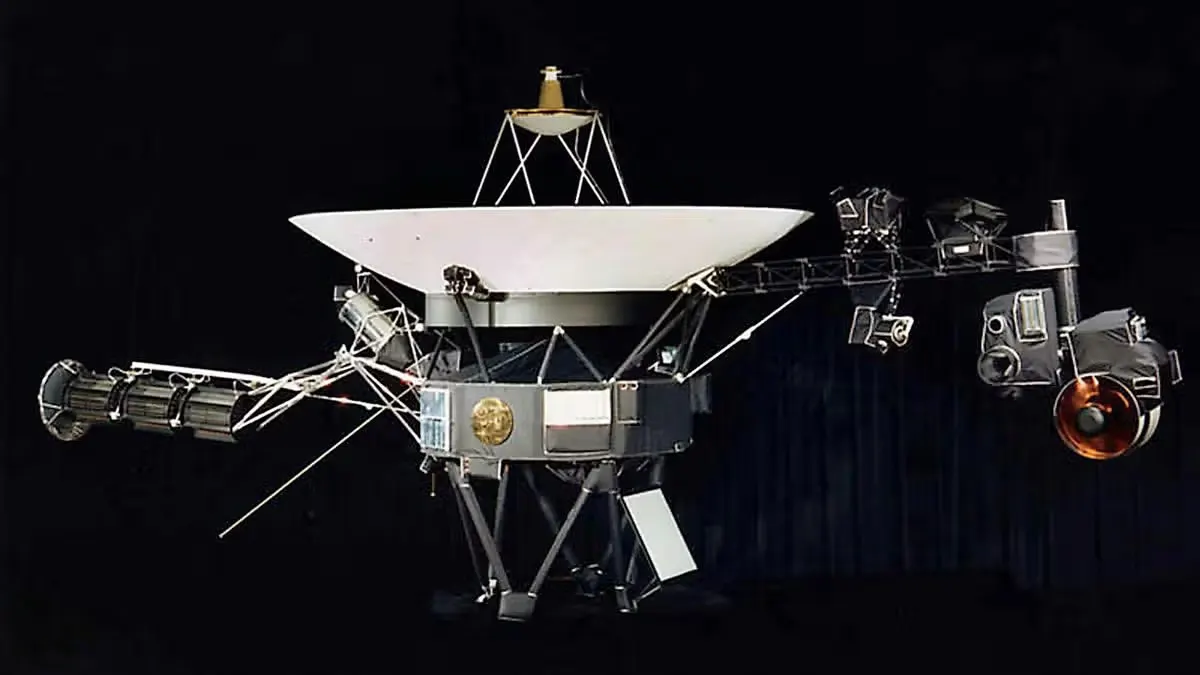
NASA's Voyager 1 is about to become the first spacecraft to reach one light-day from Earth, mirror.co.uk reports. When the probe reaches this mark on Wednesday, its radio signals will need 24 hours at the speed of light to reach Earth. By then it will have travelled more than 16 billion miles since its launch in 1977 mirror.co.uk
mirror.co.ukmirror.co.ukOpen source ↗.
NASA estimates that Voyager 1 needs another 18,000 years to cover a full light-year, and more than double that to come near another star. The probe moves at 38,000 mph. Voyager 2, launched two weeks later, will not reach the one light-day mark until 2035.
Distance and trajectory
Voyager 1 flew past Jupiter in 1979 and Saturn in 1980, then left the solar system. It reached what NASA defines as interstellar space, the region between star systems, in 2012. Voyager 2 visited Jupiter, Saturn, Uranus and Neptune and entered interstellar space in 2018.
In 1990 Voyager 1 took the most distant picture of Earth, the "Pale Blue Dot", from beyond Neptune. Each Voyager carries a 12-inch gold-plated phonographic record with greetings in 55 languages, as well as images and diagrams.
Operations and data
Both probes still send back science and engineering data almost every day. They report the strength and direction of the magnetic field, the surrounding pressure, dust and galactic cosmic rays. The flight control team at NASA's Jet Propulsion Laboratory in Pasadena, California, sends commands about once a week.
Project manager Suzanne Dodd, who has worked with the Voyagers since 1984, said the probes continue to operate despite sporadic problems typical of age. In September controllers completed the latest power-conserving effort for the plutonium-powered spacecraft. In October they briefly lost contact with Voyager 1 and are still trying to determine why communication was disrupted.
To mark the milestone, NASA asked people to use a phone or flashlight after sunset on Tuesday to spell V-G-R, Voyager's call sign, in Morse code.