Abric Romaní: 640 charcoal fragments from a Neanderthal shelter show two zones of burned wood
Spatial analysis of charcoal from level Ra in Spain found fuel of the Pinus sylvestris type and distinct northern and southern zones, which the authors link to different uses of the shelter.
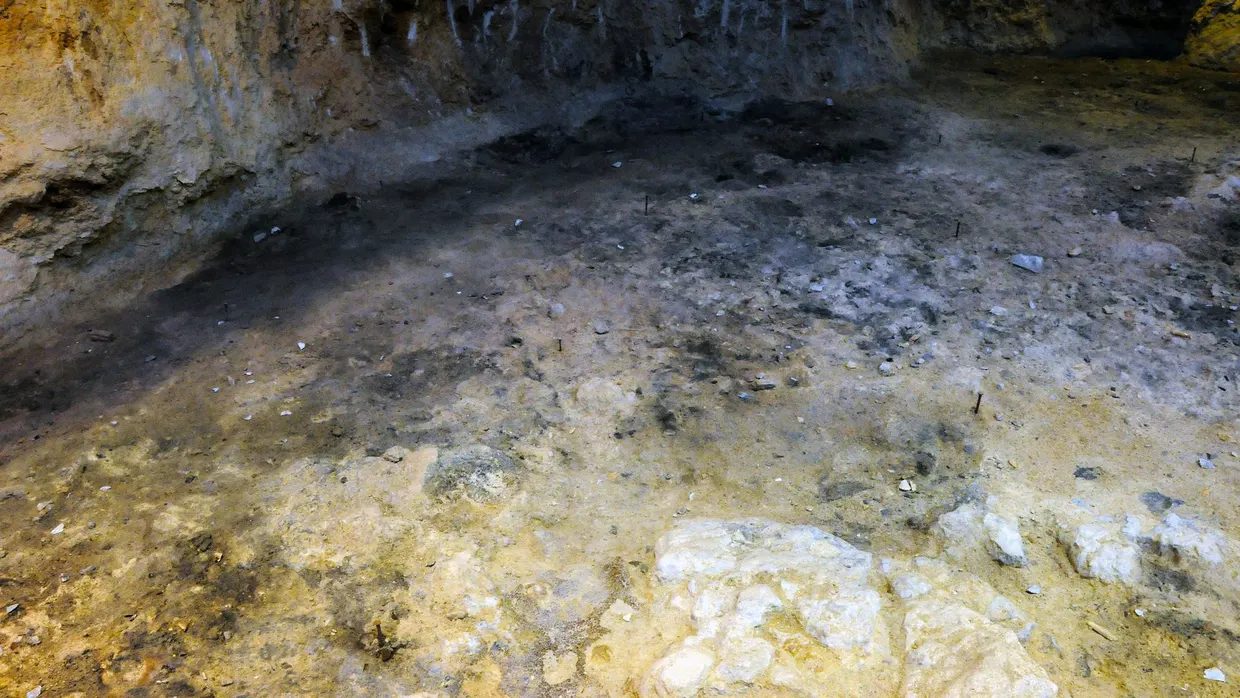
Researchers mapped 640 charcoal fragments from level Ra of Abric Romaní, a Middle Palaeolithic rock shelter in Capellades, north-eastern Spain, that was occupied by Neanderthals. The study was published in the Journal of Paleolithic Archaeology. Excavators picked the fragments by hand from 2019 to 2022 and recorded the position of each piece. The level is placed at the beginning of MIS 3 springer.com
Journal of Paleolithic Archaeologyspringer.comOpen source ↗.
Fuel and the pine forest
Of the fragments, 484 (76 percent) belong to the Pinus sylvestris type, a group of three mountain pines with very similar wood. According to the authors, this indicates that well-established mountain pine forests continued at elevations below their current boundary. Today these pines grow above about 1,970 feet (600 meters).
Compression wood, a growth trait tied to stress and common in branches, was found in 501 fragments. The authors say the occupants most likely burned branches, but more tree-ring work is needed to separate them from trunks. An alteration test on 100 fragments gave a score of 0.55, within the range for rotten wood. The authors read this as deadwood in varying states, though the test covered only that subsample.
The paper cites ethnographic reports of groups of five or six people in temperate climates that used up to 24 pounds (11 kilograms) of wood per day. On this basis the authors think the wood did not travel far. Prunus charcoal, represented by only 17 fragments in the whole sample, clustered in squares R60 and S59. The authors list kindling or extraction of a specific resource as possible reasons.
Spatial pattern and hearth cleaning
The northern sector held 495 fragments and the southern sector 145. Kernel Density Estimation showed the densest squares (U53, T57, T54 and U56) at 68 to 87 fragments per grid unit, beside the wall and on top of hearths. Southern patches reached 51 to 68 fragments per grid unit and overlapped less with hearths. The authors wrote that this pattern "could be explained by discrete hearth-cleaning events" springer.com
Journal of Paleolithic Archaeologyspringer.comOpen source ↗.
Water flowing out of the rock walls left its mark: mineral inclusions were found on 47.6 percent of the fragments. Fungal hyphae appeared in 15.7 percent, proportionally more in the southern sector, together with more mineral alteration. The authors call the southern patches compatible with displacement or maintenance of hearths, but say their position alone is insufficient to demonstrate such processes.
Charcoal also cannot show whether the fires belonged to one stay or several. Bones, stone tools and a geoarchaeological study of the hearths still have to be mapped across the same floor.