Primate-specific DACH1 enhancer raises basal radial glia counts in mice and primate stem cell models
A primate-evolved enhancer of DACH1 drives basal radial glia, cortical progenitors abundant in primates and rare in mice, authors report. Work done in mice and primate stem cells.
Researchers in Taiwan and Japan report in Science Advances that a gene regulatory element that evolved in primates controls how many basal radial glia (bRG) form in the developing neocortex science.org
Science Advancesscience.orgOpen source ↗. bRG are cortical progenitor cells, and an expanded progenitor pool is a defining feature of the primate neocortex. The study combined comparative transcriptomics of developing human and mouse cortex with experiments in primate embryonic stem cells and mouse models.
Comparing developing human and mouse neocortical cells, the authors identified the transcription factor DACH1 as enriched in human neurogenic radial glia. They describe an LHX2-DACH1-miR-215-5p program that regulates bRG production.
DACH1 enhancer and bRG production
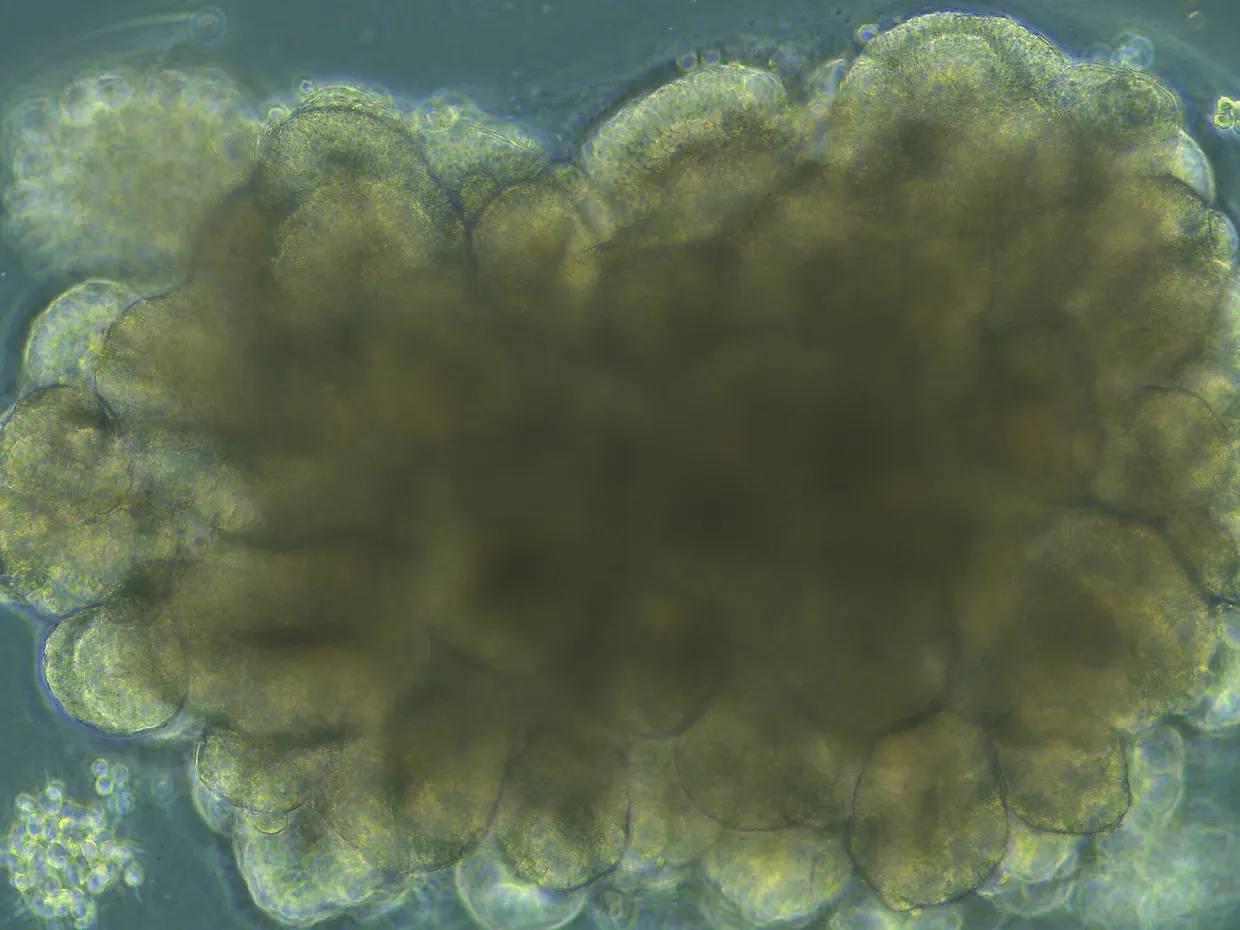
LHX2 regulates DACH1 through an enhancer that evolved in primates, the authors found. Introducing this enhancer into mice promoted bRG generation, while removing it in primates impaired bRG production. In models grown from primate stem cells, deleting the region reduced the number of cells carrying a bRG marker, while other populations of developing brain cells were less affected.
In further experiments, raising DACH1 activity increased the share of daughter cells that became bRG from roughly 4% to almost 15%. Mechanistically, DACH1 promotes bRG generation by suppressing the miR-215-5p-mediated down-regulation of centromere- and centrosome-related genes science.org
Science Advancesscience.orgOpen source ↗.
Effects on neuron types
Loss of DACH1 in human cortical progenitors impaired bRG production and shifted neuronal output toward corticospinal neurons. Depleting Dach1 in mice had no effect. Conversely, ectopic DACH1 expression in the rodent neocortex induced bRG formation and promoted the production of callosal neurons.
The authors conclude that the expansion of cortical progenitors shapes the primate cortical connectome. Development depends on many interacting genes and signals, and a change that increases one kind of stem cell may also affect the timing and organization of later stages. Further studies will need to examine these wider effects and compare additional primate species.
The experiments do not establish a direct explanation for human intelligence, and organoids cannot reproduce a complete living brain.