Meis2 expression in adult interneurons restores memory in autism model mice, Nature study
In Cntnap2-deficient mice, raising Meis2 in hippocampal PV interneurons restored inhibition and memory and reduced seizures. The work was done on mice only.
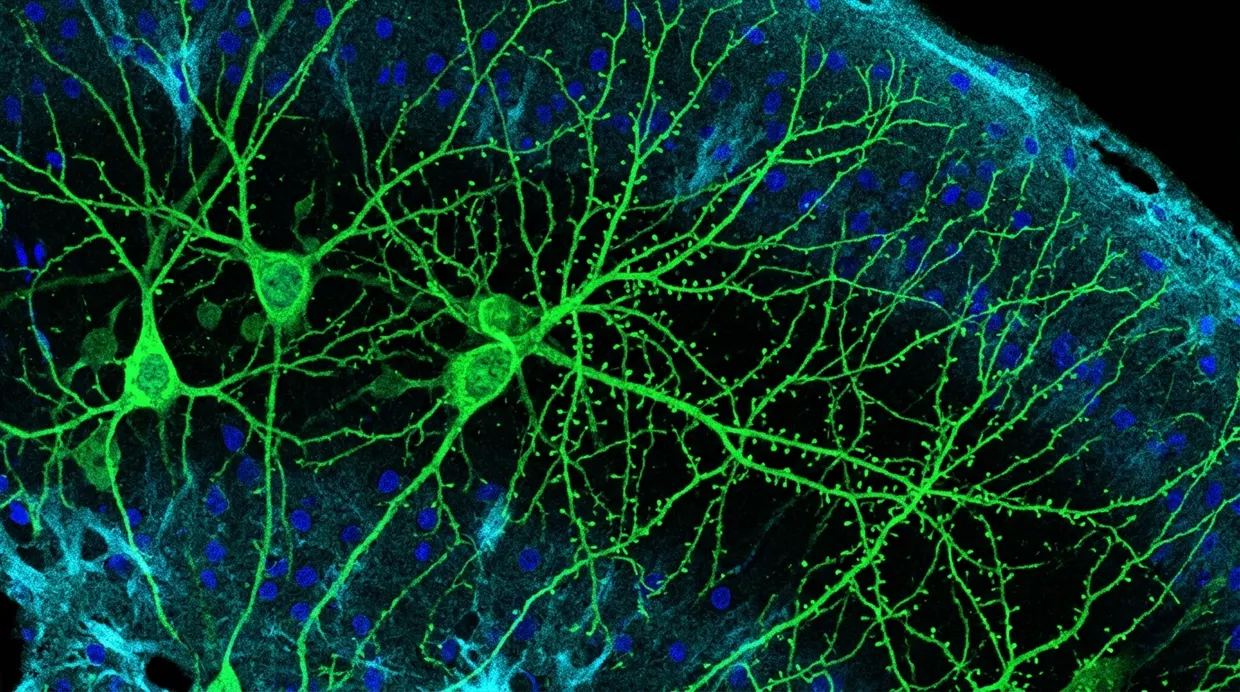
Shih and colleagues reported in Nature that increasing expression of the transcription factor Meis2 in adult hippocampal CA3/2 parvalbumin-expressing interneurons (PV-INs) rescued circuit and cognitive deficits in Cntnap2-deficient autism model mice. The study is described in a commentary available via doi.org nature.com
doi.orgnature.comOpen source ↗. All experiments were performed in mice.
How the plasticity genes were identified
PV basket cells provide perisomatic inhibition of principal neurons and shape how these neurons are recruited into active ensembles. The authors used a defined connection between dentate granule cell mossy fiber terminals and PV-INs in hippocampal CA3/2. Reducing granule cell ABLIM3 with shAblim3, a brake on mossy fiber filopodial growth, increases filopodial excitatory contacts onto PV-INs and recruits feedforward inhibition in CA3/CA2.
They combined this manipulation with PV-IN-specific purification of ribosome-associated mRNAs. This gave an input-driven screen for candidate experience-dependent plasticity genes without behavioral training. The upregulated candidates include 82 high-confidence autism-associated genes, as well as genes implicated in schizophrenia and bipolar disorder. About one-third of them encode transcriptional or epigenetic regulators.
Many candidates, including Meis2, Bcl11, Tbr1 and Herc1, are linked to disease through loss-of-function variants. Increasing expression of Meis2, Bcl11a, Tbr1 or Herc1 enhanced perisomatic inhibitory synapse density nature.com
doi.orgnature.comOpen source ↗.
Meis2 in Cntnap2-null mice
Cntnap2 mutants have fewer PV-IN synapses. Unlike wild-type mice, they do not show the social experience-dependent increases in Meis2 expression and perisomatic innervation. Viral Meis2 expression, directed preferentially to PV-INs in CA3/2 by the S5E2 enhancer, restored perisomatic synapse density, interneuron excitability and feedforward inhibition onto CA2 principal neurons. It also restored inhibitory long-term depression.
Tbr1 expression increased inhibitory connectivity without a comparable change in intrinsic excitability. This suggests that individual plasticity genes may control separable components of the adaptive response.
At the behavioral level, Meis2 expression rescued object-location and social-recognition memory in the mutant mice. These improvements were accompanied by more selective reactivation of social-stimulus ensembles in CA2 and by recovery of sharp-wave ripple properties recorded in CA1 during post-experience non-rapid eye movement sleep. Sustained Meis2 expression also reduced the frequency of later spontaneous seizures nature.com
doi.orgnature.comOpen source ↗.