Polymetallic nodules in the Clarion-Clipperton Zone host crevice fauna distinct from sediment
Nematodes and copepods live in cracks of nodules in the eastern Clarion-Clipperton Zone, authors report. Mining the nodules would remove this habitat.
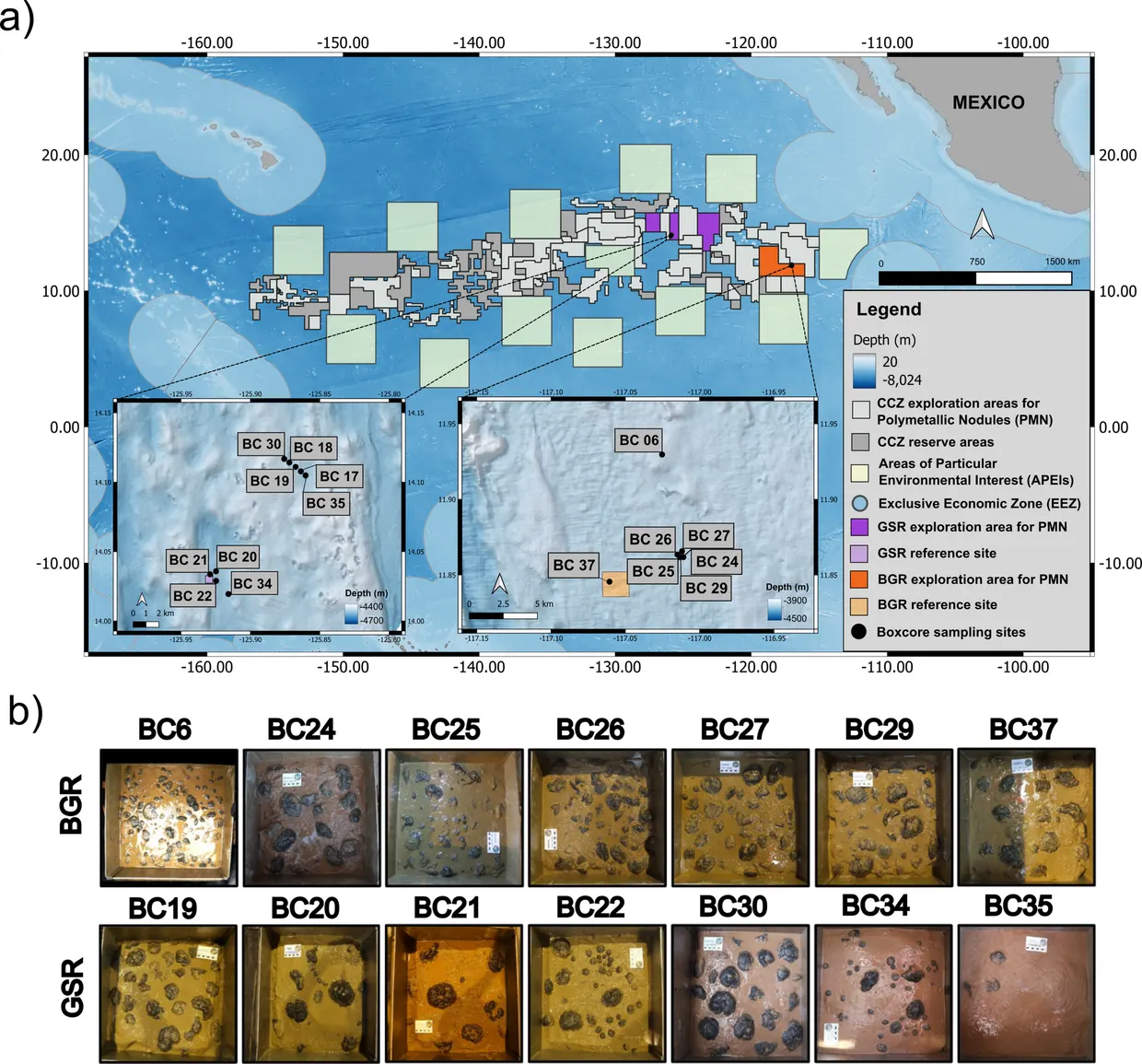
A study published on nature.com quantified meiofauna living in the crevices of polymetallic nodules in the Clarion-Clipperton Zone (CCZ), Central Pacific, and compared it with fauna of nearby sediments nature.com
nature.comnature.comOpen source ↗. The samples came from two exploration contract areas in the eastern CCZ, BGR and GSR. They were collected with box cores during the SO268 expedition in 2019, and each box core covered a surface area of 2,500 cm².
Nodules as a habitat
The CCZ spans the Pacific from Hawaii to Mexico. Its nodules consist mainly of iron and manganese oxides and contain nickel, copper and cobalt, which makes them a primary target for potential deep-seabed mineral extraction. Nodules take millions of years to form. The authors note that organisms dependent on them will not recover after mining, because their habitat is lost at the mined location.
The team used scanning electron microscopy, energy-dispersive X-ray spectroscopy and digital microscopy. With these they characterised porosity, crack diameter and the elemental composition of cracks in 24 nodules from the BGR area. According to the authors, nodules contain internal cracks and microfossils.
Crevice fauna compared with sediment
The crevice communities were dominated by nematodes and copepods, and foraminifera were a recurrent component nature.com
nature.comnature.comOpen source ↗. Faunal abundance increased significantly with nodule volume. Nematode and copepod abundances in crevices were approximately 10% and 25%, respectively, of those recorded in nearby sediments.
Based on 18S rRNA data, the nematode and copepod assemblages from nodule crevices differed from those in sediments collected during the same expedition within the same contract areas. Before this work, only seven studies had examined nodule-crevice fauna, all based on morphology. Copepods had never been investigated quantitatively, and molecular studies were lacking.
Earlier mining simulations and test mining with prototype collector vehicles caused immediate losses of faunal abundance and diversity within the path of disturbance. The authors conclude that their findings demonstrate nodule-associated crevice fauna and a risk of biodiversity loss if nodules are removed by future commercial mining. They also point to the need for baseline data before the International Seabed Authority grants exploitation contracts.