Aarhus team: Central Europe was mostly a mosaic of open land and woodland for 20 million years
A review of palaeoecological records by Aarhus University researchers shows large herbivores kept much of Europe open. The finding challenges the picture of a fully forested continent.
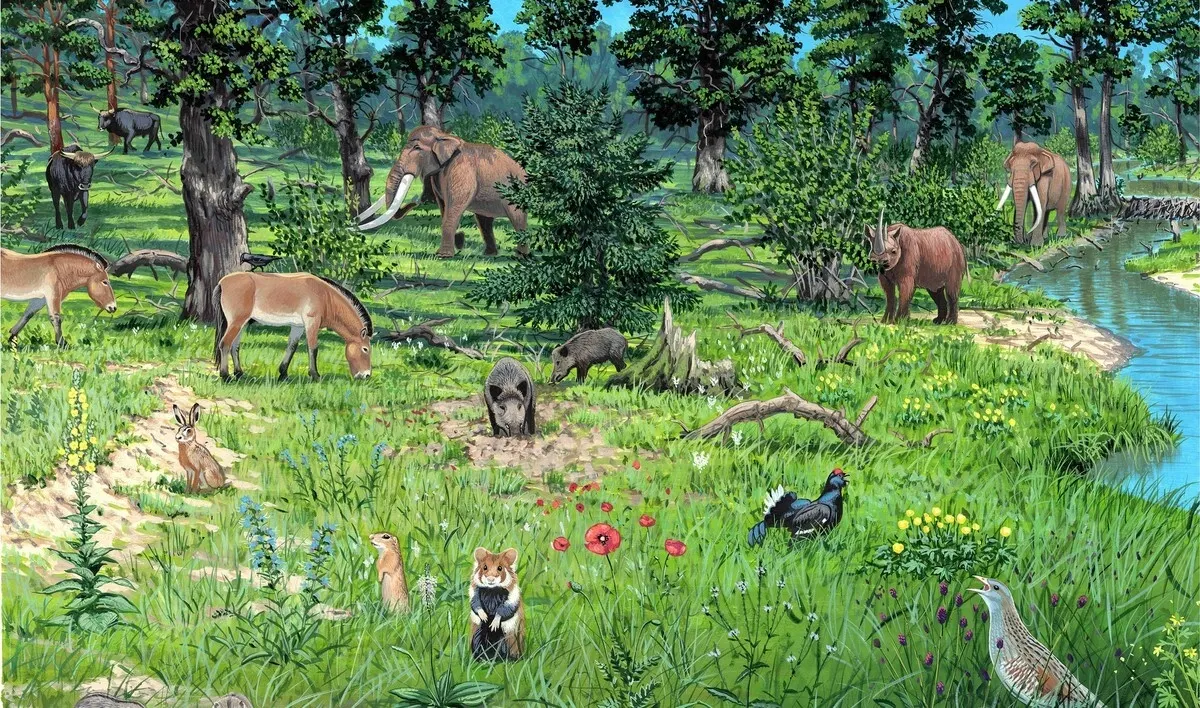
Researchers led by Szymon Czyżewski and Jens-Christian Svenning at Aarhus University have compiled the available palaeoecological research on European landscapes, according to forschung-und-wissen.de. The review spans the period from the start of the Miocene to the pre-industrial era and was published in the journal Biological Conservation. Its main result is that for more than 20 million years Central Europe was dominated by a mosaic of grassland, shrubs and open woodland forschung-und-wissen.de
forschung-und-wissen.deforschung-und-wissen.deOpen source ↗.
The work is a synthesis of existing studies, not a new excavation. It does not describe a single site but compares many independent lines of evidence on how vegetation and herbivores shaped landscapes over long periods.
Evidence from many archives
A single type of fossil shows only part of past vegetation. Pollen reflects plants over a wider area, while preserved leaves and seeds give more specific information, and charcoal particles can point to fire. Each of these traces has its own limits, shaped by deposition, preservation and find conditions.
The team therefore evaluated several kinds of evidence together: pollen, larger plant remains and charcoal from old deposits. It also used stable isotopes in the teeth and bones of herbivores, fossil insects and mammals, and ancient environmental DNA preserved in sediments. The authors note that results depend on which deposits were studied and how well the traces survived, and that landscapes differed from region to region forschung-und-wissen.de
forschung-und-wissen.deforschung-und-wissen.deOpen source ↗.
Large herbivores keep land open
According to the review, large herbivores influenced vegetation through daily feeding. Elephants could break branches and young trees and strip bark, while rhinoceroses, wild horses, aurochs and bison used other plants and vegetation layers. This did not stop trees growing everywhere, but it held certain areas open and limited the spread of dense woody growth.
Beavers, which alter river banks and fell trees, and fire also contributed to shifts between open and wooded areas. The open mosaic was not confined to unusually warm or cold phases: similar landscape structures existed under moderate conditions resembling today's climate across much of Europe.
The authors stress that an open woodland is not a treeless steppe, and a landscape with many trees need not be a closed forest. Larks, jackdaws, the European hamster and the poppy may have ecological roots in such earlier forest mosaics. For present-day afforestation projects, the authors conclude that dense tree cover is not the right conservation goal everywhere forschung-und-wissen.de
forschung-und-wissen.deforschung-und-wissen.deOpen source ↗.