King's College London: two temperature-sensing channels explain why female mice prefer warmer floors
In mice, the TRPM2 and TRPM8 channels in female nerves switch on at higher temperatures than in males, the authors report. The study did not cover humans.

Researchers at the Institute of Psychiatry, Psychology & Neuroscience (IoPPN) at King's College London report that female mice prefer warmer surfaces than males because two temperature sensors in their nerves activate at higher temperatures, according to kcl.ac.uk. kcl.ac.uk
kcl.ac.ukkcl.ac.ukOpen source ↗ The study was led by the Wolfson Sensory, Pain and Regeneration Centre and published in The Journal of Physiology. It was carried out in mice; humans were not studied.
Female mice choose a floor temperature of 36°C, while males prefer 32°C. In humans, women on average prefer a room at around 25°C and men at around 22°C. The molecular basis of this difference had not been identified until now.
Two ion channels, shifted ranges
TRPM2 and TRPM8 are ion channels: tiny pores in nerve cells that open as the temperature changes, let charged particles in and ultimately fire a signal to the brain. TRPM2 picks up gentle warmth, TRPM8 picks up coolness. In female mice, both channels activate at warmer temperatures than in males. Humans also have both types of channel, and the senior author, Professor McNaughton, considers a similar mechanism likely in people.
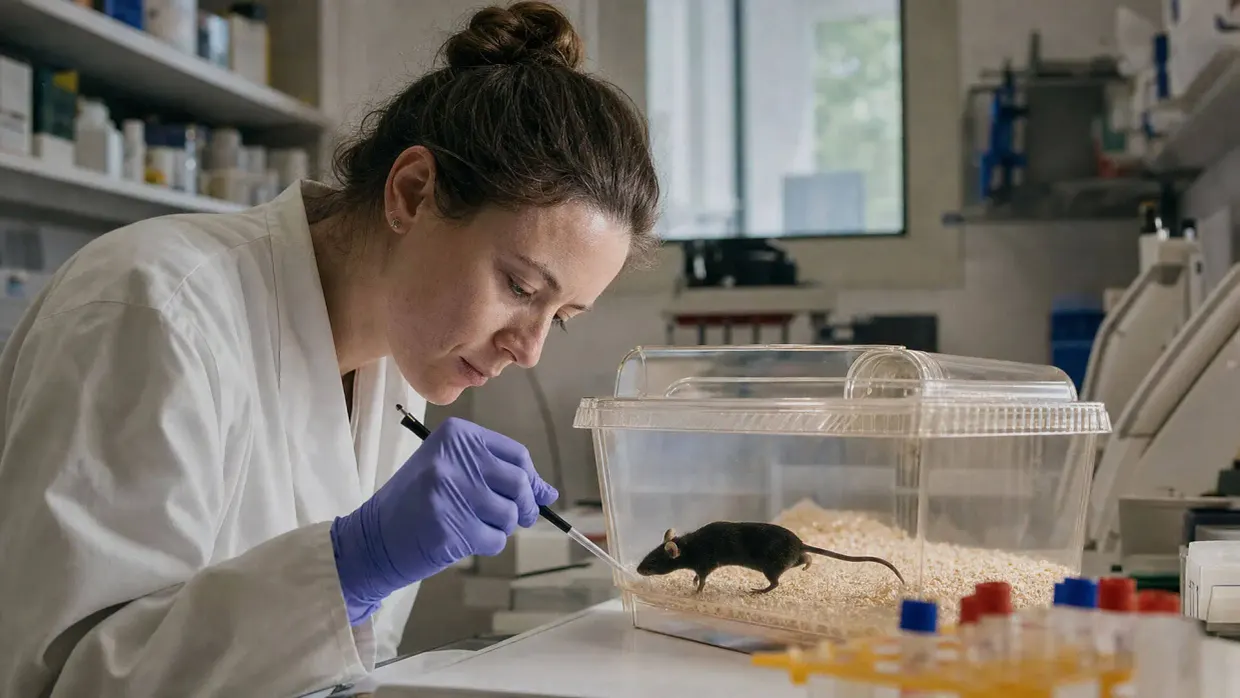
In the experiment, mice were placed on two heated metal plates side by side. One was kept at 33°C and the other was varied. Males avoided a plate heated to 38°C, while females strongly preferred it. kcl.ac.uk
kcl.ac.ukkcl.ac.ukOpen source ↗ Genetically removing the warmth sensor TRPM2 shifted males towards warmer temperatures but had almost no effect in females. Removing or blocking the cool sensor TRPM8 shifted females towards cooler ones. A genetic change and a drug that blocks the sensors gave the same result, so the authors conclude the effect is due to direct action on the sensors.
Hormones and open questions
Lowering testosterone in male mice shifted them towards the female preference for warmth, and raising it in females made them more averse to warmth. Female sex hormones had no effect, and testosterone did not explain the whole difference. Core and skin temperature were the same in both sexes, which suggests the mice were responding to what they felt through their paws.
Some questions remain. The sensors were removed throughout the body, so it is not yet clear whether the difference lies in the nerves that detect temperature or in how the brain reads their signals. Nerve cells isolated in the lab did not show the pattern seen in the animals, which the researchers attribute to the effects of isolation on cell processes. Next, they plan to genetically fine-tune the two sensors at the nerve endings in the paws and test whether the animals' behaviour changes.