Octopuses squeeze through small apertures in 3 or 4 steps, depending on hole size
Researchers filmed octopuses passing through a hole in a transparent wall and described the sequence of arm and mantle movements. The authors want to apply it to soft robots.
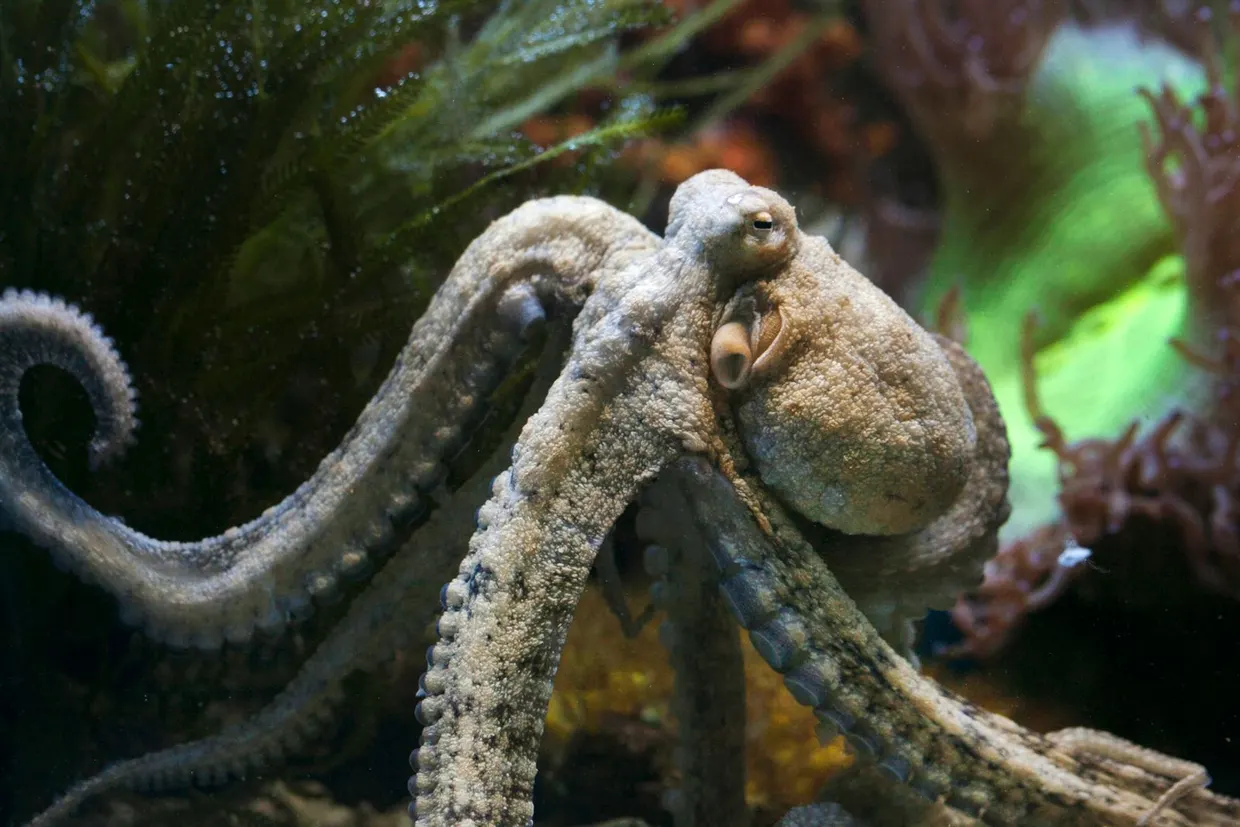
Researchers have described how octopuses pass through apertures much smaller than their bodies, according to a study in the Journal of Experimental Biology. doi.org
Journal of Experimental Biologydoi.orgOpen source ↗ The animals were filmed in aquariums separated by a transparent wall with a hole, and the team examined how they coordinate eight arms and the body during the passage. The observations covered three young common octopuses and four Maya octopuses.
Three or four steps
Octopuses have no rigid skeleton, so the arms and the mantle, the large sac behind the head, can deform strongly. Parts of the head are protected by cartilage, which is more rigid than the rest of the body. The researchers therefore compared the width of the holes with the distance between the animals' eyes.
The authors characterized a consistent strategy of three or four steps: probing, shifting 3-5 arms and squeezing. In a relatively wide passage, a common octopus first puts one arm through to explore the other side, and several more arms follow. Two arms that have already passed then attach to the wall with their suckers, stiffen and push, pulling the rest of the animal through. The maneuver can take about twenty seconds.
Narrow holes and species differences
The choice of strategy is governed by aperture size. doi.org
Journal of Experimental Biologydoi.orgOpen source ↗ In smaller openings the octopus no longer pushes its remaining arms and mantle through together. It passes the remaining arms first, then compresses and moves the head and the mantle separately, which adds a step.
Not all animals behaved the same way. The Maya octopuses did not try to pass the tightest holes. When they could choose among several openings, they sometimes examined the smallest one before taking the largest. A single method therefore cannot be generalized to all species.
The observations rest on a small number of animals, but they describe in detail movements that were poorly known. The authors present the findings as a biological blueprint for the design of next-generation bio-inspired soft robots. They intend to use them to build soft robots able to move through rubble.