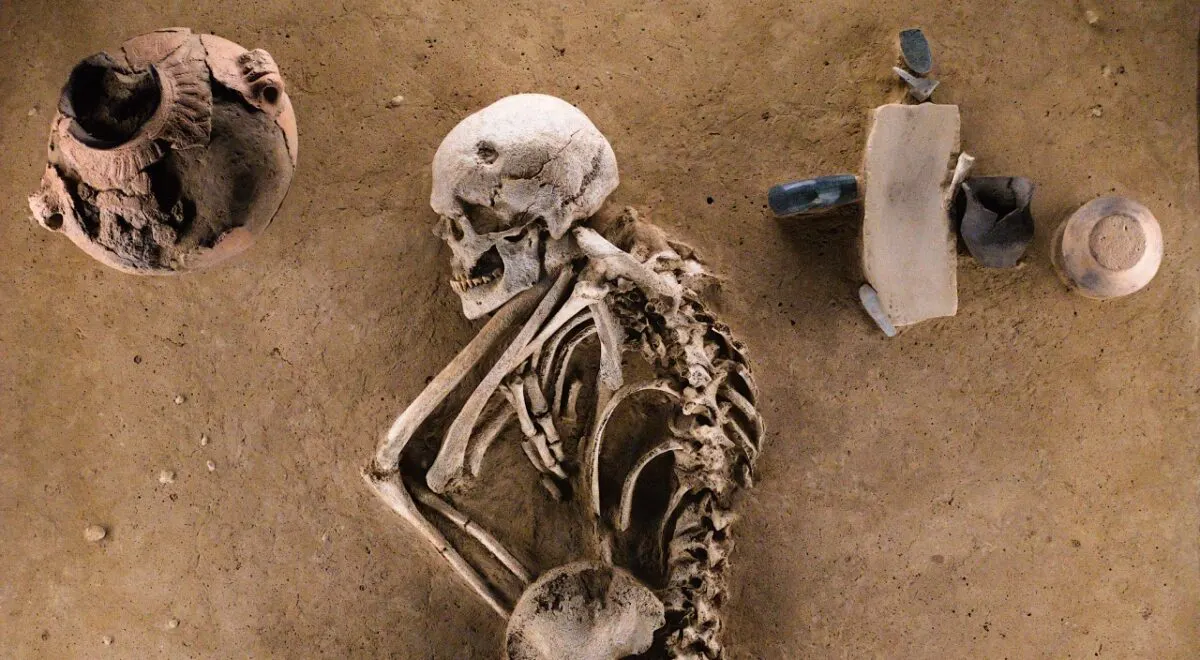
Poisoned hunting points found at 125,000-year-old Mundafan paleolake site in Saudi Arabia
Archaeologists report a ~125,000-year-old lakeshore site in Saudi Arabia with stone points bearing plant-poison residue and bones of hippos and other large animals.
A team led by the Saudi Heritage Commission, King Abdullah University of Science and Technology (KAUST) and Griffith University described 'Uruq Aljelibah, a Middle Paleolithic site on the shore of the Mundafan paleolake in Saudi Arabia, in Science on 12 November 2026. The site dates to about 125,000 years ago (marine isotope stage 5e) science.org
Sciencescience.orgOpen source ↗. Surveys across more than 130 locations documented over 500 fossil specimens of plants and animals, including invertebrates.
The Saharo-Arabian archaeological record of this period remains sparse, and the authors present the site as a dated context where tools, animal remains and plant traces lie together.
Lake, animals and stone tools
Satellite terrain modeling showed an ancient lake of about 340 square kilometers (131 square miles) with a maximum depth of 29 meters (95 feet). Sediments, landforms and aquatic remains indicate a relatively stable freshwater body surrounded by vegetation and grassland.
Animal remains include hippopotamus, extinct long-horned buffalo, camel, Arabian oryx, gazelle and ostrich science.org
Sciencescience.orgOpen source ↗. The researchers collected 5,511 stone tools larger than 2 centimeters (0.8 inches) from the main study area; more than 98% are flint. The assemblages show Levallois technique, and refits indicate in situ tool production and carcass processing. Dating used two methods applied to sand and fossil teeth, and 3D refitting was used to study how the tools were made.
Plant residues and poison traces
Residues, use-wear and biomarkers on the tools show processing of animal and plant material, including palms, tubers, trees and shrubs. Traces of resin and woody tissue suggest that some stone points were attached to handles or shafts.
Several points show impact damage and residues of poison from Acokanthera schimperi. According to the authors, this indicates their use as hafted weapon tips within composite hunting systems. The precise purpose of the toxic residues remains uncertain, but the findings are described as some of the earliest potential evidence of this practice in Saudi Arabia. The study also reports some of the region's earliest evidence of palm-related vegetation.
The authors say the remains show use of freshwater and grassland ecosystems by hominins science.org
Sciencescience.orgOpen source ↗. Because stone tool production, hunting equipment, food processing and fiber work left traces at a single dated site, the researchers could examine how these activities relate to one another.