Radio source LPT J1555-5631 pulses every 62.2 minutes, with two different pulses per cycle, study reports
A study in The Astrophysical Journal found two pulses of opposite polarization in each cycle of the long-period transient LPT J1555-5631. Its magnetic poles are 165.4 degrees apart.
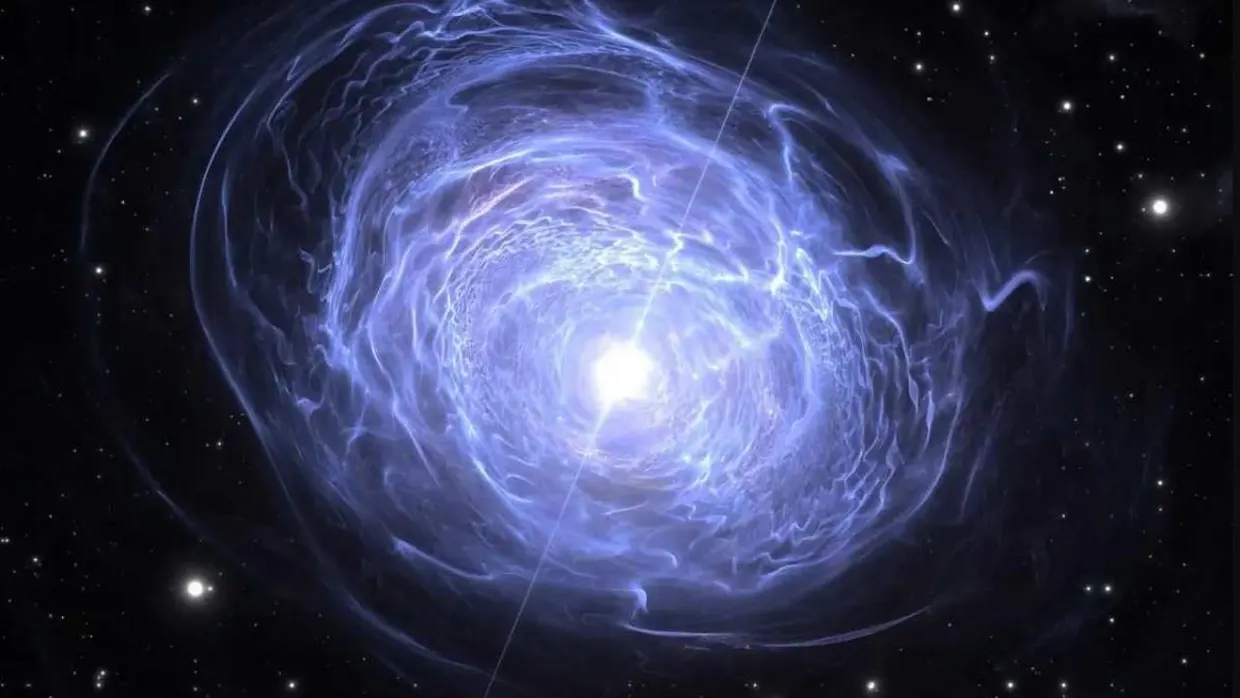
According to pravda.ru, astronomers are studying LPT J1555-5631, a radio source in the Milky Way that flares every 62.2 minutes. A new study in The Astrophysical Journal found that each cycle contains two different pulses, one long and one short pravda.ru
pravda.rupravda.ruOpen source ↗.
A similar case came earlier. In 2002 a source in the Milky Way emitted five powerful radio bursts at a strict 77-minute interval and then disappeared. Astronomer Scott Hyman of Sweet Briar College spent years looking for an explanation. Twenty years later, researchers going through archival data from another study found LPT J1555-5631.
Such objects are called long-period transients (LPT). Pulsars, which are dead stars, usually complete a rotation in a fraction of a second. LPTs behave anomalously slowly, with hours passing between pulses. About a dozen of them are known so far.
Opposite polarization and an unusual geometry
The polarization analysis, which describes how the radio waves are twisted, gave the most unexpected result. The waves of one pulse rotate in one direction and the waves of the other in the opposite direction pravda.ru
pravda.rupravda.ruOpen source ↗. This points to a complex magnetic field structure. Hyman says the emission most likely comes from regions near both magnetic poles of the object.
In an ordinary dipole magnet or star, the poles lie exactly opposite each other, at 180 degrees. For LPT J1555-5631 the angle is 165.4 degrees. This deviation indicates that the object's magnetic field is considerably more complex than that of most known stars.
Unstable activity and candidate explanations
The main difficulty in studying LPTs is their instability. Most of them, including LPT J1555-5631, flare briefly and then vanish from the radio sky for years. Only a couple of objects on the list have shown activity again. Researchers link the abrupt changes to processes in the magnetosphere, which may switch on and off under the influence of internal processes.
Three explanations are discussed. Neutron stars, including magnetars, are one, but at such a slow rotation rate they should not theoretically generate radio emission. White dwarfs are another: in a pair with a second star, their interaction could produce powerful radio waves. The third is a new class of celestial bodies not previously seen by telescopes pravda.ru
pravda.rupravda.ruOpen source ↗.
Astronomers continue to search the data archives of the MeerKAT and ASKAP radio telescopes for new patterns.