Solar panel voltage in eclipse matches CAPSTONE's shadow crossing within 15 s in an arXiv preprint
Authors from Advanced Space, Space Exploration Engineering and Texas A&M propose eclipse data as a zero-cost navigation backup while NASA's Deep Space Network is overloaded.
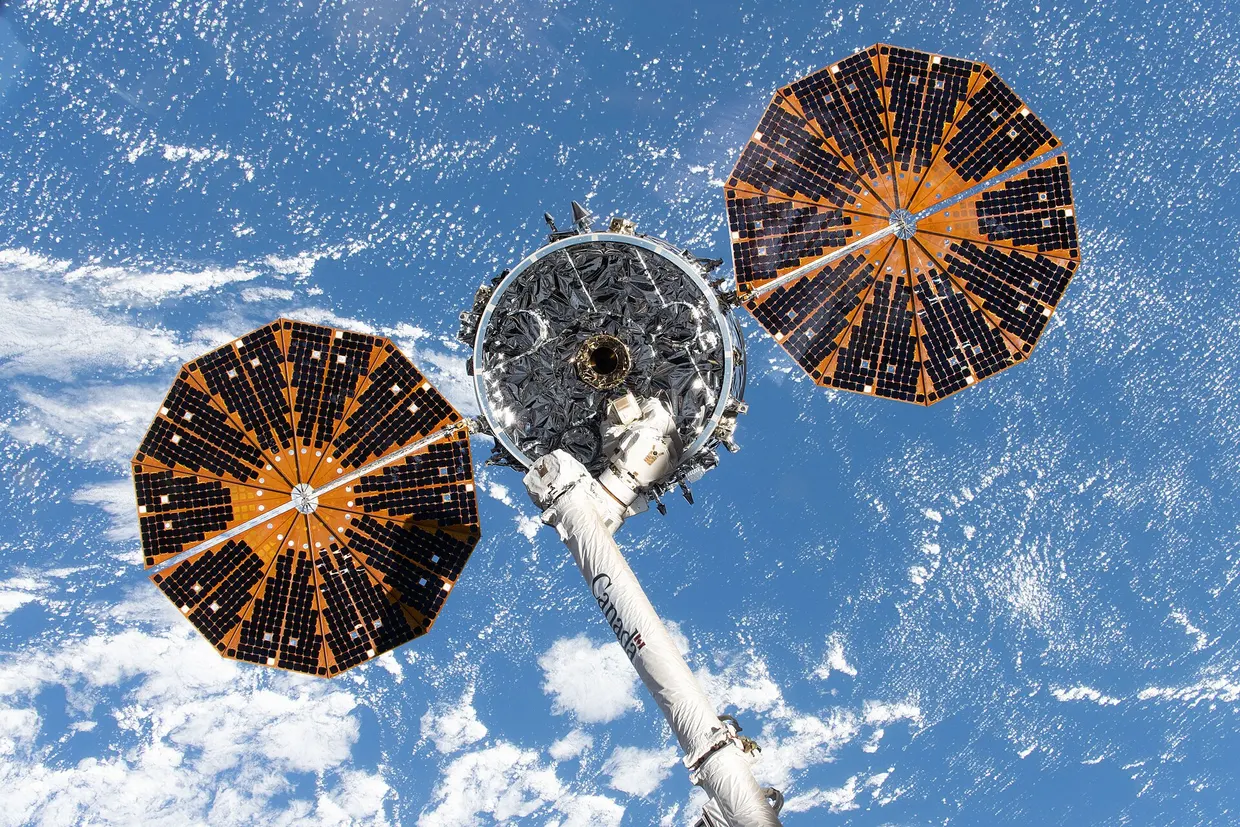
Ian Down (Advanced Space), James McElreath (Space Exploration Engineering) and Manoranjan Majji (Texas A&M) have published an arXiv preprint on determining a spacecraft's position from solar array data recorded during an eclipse, universetoday.com reports universetoday.com
universetoday.comuniversetoday.comOpen source ↗. The motivation is that NASA's Deep Space Network is receiving more tracking requests than it can comfortably handle, which complicates tracking of recently launched missions.
The authors tested the method on flight telemetry from the CAPSTONE CubeSat, recorded on 11 January 2026. Their timing of the spacecraft's entry into and exit from the Moon's shadow was within 15 seconds of CAPSTONE's actual path.
How an eclipse gives a position
Every spacecraft already monitors solar panel output. During an eclipse the arrays stop generating electricity, while the on-board battery keeps the electronics running. The positions of the Sun, Earth and Moon are known years ahead, and so are the shapes of their shadows, each consisting of a penumbra (partial block) and an umbra (full block).
A navigation algorithm takes the timestamps of the voltage drop and of the recovery after the spacecraft leaves the shadow. From them it determines the craft's three-dimensional position without cameras, star trackers or radio signals universetoday.com
universetoday.comuniversetoday.comOpen source ↗.
The precision of the timing is the hard part. The Moon has no atmosphere, so its shadow follows mountains and craters, and each feature can shift the eclipse timing by a few seconds. Earth is slightly flattened at the poles, and its atmosphere blurs the Sun and enlarges the shadow. To handle this, the researchers used more than 22,000 historical observations of lunar craters covered by Earth's shadow, collected between 1842 and 2011. With them the algorithm links parts of the shadow to specific ground features.
Test on CAPSTONE and simulation
CAPSTONE is operated by Advanced Space, where Down works. It was meant to test the orbit for NASA's now discontinued Lunar Gateway and completed its mission in July 2026. On 11 January 2026 its solar panel voltage fell from 23 V to near zero in the Moon's shadow, then rose to 31 V in sunlight.
The researchers also simulated a spacecraft that missed a check-in with ground stations, so that its position uncertainty drifted by several kilometers. Processing the eclipse data alone, without further information, reduced that uncertainty by more than 60% universetoday.com
universetoday.comuniversetoday.comOpen source ↗.
The method needs no additional hardware, which the article describes as zero-SWaP (size, weight and power). It does not replace ground-based radio tracking but works as a safety net.