Parker Solar Probe finds paired helicity peaks in solar wind at 0.1–0.8 au
Parker Solar Probe data show magnetic fluctuations in the solar wind change their preferred rotation direction at the MHD–kinetic transition, and the reversal shifts with distance.
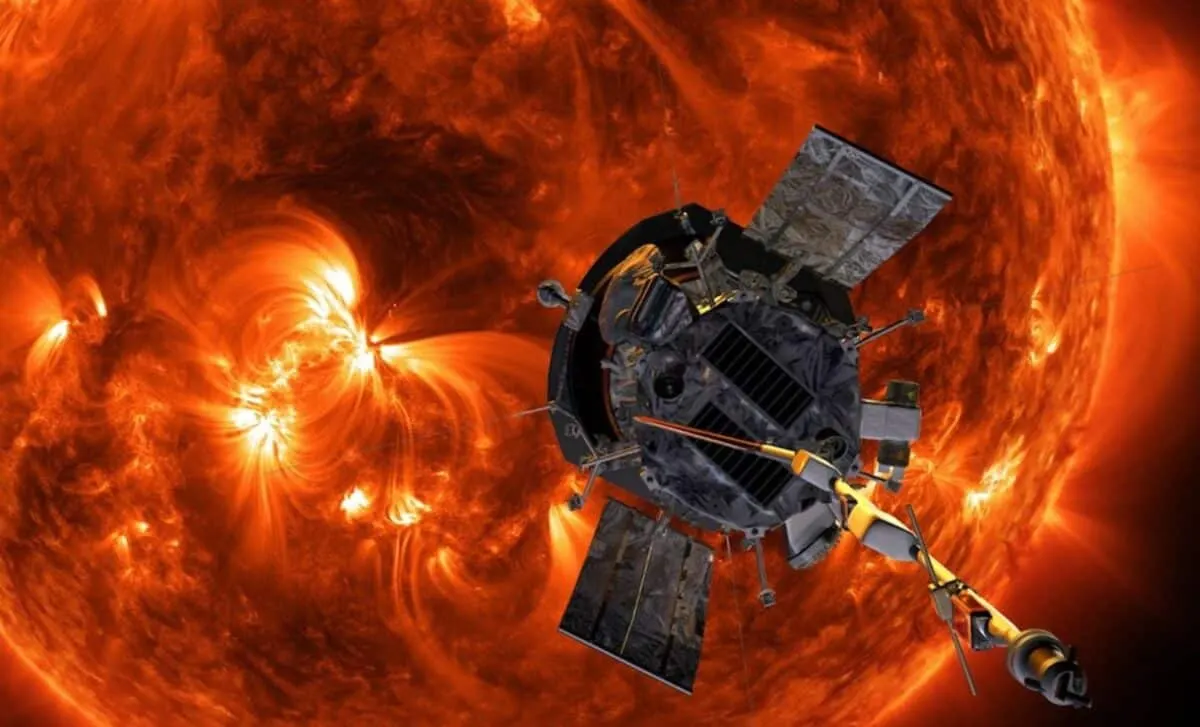
An international team from ten countries analysed Parker Solar Probe measurements taken between 0.1 and 0.8 au from the Sun and reported a paired structure in the magnetic helicity of solar wind turbulence. The results are published in The Astrophysical Journal Letters iop.org
The Astrophysical Journal Lettersiop.orgOpen source ↗. The first author is Masatomi Iizawa of Technische Universität Braunschweig; the team also includes researchers from Tohoku, Kyushu and Osaka Universities.
Magnetic helicity is typically indistinguishable from noise in the inertial range of the solar wind. The authors instead report a robust bihelical structure at the interface between the magnetohydrodynamic (MHD) and kinetic regimes. It appears as a pair of positive and negative peaks in the spectrum.
Reversal of rotation at small scales
According to the published account of the study, when viewed along a direction pointing away from the Sun, magnetic fluctuations at larger scales rotate preferentially counterclockwise. At much smaller scales the preferred rotation switches to clockwise. The reversal appears near the transition between two descriptions of the plasma.
At larger scales the plasma behaves much like a fluid, with swirling structures and electromagnetic waves interacting. At smaller scales the behaviour of individual charged particles becomes more significant, and the fluid description no longer applies. Particles in such plasma rarely collide and interact mainly with electric and magnetic fields.
"We see a clear structure in the spectrum, even though the turbulence represents unstructured motions," said Iizawa.
Dependence on distance from the Sun
The structure shifts systematically toward lower frequencies as heliocentric distance increases. Reports on the study add that the reversal becomes more pronounced with distance and moves toward longer wavelengths iop.org
The Astrophysical Journal Lettersiop.orgOpen source ↗.
This evolution deviates from local kinetic scaling laws, such as the radial decline of the ion cyclotron frequency. The authors interpret this as a nonlocal evolution of magnetic topology.
The authors state that the findings provide a new observational constraint on nonlocal MHD transport processes and on the nature of the helicity barrier in the kinetic regime.
Plasma turbulence is not limited to the solar wind. It also occurs in Earth's magnetosphere, in interplanetary space, in regions affected by solar eruptions and in disks of material around astronomical objects.