Lumina simulation covers a 1.5 billion light-year cube of the early Universe
Researchers ran Lumina on the Frontier supercomputer, modelling the first 2 billion years after the Big Bang in a volume over 100 times larger than earlier models.
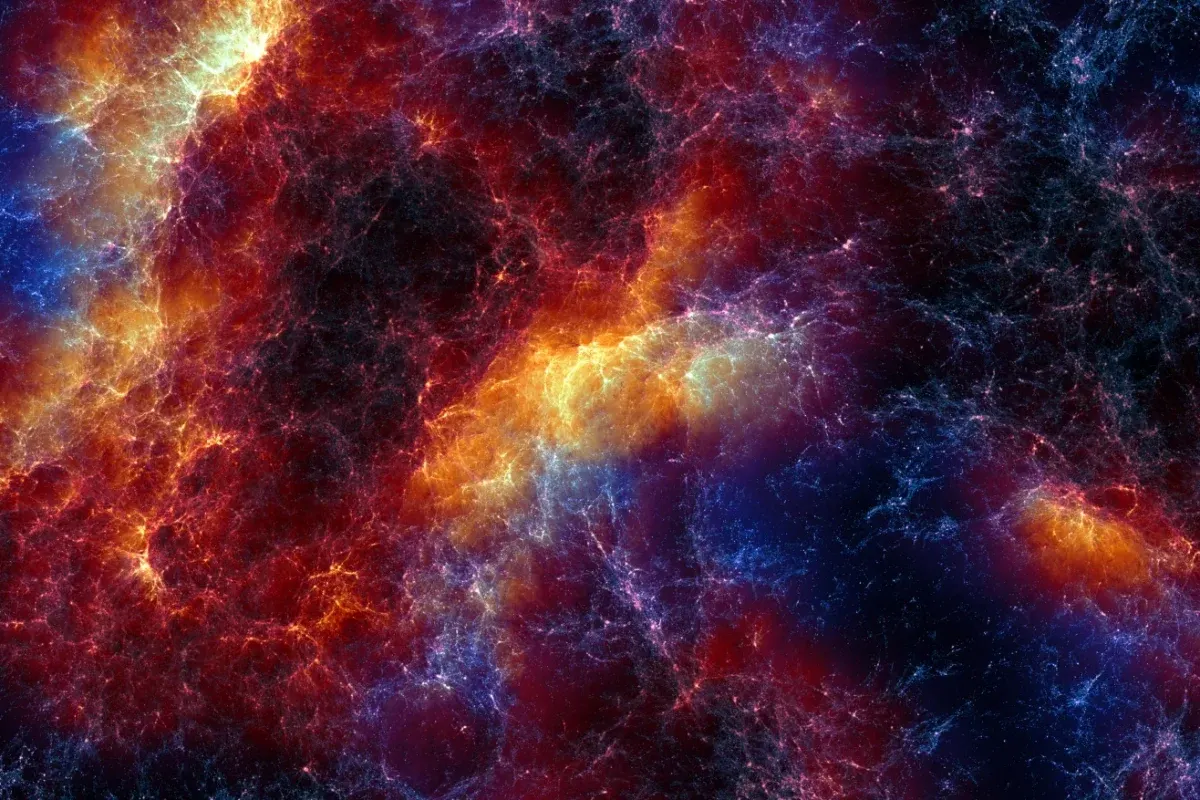
An international group of researchers has presented Lumina, a simulation of the early Universe, according to Universe Magazine. The results are published in Monthly Notices of the Royal Astronomical Society. The simulated volume is more than 100 times larger than in all previous comparable models: a virtual cube about 1.5 billion light-years in each direction universemagazine.com
Universe Magazineuniversemagazine.comOpen source ↗. For comparison, the Milky Way is about 100 thousand light-years across.
Scale and computing resources
According to the study lead Oliver Zier of the Harvard-Smithsonian Center for Astrophysics, the model shows both the global cosmic web of galaxy clusters and the structure of individual star systems at the same time. The work took almost three years on the Frontier supercomputer at Oak Ridge National Laboratory (USA), using more than 15 thousand GPUs.
The simulation itself has not yet been made publicly available. The published visualisations let the camera approach a single galaxy and then pull back to show how small it is against the whole volume. Zier notes that even at this size Lumina covers only a small part of the real Universe.
Epoch of reionization in one calculation
The project focuses on the first 2 billion years after the Big Bang, the epoch of reionization. During that period, ultraviolet radiation from the first stars and black holes knocked electrons out of hydrogen atoms, the most abundant element in space. This made the Universe transparent to light and changed how galaxies formed. Lumina is the first model to follow the transformation of both hydrogen and helium within a single calculation universemagazine.com
Universe Magazineuniversemagazine.comOpen source ↗.
Astronomer Julian Muñoz of the University of Texas at Austin called the work an impressive technical achievement. Because the early Universe evolved unevenly, only a model of this size makes it possible to trace how different regions changed at different rates. The simulation also helps study patterns millions of light-years long that are invisible to telescopes. They arose because dark and ordinary matter moved at different speeds under the influence of radiation.
By comparing the model with JWST observations, physicists can search for rare galaxies and test their ideas about the structure of the world. Discrepancies between the virtual and the real Universe interest researchers even more than agreements, since they can point to gaps in current knowledge and to new physics.