JWST MIRI finds hints of an atmosphere on ultra-hot rocky exoplanet TOI-431b
Secondary-eclipse measurements show TOI-431b's dayside is cooler than a bare rock would be; the authors say an atmosphere is the best explanation, not yet confirmed.
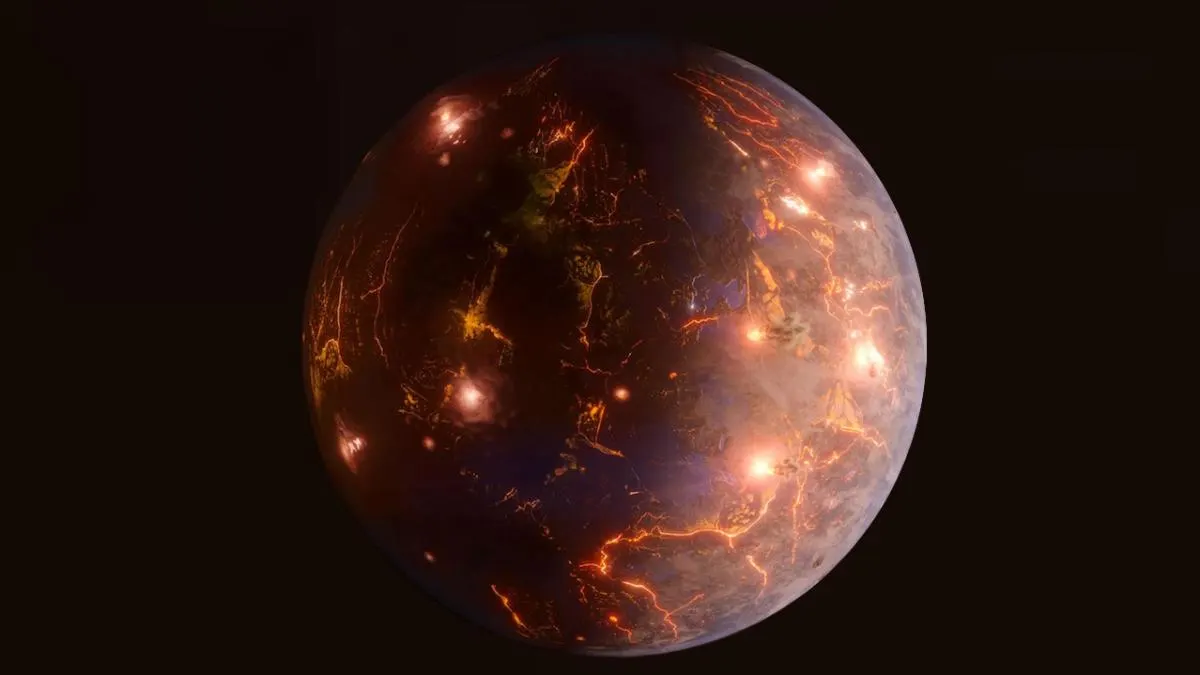
The James Webb Space Telescope (JWST) has observed signs that the ultra-hot rocky exoplanet TOI-431b may have an atmosphere, ixbt.com reports. Such planets orbit so close to their stars that their surfaces should be covered with molten magma. The observations were made with the MIRI instrument. ixbt.com
ixbt.comixbt.comOpen source ↗
Secondary eclipse measurements
Astronomers measured the planet's thermal emission during a secondary eclipse, when it passes behind its star. The eclipse depth was 81 ± 16 parts per million (ppm), and the brightness temperature of the star-facing side fell in the range of 1714–2204 K.
The ratio of the brightness temperature to the calculated temperature of a bare rocky planet without an atmosphere was 0.81 ± 0.10. For a planet with no atmosphere that neither reflects light nor transfers heat from the day side to the night side, a value of about 1 was expected. The result is 1.8 standard deviations below that level, which means the observed emission is weaker than expected from an open, hot surface.
What the authors suggest
According to the authors, the most suitable explanation is an atmosphere that could reflect part of the starlight or carry heat from the lit side of the planet to the night side. ixbt.com
ixbt.comixbt.comOpen source ↗
The observations covered only part of one eclipse, so the atmosphere cannot yet be confirmed. Further measurements, including the already obtained full phase curve of TOI-431b over its orbit, should help refine its properties and chemical composition.