LHAASO: intervals between 172 TeV-range photons of GRB 221009A follow a power law, not exponential
Authors analysed arrival times of 172 TeV-range photons from GRB 221009A recorded by LHAASO; the pattern departs from a constant-rate random process.
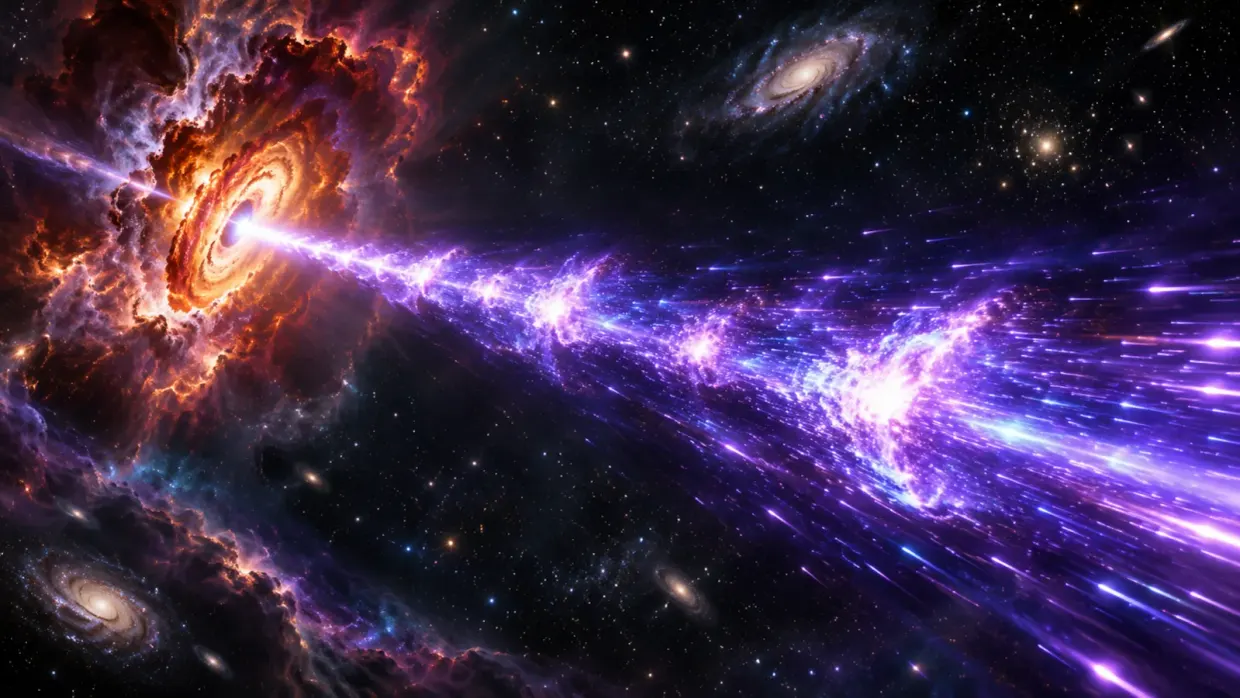
Researchers at Qufu Normal University (China), led by Prof. Shuang-Xi Yi, statistically analysed the arrival times of 172 teraelectronvolt photons from the gamma-ray burst GRB 221009A. The photons were recorded by the KM2A array of the Chinese LHAASO observatory. The burst was detected on 9 October 2022, and its radiation had travelled about 2.4 billion light years. The results are published in «Astronomy and Astrophysics» aanda.org
Astronomy and Astrophysicsaanda.orgOpen source ↗.
The team calculated the time between each pair of consecutive photons. For independent events arriving at a constant rate, the waiting times would follow an exponential distribution. The measured distribution deviates from it.
Waiting times and critical behaviour
The photons show features resembling a self-organized critical system, such as a power-law distribution and scale invariance in the waiting-time distribution. Such systems are often illustrated by a sand pile before an avalanche, where small triggers can set off events of very different sizes. The power-law distribution of waiting times is consistent with the prediction for a nonstationary process.
For a second dataset, the analysis was restricted to 143 photons registered between 230 and 900 seconds after the burst signal. This selection was meant to reduce possible background events and to check whether the pattern persists during the main phase. In both samples, a power-law distribution fitted markedly better than the exponential one, with longer gaps occurring relatively more often than in the simple random model.
Deviation from theory and possible causes
The relationship between the power-law slopes of the waiting-time distribution and the scale-invariant characteristics of the Tsallis q-Gaussian distribution deviates from existing theory aanda.org
Astronomy and Astrophysicsaanda.orgOpen source ↗. The authors suggest that this is because the photons are not completely independent of each other. The measured pattern therefore cannot simply be classed as a typical case of self-organized criticality.
The results argue against a model of fully independent photon events with a constant production rate. They do not, however, prove a direct mutual influence between photons or a specific mechanism, since an emission rate that changes over time can also produce power laws.
Based on other relevant research, the authors propose that a partially magnetically dominated component and continuous energy injection from the central engine could make the teraelectronvolt afterglow deviate from a simple external-shock-dominated process. This would give rise to the self-organized critical characteristics described above. Whether magnetic processes or sustained energy input are actually responsible must be settled by further observations and model calculations.